
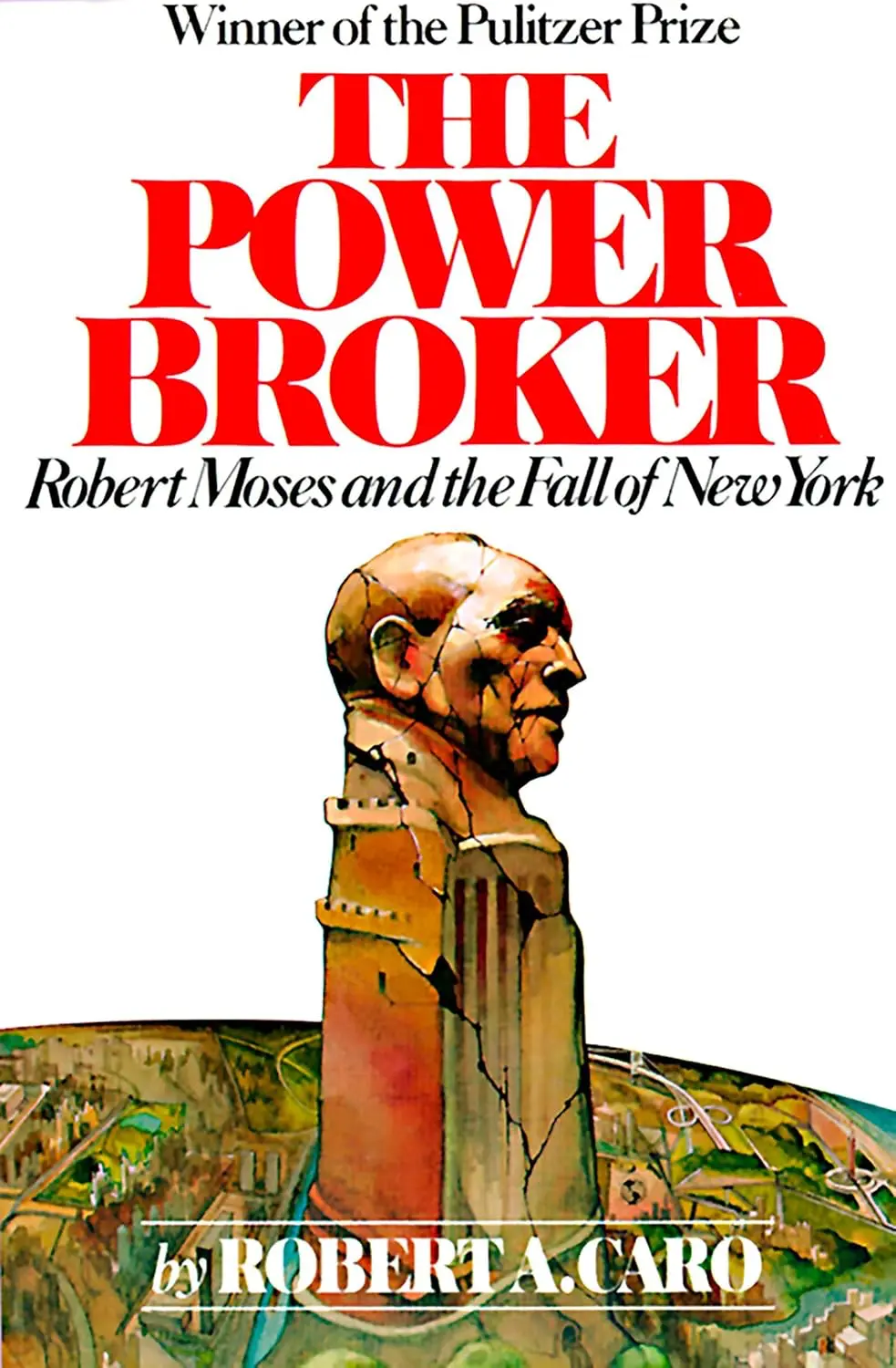
The Power Broker is Robert Caro’s biography of Robert Moses, who from the 1920s through the 1960s shaped the physical shape of New York City and its surrounding region more than any other single person. Moses built parks, beaches, highways, bridges, housing projects, and public works on a scale that is difficult to comprehend. He was never elected to any office. He accumulated power through appointed positions and used legal, financial, and political mechanisms to make himself virtually immune to oversight.
Caro’s account traces Moses’s career from his early years as an idealistic reformer (his first major project, Jones Beach, was a democratic masterpiece that gave working-class New Yorkers access to the ocean) through his transformation into a power broker who bulldozed neighborhoods, displaced hundreds of thousands of people, and designed infrastructure that deliberately excluded the poor and racial minorities (his highway overpasses were built too low for buses, effectively preventing public transit users from reaching his parks and beaches).
The book is as much about the nature of power as it is about Moses specifically. Caro shows how Moses used control over bond revenue, construction contracts, and toll income to create a financial empire independent of government oversight. He shows how Moses manipulated public opinion, intimidated elected officials, and destroyed the careers of anyone who opposed him. And he shows how the checks and balances designed to prevent this kind of accumulation of power failed one by one.
The human cost sections are the book’s moral center. Caro profiles the families displaced by the Cross-Bronx Expressway, the communities destroyed by highway projects that could have been routed differently, and the parks and playgrounds that were built in wealthy neighborhoods while poor neighborhoods were neglected or demolished.
For founders who are interested in how power works, how institutions are built and corrupted, and how the physical environment shapes social outcomes, the book is one of the greatest nonfiction works of the 20th century. The specific details are about New York, but the dynamics of power, bureaucracy, and the tension between building at scale and respecting the people affected are universal.
The writing is meticulous and compelling. At 1,300 pages, the book is an investment. But Caro’s narrative skill is such that it reads faster than its length suggests. It won the Pulitzer Prize and is consistently ranked among the best nonfiction books ever written in English.
