
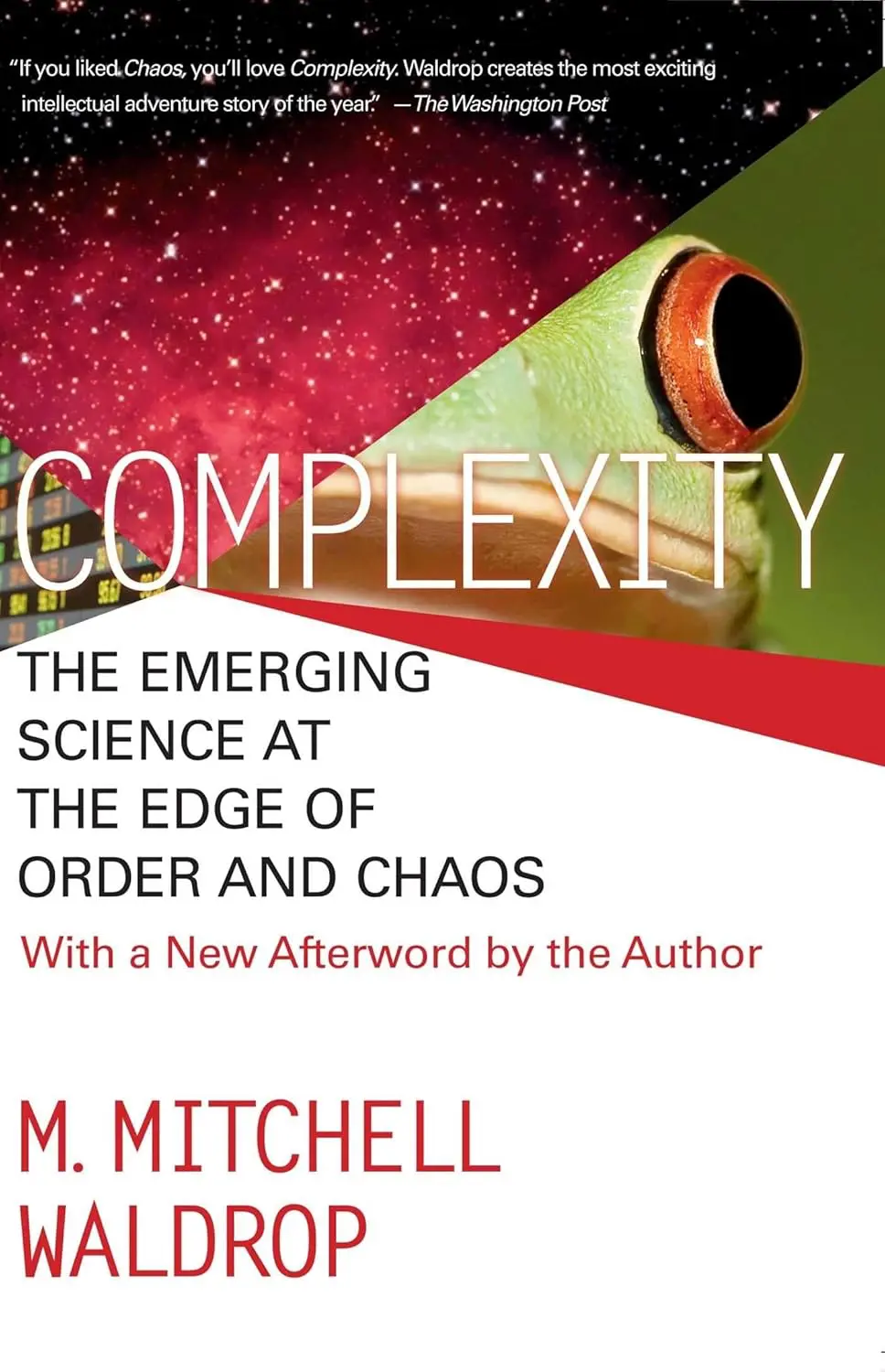
Complexity is Mitchell Waldrop’s narrative history of the Santa Fe Institute and the birth of complexity science. The book follows a group of scientists from different disciplines, physics, economics, biology, computer science, who came together in the late 1980s around a shared observation: many of the most interesting phenomena in nature and society emerge at the boundary between order and chaos, and the tools of traditional science (which work best on simple, isolated systems) are inadequate for understanding them.
The central characters are Brian Arthur (an economist who challenged the assumption of diminishing returns), Stuart Kauffman (a biologist who studied self-organization in genetic networks), Chris Langton (a computer scientist who pioneered artificial life), and John Holland (a computer scientist who developed genetic algorithms). Waldrop uses their stories to explain the concepts: how positive feedback creates increasing returns in economics, how simple rules produce complex behavior in cellular automata, how ecosystems and economies self-organize without central control, and how adaptation and evolution can be modeled computationally.
The “edge of chaos” concept is the book’s most evocative idea. Systems that are too orderly (frozen, rigid, unable to adapt) and systems that are too chaotic (random, without structure) are both unproductive. The most interesting behavior, the most creative, the most adaptive, happens at the boundary between the two. This idea has been applied to everything from management theory to evolutionary biology to political science.
For founders, complexity science offers a useful mental model. A startup is a complex adaptive system: it consists of interacting agents (employees, customers, competitors) following simple rules that produce emergent behavior no one planned. Understanding that you can’t control emergent behavior directly but can influence it by changing the rules and the environment is a practical insight for anyone managing a growing organization.
The writing is narrative-driven and accessible. Waldrop is a science journalist, and the book reads like a story rather than a textbook. The characters are vivid and the intellectual debates are presented with enough context that non-scientists can follow them. Published in 1992, some of the specific scientific claims have been refined or challenged since, but the big ideas about emergence, adaptation, and self-organization remain as relevant as ever.
