
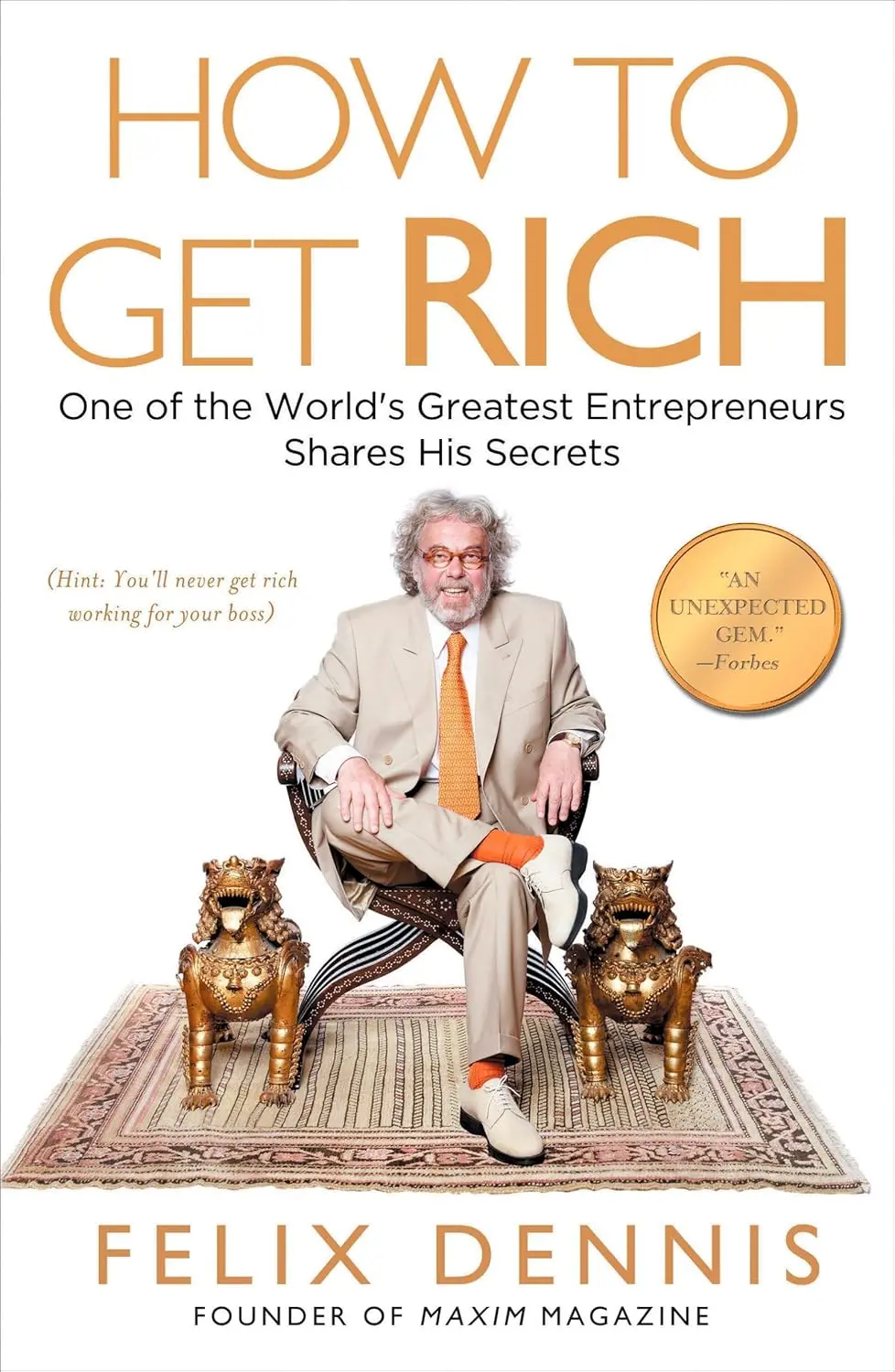
How to Get Rich is Felix Dennis’s account of what it takes to build a fortune, written with a candor that most business books lack because Dennis had no reputation to protect and no consulting business to promote. Dennis built Dennis Publishing (which included Maxim, The Week, and other titles) from nothing into a company worth hundreds of millions of pounds, and he wrote this book late in life with the explicit goal of being useful rather than flattering.
The book’s most valuable quality is its honesty about the costs. Dennis is blunt that getting rich requires an obsessive, all-consuming commitment that damages personal relationships, limits your experiences, and often makes you less happy rather than more. He’s not trying to discourage anyone; he’s trying to make sure you go in with your eyes open. He writes that most people would be happier earning a comfortable living and spending their time on relationships and hobbies, and that the drive to get rich is a kind of sickness that happens to have a profitable side effect.
The practical sections cover negotiation (never negotiate over the phone if you can meet in person), hiring (hire people smarter than you and give them real authority), ownership (never dilute your equity unless you absolutely must), and execution (ideas are worth nothing; execution is everything). Dennis is especially good on the psychology of risk: he argues that the ability to tolerate failure and keep going is more important than intelligence, education, or connections.
Dennis also includes a “wealth scale” that classifies different levels of richness and discusses the realistic probability of reaching each one. His estimate that fewer than 1 in 1,000 people who try will get truly rich is sobering and probably accurate.
For founders, the book is a useful corrective to the motivational literature that portrays wealth-building as a path to freedom and fulfillment. It can be, but Dennis’s account of the trade-offs is more honest than most. If you’re going to pursue it, he argues, at least know what you’re giving up.
The writing is witty, irreverent, and occasionally vulgar. Dennis was a poet as well as a publisher, and his prose has a rhythm and directness that make the book a pleasure to read even when the message is uncomfortable.
