
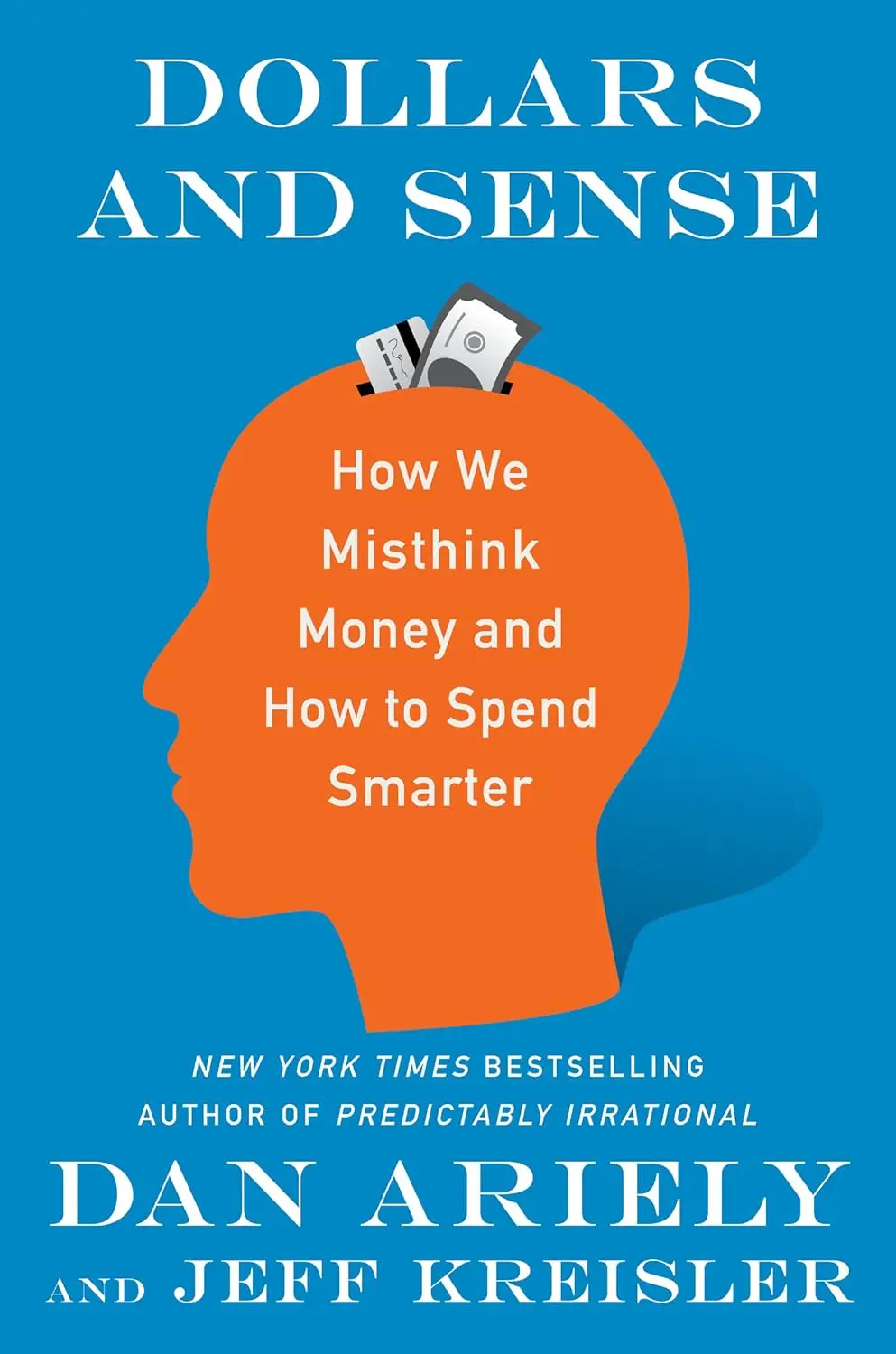
Dollars and Sense is Dan Ariely’s application of behavioral economics to personal financial decisions. Ariely, whose earlier books (Predictably Irrational, The Upside of Irrationality) covered decision-making biases in general, narrows the focus here to the specific ways people misjudge the value of money. Jeff Kreisler, a comedian and financial writer, adds a lighter tone that keeps the material accessible.
The book covers a series of mental shortcuts that lead to bad financial decisions. Mental accounting: people treat money differently depending on where it came from or what it’s labeled for, even though a dollar is a dollar. The pain of paying: cash transactions feel more painful than credit card transactions, which is why people spend more with cards. Relativity: a $10 discount feels significant on a $30 purchase but trivial on a $3,000 purchase, even though it’s the same $10. Anchoring: the first price you see sets a reference point that distorts all subsequent judgments.
Each chapter presents the psychological mechanism, illustrates it with experiments and everyday examples, and offers practical suggestions for counteracting the bias. The suggestions are modest and realistic: Ariely doesn’t pretend you can eliminate these biases entirely, but you can build systems (like using cash for discretionary spending, or waiting 24 hours before making large purchases) that reduce their impact.
For founders, the financial psychology sections are useful for both personal finance and for understanding customer behavior. If you sell a product, understanding how customers perceive price (through anchoring, relativity, and the pain of paying) directly affects your pricing strategy, your payment flow design, and your marketing messaging.
The writing is lighter and more humorous than Ariely’s earlier books, thanks to Kreisler’s influence. The trade-off is that some sections feel less rigorous: the research is presented more casually, and the practical advice occasionally veers into common-sense territory. But as an introduction to the psychology of money, the book is engaging and covers ground that most personal finance books miss entirely because they assume people are rational about money.
