
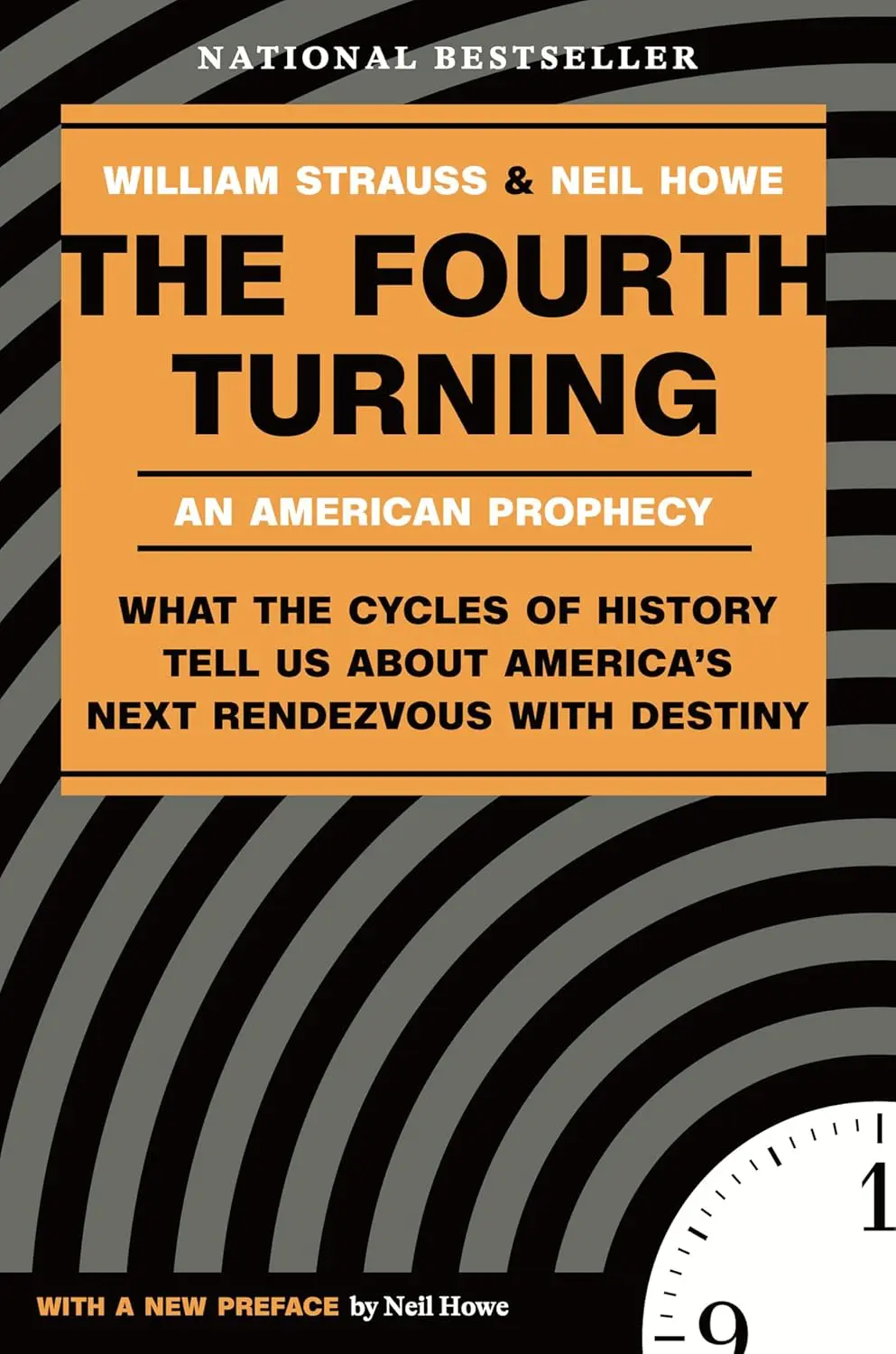
The Fourth Turning is William Strauss and Neil Howe’s theory that American history moves in recurring cycles of approximately 80 years, each divided into four phases (or “turnings”) of about 20 years each. The first turning is a High, a period of institutional confidence and social conformity (like the post-WWII era). The second is an Awakening, when individuals rebel against institutions (like the 1960s). The third is an Unraveling, when institutions weaken and individualism dominates (like the 1980s and 1990s). The fourth is a Crisis, when a major challenge forces society to rebuild its institutions from the ground up (like the Depression and WWII).
Strauss and Howe published the book in 1997 and predicted that the next Crisis turning would begin around 2005 and would likely involve a major economic, political, or military upheaval that would fundamentally restructure American society. Many readers have since connected this prediction to the 2008 financial crisis, the political polarization that followed, and the pandemic. Whether the theory is genuinely predictive or retroactively fitted to events is debated, but the framework has attracted a significant following.
The generational analysis is the other major contribution. Strauss and Howe define four generational archetypes (Prophet, Nomad, Hero, Artist) that cycle in sequence, with each generation’s character shaped by which turning it grows up in. Boomers are the Prophets of the most recent cycle, Generation X are the Nomads, Millennials are the Heroes, and Generation Z are the Artists. The archetypes are specific about what each generation tends to value, how it behaves in crisis, and what role it plays in the institutional rebuilding that follows.
For founders, the book offers a macro-level framework for understanding the social and political context in which you’re building. If the theory is even roughly correct, the current period is one of institutional breakdown and rebuilding, which creates both dangers (instability, polarization, economic disruption) and opportunities (new institutions need to be built, and the people who build them will have outsized influence).
The writing is dense and the historical analysis is extensive. The book is long and some sections feel speculative, particularly the predictions about specific events. The generational archetypes can feel reductive. But the cyclical framework, taken as a rough model rather than an exact prediction, provides a useful long-term perspective that most business books lack entirely.
