
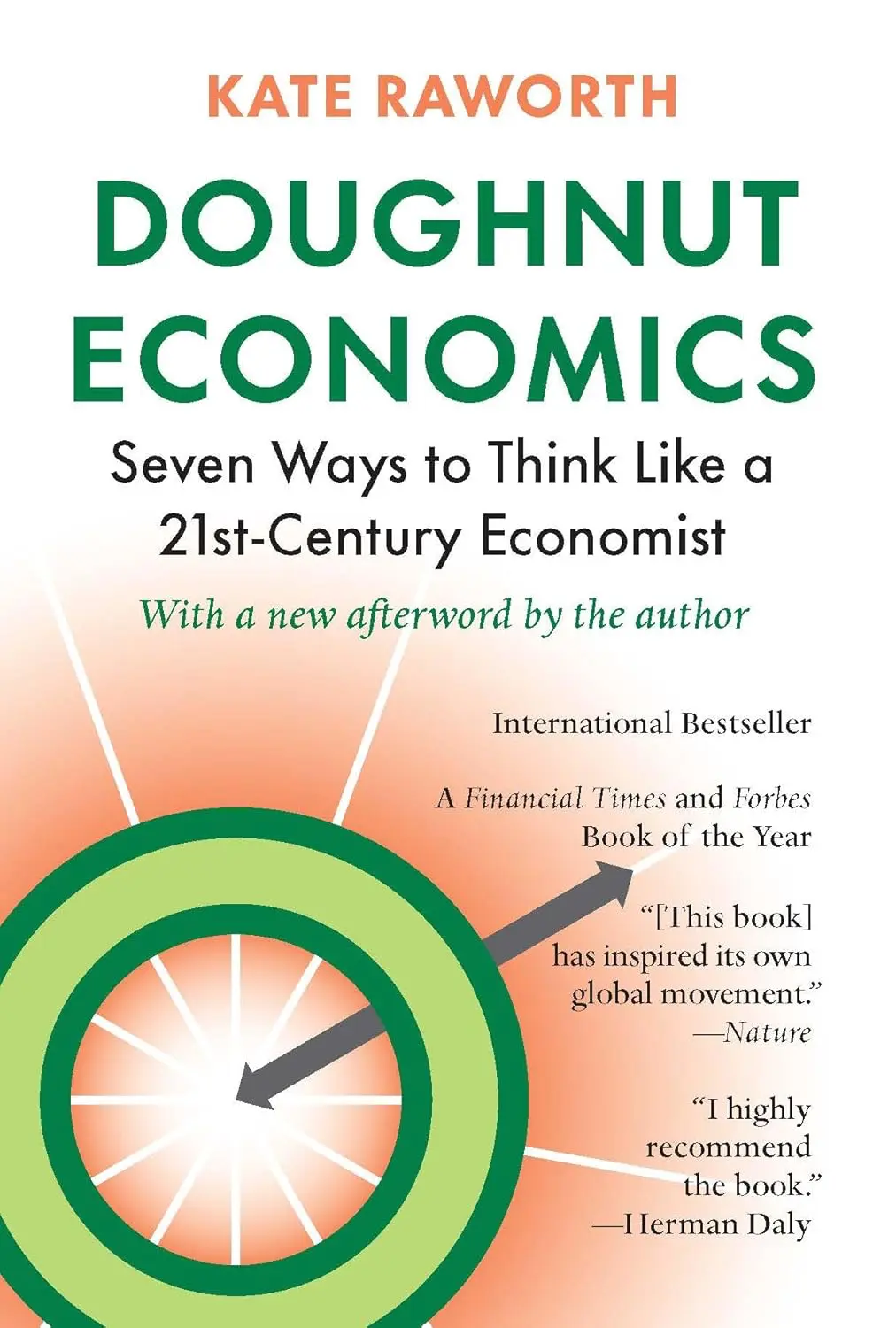
Doughnut Economics is Kate Raworth’s attempt to redesign economics for the 21st century. The central image is a doughnut: the inner ring represents the social foundation (the minimum standard of living that everyone should have, covering food, health, education, housing, and other basics), and the outer ring represents the ecological ceiling (the planetary boundaries we cannot cross without triggering environmental collapse). The goal of economics, Raworth argues, should be to get into the doughnut: meeting human needs without overshooting Earth’s limits.
Raworth organizes the book around seven ways that mainstream economics needs to change. She argues against GDP growth as the primary measure of progress, against the rational economic man model of human behavior, against the assumption that markets are self-correcting, and against the idea that inequality is a necessary price of growth. In each case, she draws on recent research to show that the standard textbook model is outdated and proposes an alternative.
The most interesting chapters deal with growth itself. Raworth doesn’t argue that growth is bad, but she questions the assumption that it must continue forever. She profiles countries and cities that are experimenting with “post-growth” economics, where the goal is to improve well-being within ecological limits rather than to maximize GDP. Amsterdam, for example, has officially adopted the doughnut framework as a guide for city policy.
For founders, the book is relevant if you’re thinking about building a business that operates within ecological and social constraints, or if you’re interested in the growing market for sustainable products and services. Raworth’s framework also offers a useful challenge to the growth-at-all-costs mindset that dominates startup culture: is there a version of success that doesn’t require endless expansion?
The writing is accessible and well-illustrated. Raworth uses hand-drawn diagrams throughout the book, which makes the economic concepts more approachable than the usual textbook approach. Some economists have criticized her proposals as too vague or impractical at a policy level. Those critiques have merit, but as a framework for rethinking what the economy is for, the book is original and thought-provoking.
