
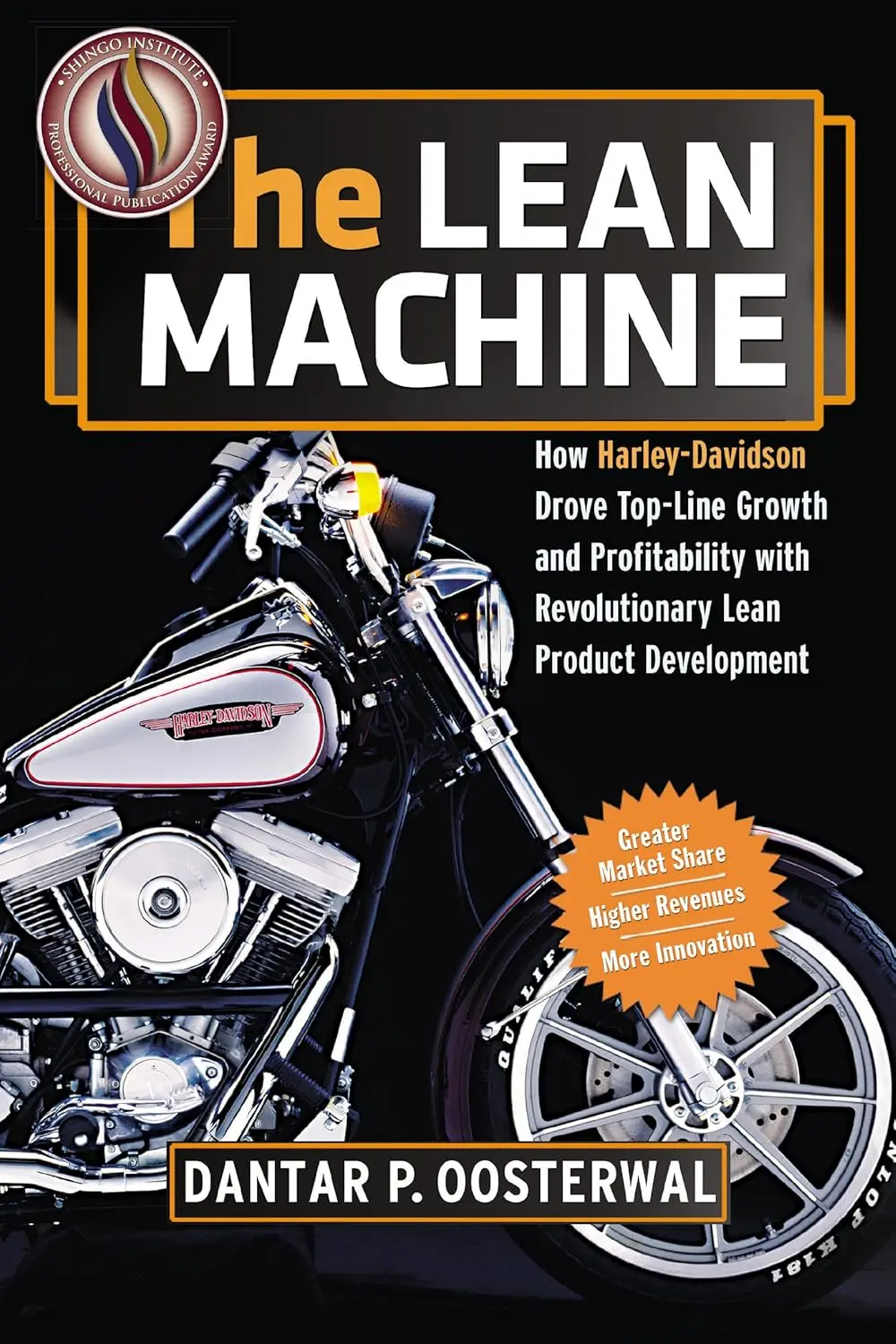
The Lean Machine is an inside account of how Harley-Davidson transformed its product development process using lean principles borrowed from Toyota’s system but adapted for an American manufacturing company. Dantar Oosterwal, who led the transformation, describes the specific methods, organizational changes, and cultural shifts that allowed Harley to develop better products faster and at lower cost.
The book covers two main approaches. Set-based concurrent engineering (SBCE) means exploring multiple design options in parallel rather than picking one early and iterating on it. Instead of committing to a single solution and fixing problems as they emerge, Harley’s teams developed several alternatives simultaneously, tested them against criteria, and narrowed the set based on evidence. This reduces rework and produces better final designs because bad options are eliminated by data rather than by opinion.
Knowledge-based development, the other main concept, means treating every project as a learning opportunity that feeds future projects. Harley built systems for capturing what was learned during each product development cycle and making that knowledge accessible to future teams. This is a simple idea that most companies fail to implement because the pressure to start the next project is always stronger than the discipline to document what was learned from the last one.
For founders and product builders, the book is relevant because the principles apply beyond manufacturing. The idea of exploring multiple solutions before committing to one, and of systematically capturing knowledge for reuse, translates well to software development, product design, and business strategy. The set-based approach in particular is a useful corrective to the common startup pattern of locking in on the first plausible solution and ignoring alternatives.
The writing is practical and detail-oriented, reflecting Oosterwal’s engineering background. Some sections are specific to manufacturing and may be less relevant to readers outside that industry. But the organizational and process chapters, which deal with how to get a traditional company to adopt lean methods, contain lessons that apply to any organization trying to change how it works. The book is less well-known than many lean titles but more grounded in a specific, documented case study.
