
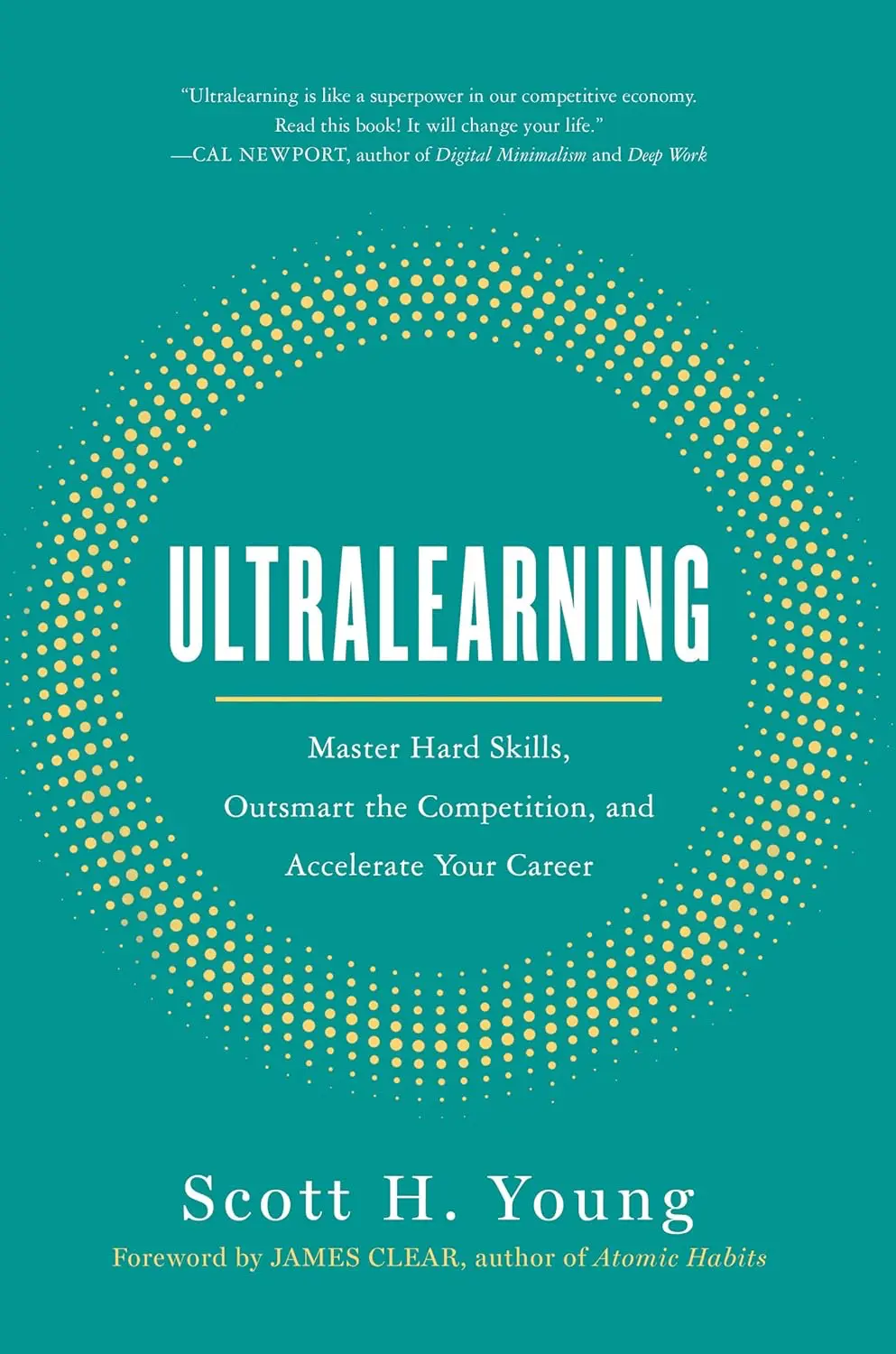
Ultralearning is Scott Young’s framework for teaching yourself hard skills in a compressed timeframe. Young became known online for his “MIT Challenge,” where he completed the equivalent of MIT’s four-year computer science degree in 12 months using only free online resources. The book generalizes the approach he used into nine principles that anyone can apply.
The nine principles are: metalearning (studying how to study your chosen subject before diving in), focus (managing your attention and environment), directness (practicing the actual skill you want rather than studying theory about it), drill (isolating and hammering your weakest components), retrieval (testing yourself rather than reviewing notes), feedback (getting honest signals about your performance), retention (using spaced repetition and mnemonics to keep what you learn), intuition (developing deep understanding through problem-solving rather than memorization), and experimentation (pushing beyond established methods to find your own approach).
Young profiles several “ultralearners” beyond himself: a man who taught himself four languages in a year, a woman who became a competitive Scrabble player in months, and others who acquired complex skills outside of formal education. These profiles illustrate the principles in action and show that the approach works across different domains.
For founders, the framework is useful in two ways. First, personally: building a company often requires learning skills you don’t currently have, whether that’s programming, sales, design, or financial modeling. Young’s approach gives you a structured way to acquire those skills faster than traditional courses would. Second, for your team: the principles of directness and drilling are directly applicable to how you train employees. Most training programs are too abstract; Young’s approach emphasizes practicing the actual work from day one.
The writing is well-organized and the examples are engaging. Young is honest about the effort required: ultralearning is not easy, it’s just efficient. Some critics have questioned whether the MIT Challenge was truly equivalent to a degree, and those concerns are fair. But the underlying learning science is well-supported, and the nine principles are practical regardless of whether you’re aiming for a massive project or just trying to pick up a new skill.
