
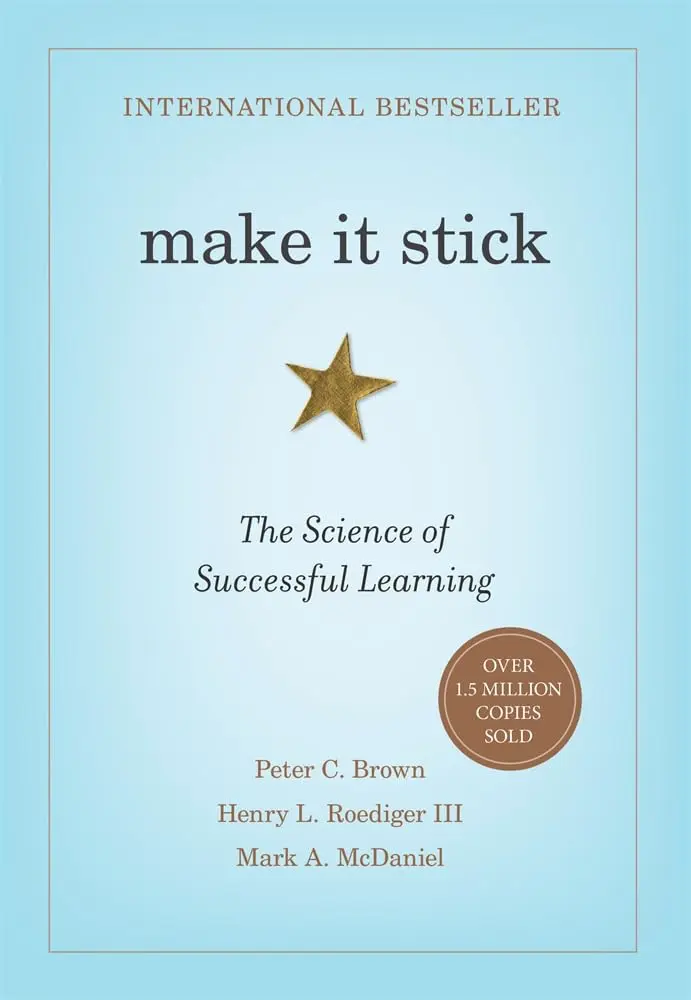
Make It Stick is one of the better books on the science of learning, written by two cognitive psychologists (Henry Roediger and Mark McDaniel) and a storyteller (Peter Brown). The book’s central argument is that the study methods most people rely on, rereading notes, highlighting textbooks, massed practice of a single skill, feel effective but produce poor long-term retention. The methods that actually work feel harder and slower in the moment but produce dramatically better results.
The three most important techniques the book covers are retrieval practice (testing yourself on material rather than rereading it), spaced repetition (spreading practice sessions out over time rather than cramming), and interleaving (mixing different types of problems or skills in a single practice session rather than focusing on one at a time). Each technique is supported by controlled experiments, and the authors explain both the research and the cognitive mechanisms behind why each approach works.
The book also covers the concept of “desirable difficulty.” Learning feels most productive when it’s easy, but easy learning doesn’t stick. The slight struggle of trying to recall something you’ve forgotten, or solving a problem that’s just beyond your current ability, is what forces your brain to build stronger memory traces. This is counterintuitive and explains why students rate easy lectures higher even though they learn less from them.
For founders, the applications go beyond personal learning. If you’re training employees, onboarding new team members, or building educational products, the principles in this book tell you exactly what works and what doesn’t. Most corporate training is built on methods (lectures, slide decks, cramming before a certification) that the research shows are ineffective. Switching to retrieval-based, spaced methods costs nothing extra and produces measurably better outcomes.
The writing is clear and well-organized. Each chapter follows the same pattern: present the research, explain the mechanism, show real-world applications, and address common objections. The real-world examples range from medical students to pilots to athletes, which keeps the material grounded. Some readers find the academic style slightly dry, but the clarity of the argument makes up for it.
