
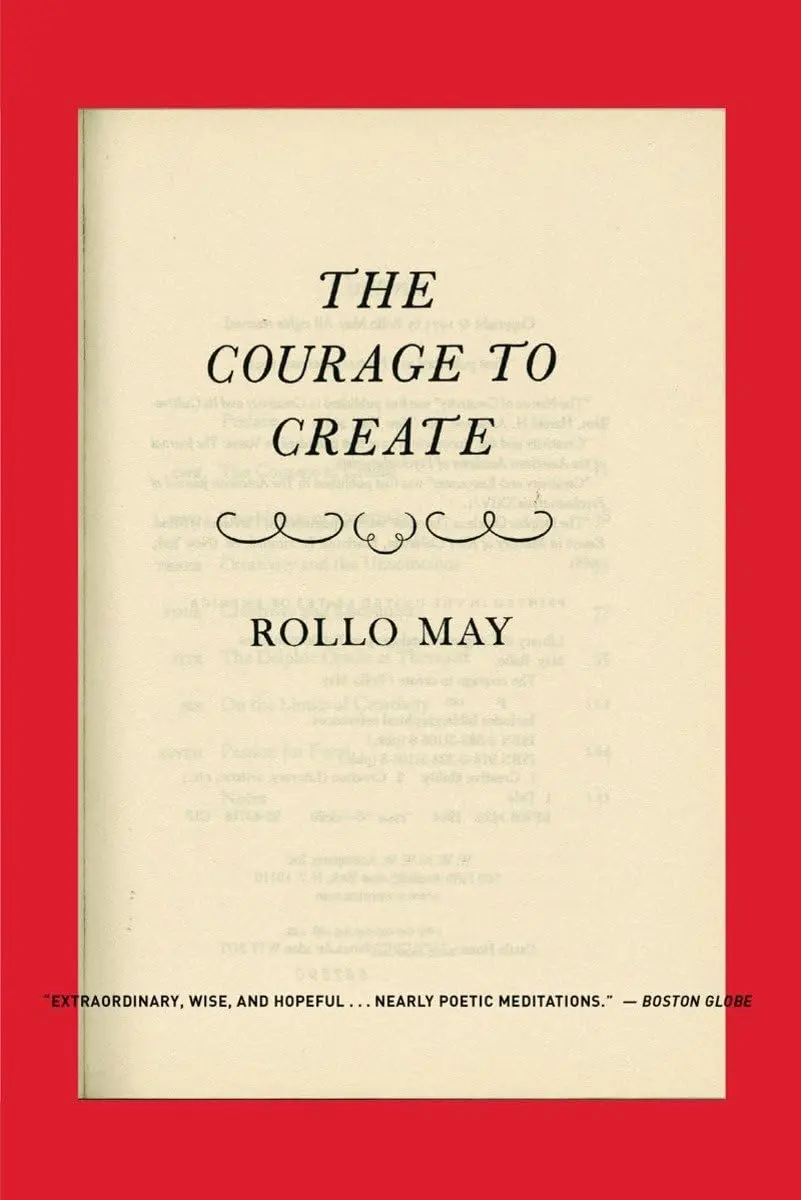
The Courage to Create is Rollo May’s exploration of what it actually takes to produce original work. May, an existential psychologist who was a contemporary of Abraham Maslow and Carl Rogers, argues that creativity is not a pleasant, relaxed state but an encounter with anxiety. To create something new, you have to leave the safety of what already exists, and that departure produces real psychological discomfort. The courage in the title is not bravery in the dramatic sense but the willingness to sit with that discomfort instead of retreating from it.
May distinguishes between several types of courage. Physical courage and moral courage are familiar. Creative courage, which he argues is the least understood, is the courage to discover new forms, new symbols, new patterns of meaning. This kind of courage is needed not just by artists but by anyone who makes something that didn’t exist before, including entrepreneurs, scientists, and anyone else who builds in the face of uncertainty.
The book draws from a wide range of sources. May discusses the creative processes of Picasso, Cezanne, and various poets and musicians. He connects their experiences to clinical observations from his own practice, where he treated patients whose symptoms often stemmed from suppressing their creative needs. He also engages with existential philosophy, particularly the work of Kierkegaard and Tillich, on the relationship between anxiety and authentic living.
For founders, May’s framework puts words to something many experience but rarely articulate: the anxiety that comes with creating something new. Most business books treat this anxiety as a problem to be managed or eliminated. May treats it as a signal that you are doing something that matters. The discomfort is not a bug; it is the natural consequence of the creative act.
The writing is thoughtful and measured. May writes like a clinician who is also a philosopher, which means the prose rewards careful reading. The book is short, under 200 pages, and works well read in a few sittings. It was published in 1975 but feels surprisingly current, partly because the psychological dynamics of creativity have not changed.
