
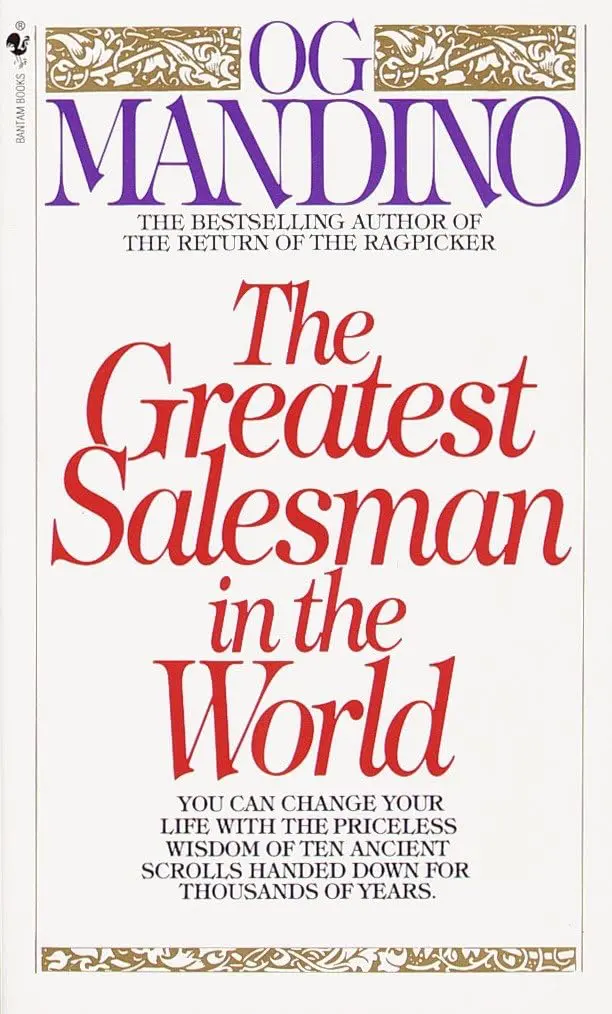
The Greatest Salesman in the World is a parable set in biblical times. Hafid, a poor camel boy, is given ten ancient scrolls by his master, each containing a principle for success in selling and in life. The instructions are specific: read each scroll three times a day for thirty days before moving to the next one. The process takes ten months, and the scrolls cover persistence, love, emotional control, laughter, living fully in the present, and the habit of treating each day as your last.
Mandino published the book in 1968, and it has sold over 50 million copies, making it one of the bestselling self-help books in history. The sales principles are wrapped in spiritual language that draws from multiple traditions, and the tone is closer to a devotional text than a business manual. Each scroll reads like a meditation rather than a set of tactics.
The scrolls themselves contain ideas that are now common in personal development: I will persist until I succeed, I will greet this day with love in my heart, I will live this day as if it is my last. What makes the book different from the dozens of books that have repeated these ideas since is the delivery method. Mandino designed the book to be used as a daily practice, not just read once. The repetition-over-thirty-days structure is the actual mechanism, and people who follow it report that the repetition changes behavior in ways that a single reading does not.
For founders, the book is unusual in that it approaches sales from the inside out. Instead of techniques for closing or handling objections, it focuses on the salesperson’s mindset, emotional state, and daily habits. Mandino’s argument is that if you get the internal work right, the external results follow. This is a claim that many modern sales trainers have since echoed, though usually in less spiritual language.
The writing is simple and deliberate. The parable format can feel old-fashioned to modern readers, and the spiritual tone is not for everyone. But the book’s longevity and continued sales suggest that the approach resonates with a large audience. If you prefer practical, data-driven sales advice, look elsewhere. If you’re open to a different kind of sales book, one that treats selling as a practice rather than a skill set, this is the original.
