
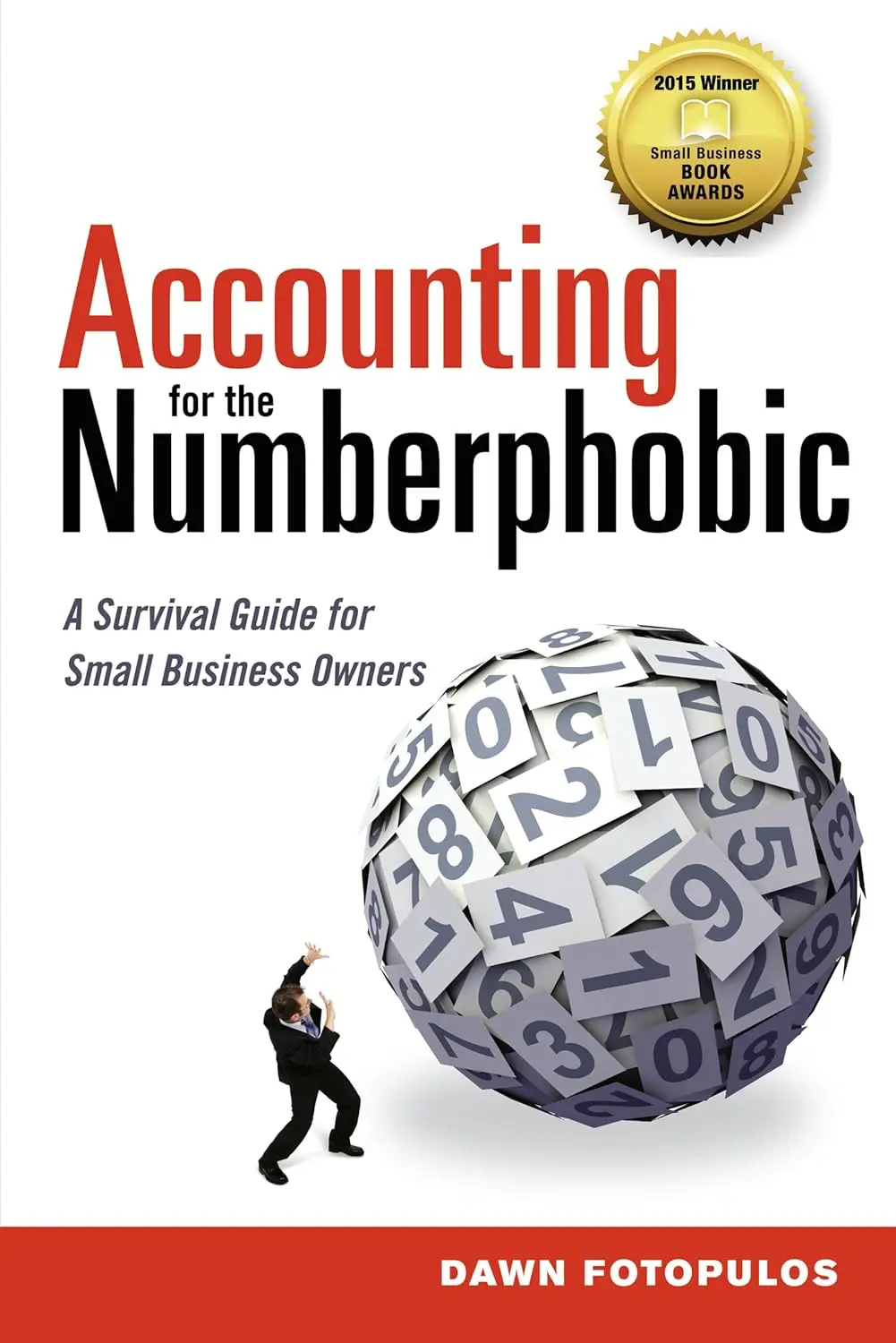
Accounting for the Numberphobic is Dawn Fotopulos’s guide for small business owners who avoid their financial reports because the numbers feel intimidating. Fotopulos, who teaches at NYU’s Stern School of Business and has worked with thousands of small business owners, wrote the book after seeing how many entrepreneurs run their businesses blind because they can’t face their own accounting.
The book focuses on three reports: the net income statement (are you making money?), the cash flow statement (where is your money going?), and the balance sheet (what is your business actually worth?). Fotopulos explains each one in the simplest possible terms, using plain language, visual examples, and step-by-step walkthroughs. She deliberately avoids accounting jargon and starts from the assumption that the reader knows nothing.
The practical sections cover specific decisions: how to know whether to raise or lower your prices, how to figure out which products or services are actually profitable, how to set a budget, and how to tell whether you can afford to hire someone. Each decision is connected directly to a number in one of the three reports, which teaches the reader to use their financials as a decision-making tool rather than a compliance obligation.
For founders who handle their own books or who feel lost when their accountant sends monthly statements, the book is a good starting point. It won’t replace an accountant, but it will give you the literacy to understand what your accountant is telling you and to ask better questions. The pricing section alone is worth the read for anyone running a small business.
The writing is warm and encouraging, clearly shaped by Fotopulos’s teaching experience. She anticipates the reader’s resistance to the material and addresses it directly, which makes the book feel less like a textbook and more like a patient tutor. Some readers with any financial background will find it too basic. That’s by design: the book is for the people who have been avoiding this subject entirely.
