
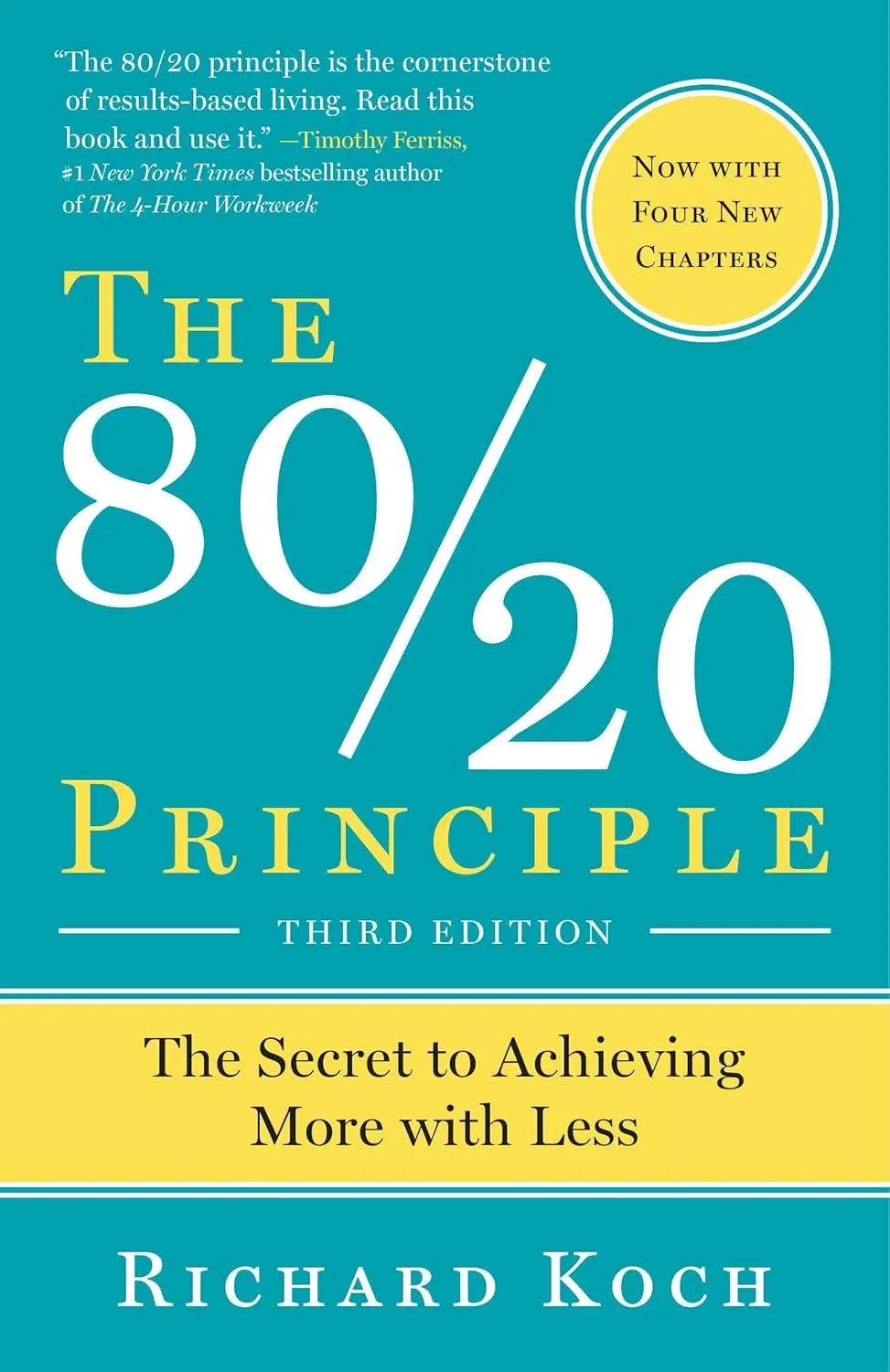
The 80/20 Principle is Richard Koch’s exploration of the Pareto Principle, the observation that roughly 80% of effects come from 20% of causes. Koch applies this pattern across business, time management, relationships, and personal happiness, arguing that most people dramatically overinvest in the 80% of activities that produce only 20% of their results.
The business sections are the most directly actionable. Koch shows how to identify which 20% of your customers generate 80% of your profit, which products or services produce the most revenue relative to effort, and which activities in your workday actually move the needle. His argument is that most companies spread their attention too evenly across all customers, all products, and all activities, when they should be concentrating resources on the critical few.
Koch also applies the principle to personal life: which 20% of your activities produce 80% of your happiness? Which relationships matter most? Which habits have the most impact on your health? The personal sections are more philosophical than the business sections, but the underlying logic is the same: figure out what matters most and do more of it.
The book’s biggest limitation is that the 80/20 ratio is an approximation, not a law. In some cases the split is 90/10 or 70/30 or something else entirely. Koch acknowledges this but sometimes writes as if the principle is more precise than it actually is. The examples, while illustrative, occasionally feel cherry-picked to fit the thesis.
For founders, the principle is most useful as a diagnostic tool. When you’re overwhelmed by a long task list, asking “which 20% of these tasks will produce 80% of the results?” is a simple way to prioritize. When your company is serving hundreds of customers, figuring out which handful produce most of the revenue (and which ones are actually costing you money) can change how you allocate sales and support resources.
The writing is clear but can feel repetitive, since Koch applies the same pattern across many domains. Some readers get the point after a few chapters and feel the rest is padding. Others appreciate seeing the principle applied across different areas. As a thinking tool rather than a page-by-page read, it is useful to have on the shelf.
