
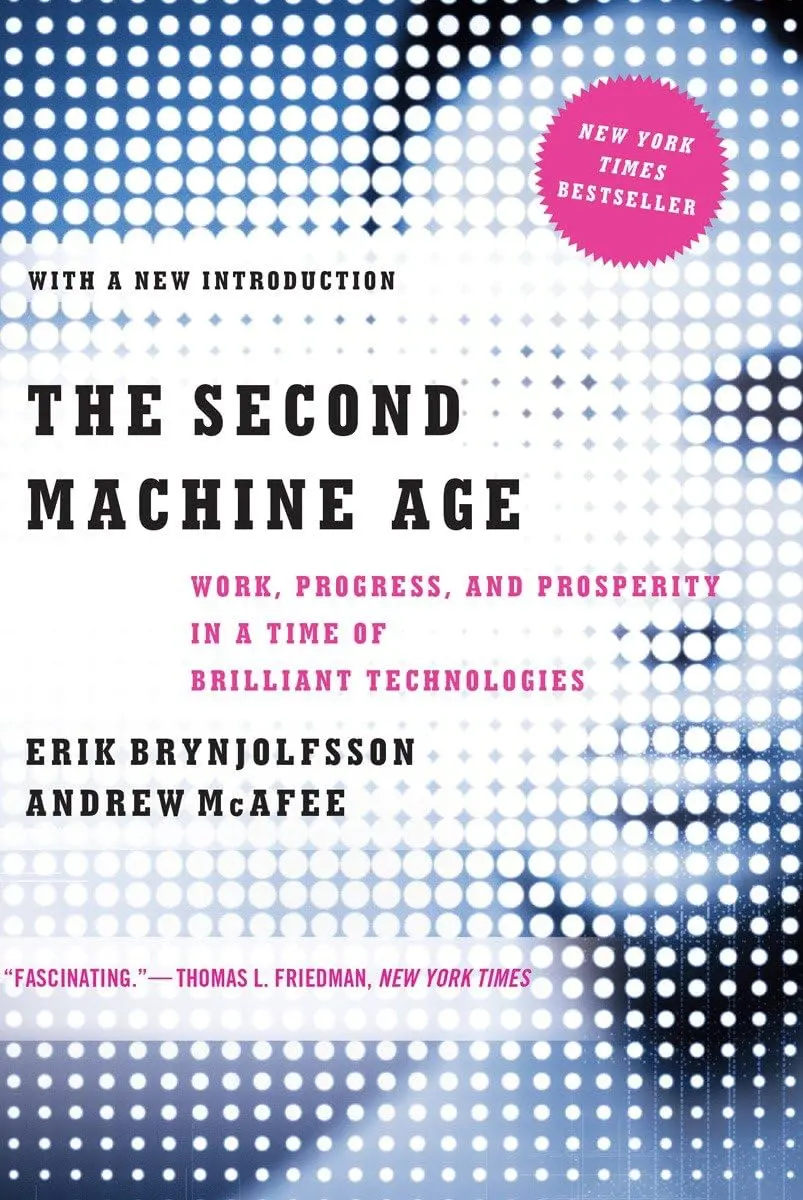
The Second Machine Age is Erik Brynjolfsson and Andrew McAfee’s argument that we are in the early stages of a technology-driven economic transformation comparable to the Industrial Revolution. The “first machine age” was the steam engine era, which augmented physical labor. The “second machine age” is the digital era, which augments cognitive labor. And the key insight is that digital technology improves exponentially, which means the most disruptive changes are still ahead of us.
The book covers three forces driving the transformation. First, exponential growth: following Moore’s Law, computing power doubles roughly every 18 months, and we’ve reached the point on the exponential curve where each doubling produces enormous absolute gains. Second, the digitization of nearly everything: once information is digital, it can be copied at near-zero cost, which changes the economics of every industry that deals in information. Third, combinatorial innovation: the ability to combine existing digital technologies in new ways, the way a smartphone combines a camera, GPS, accelerometer, and internet connection into something none of those components could be alone.
The economic sections deal with the downsides. Brynjolfsson and McAfee are honest about the fact that technology creates wealth unevenly. The returns go disproportionately to people who own capital or who have skills that complement machines, while people whose jobs can be automated face declining prospects. They propose policy responses including education reform, infrastructure investment, and experimentation with new economic models.
For founders, the book provides useful context for understanding which industries are about to be disrupted and why. The framework of exponential improvement plus combinatorial innovation helps explain why so many sectors (healthcare, education, transportation, finance) are ripe for technology-driven change. The book was published in 2014, and some of the specific predictions have already come true with AI. Others are still unfolding.
The writing is clear and well-organized. The authors are academics but write for a general audience. Some readers found the policy sections less compelling than the technology analysis. But as a framework for understanding the economic impact of digital technology, the book remains one of the better entries in the field.
