
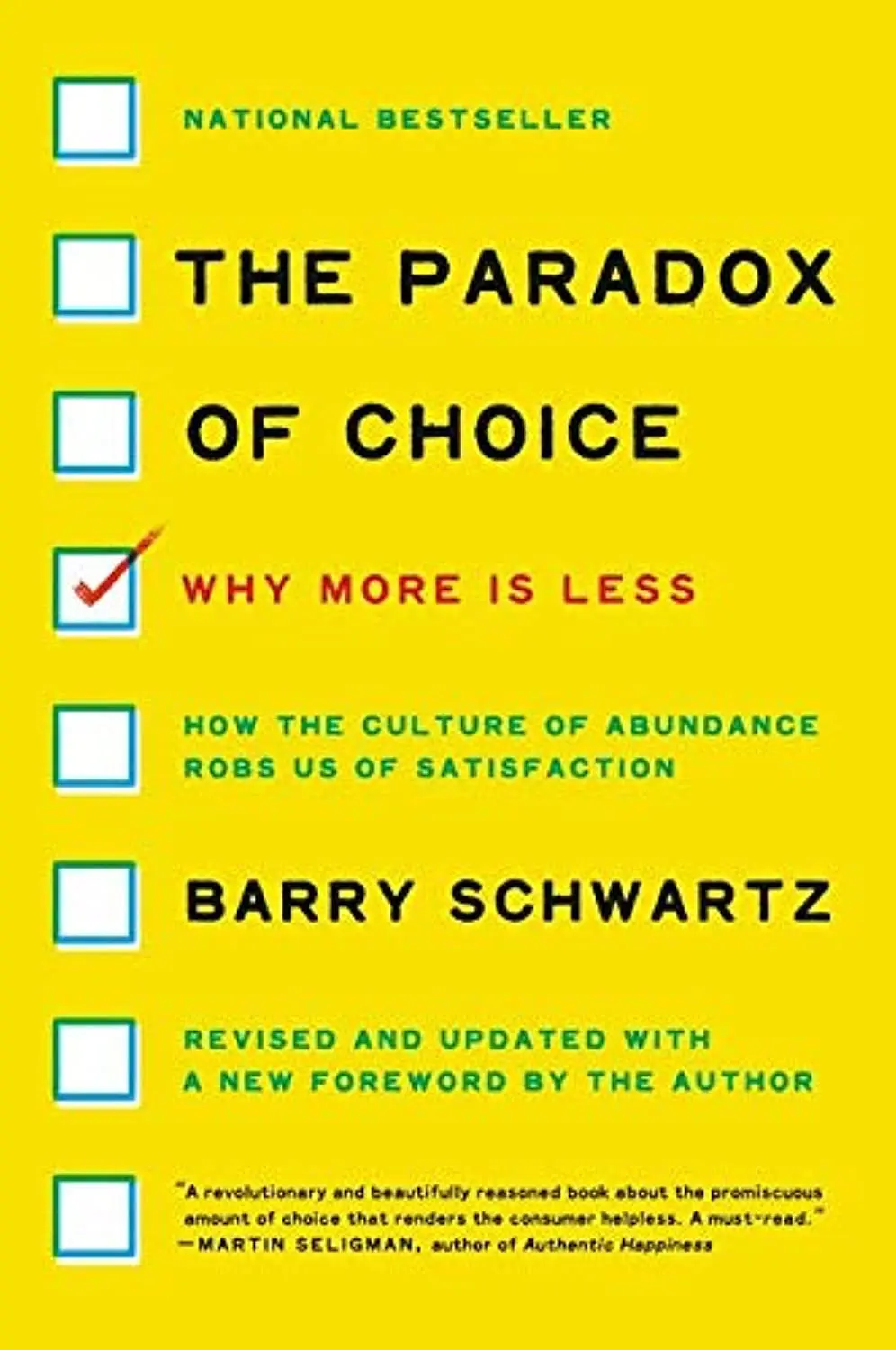
The Paradox of Choice is Barry Schwartz’s argument against the common assumption that more options are always better. Drawing from research in psychology and behavioral economics, Schwartz makes the case that the explosion of choice in modern life, from retirement plans to jeans to breakfast cereal, has produced not freedom but paralysis, anxiety, and dissatisfaction.
Schwartz identifies two types of decision-makers. “Maximizers” try to find the absolute best option, which means they research exhaustively, compare endlessly, and still feel unsure after choosing. “Satisficers” look for something that meets their criteria and stop there. The research consistently shows that satisficers are happier with their decisions, even though maximizers sometimes make objectively better choices, because maximizers pay a psychological cost that outweighs whatever marginal improvement they gain.
The book covers several mechanisms by which too much choice hurts us. The more options you have, the higher your expectations, and the more likely you are to blame yourself if the result disappoints. Opportunity cost feels more painful when you can clearly see the alternatives you gave up. And the sheer cognitive burden of evaluating many options drains the mental energy you need for other things.
For founders, the book has applications in two directions. First, for product design: adding more features, options, or configurations can actually reduce user satisfaction rather than increase it. Simplifying the choice architecture of your product is often more effective than expanding it. Second, for personal decision-making: founders who are natural maximizers (and many are) can burn enormous energy on decisions that don’t warrant it. Learning to satisfice on low-stakes choices preserves mental energy for the decisions that actually matter.
The book was published in 2004 and some of the specific examples are dated, but the underlying psychology has held up well. The writing is accessible and draws heavily from real research studies. Schwartz has a TED talk on the same topic that covers the core argument in 20 minutes, but the book adds the depth and nuance the talk necessarily omits.
