
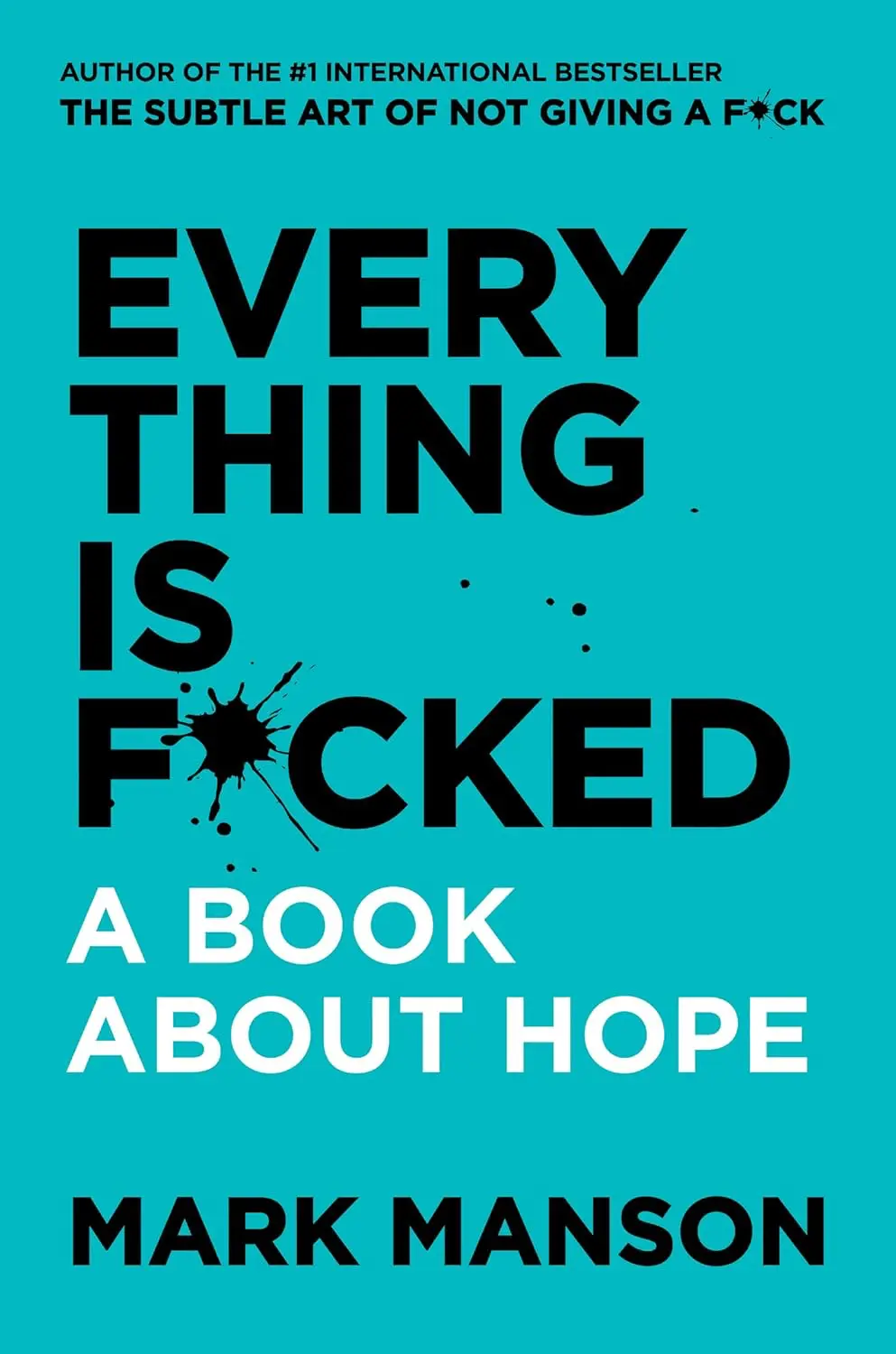
Everything Is F*cked is Mark Manson’s second book, and it tackles a bigger question than his first. The Subtle Art of Not Giving a F*ck was about personal values and letting go of things that don’t matter. This one asks why, even when you’ve figured out your values, the world still feels like it’s falling apart. Manson’s answer draws from Immanuel Kant, Nietzsche, behavioral psychology, and neuroscience to build an argument about the nature of hope and why it is both necessary and dangerous.
The book’s central idea is what Manson calls the “Uncomfortable Truth”: that human life has no inherent meaning or purpose, and that the narratives we construct to give it meaning (religion, nationalism, progress, career achievement) are all, in some sense, made up. The question is not whether these narratives are true but whether they are useful, and what happens when they stop working.
Manson covers the “Thinking Brain” versus the “Feeling Brain,” arguing that most of what we call rational decision-making is actually emotional. He discusses Kant’s moral philosophy in accessible terms, profiles Newton’s psychological breakdown, and examines how modern technology has created what he calls a “crisis of hope” by giving people everything they thought they wanted and leaving them feeling empty anyway.
For founders, the book is less directly applicable than a business book, but it addresses something many ambitious people experience: the realization that achieving your goals doesn’t necessarily make you feel the way you expected. Manson’s argument is that the solution is not to set better goals but to develop a healthier relationship with uncertainty and discomfort. The chapters on the difference between “hope” (which requires narrative) and “acceptance” (which doesn’t) are the most original parts.
The writing is casual and irreverent in Manson’s signature style, though this book is noticeably more philosophical and slower-paced than The Subtle Art. Some readers found it less entertaining as a result. Others found it more substantial. The philosophy sections are well-researched for a popular audience, though professional philosophers might quibble with some of the simplifications.
