
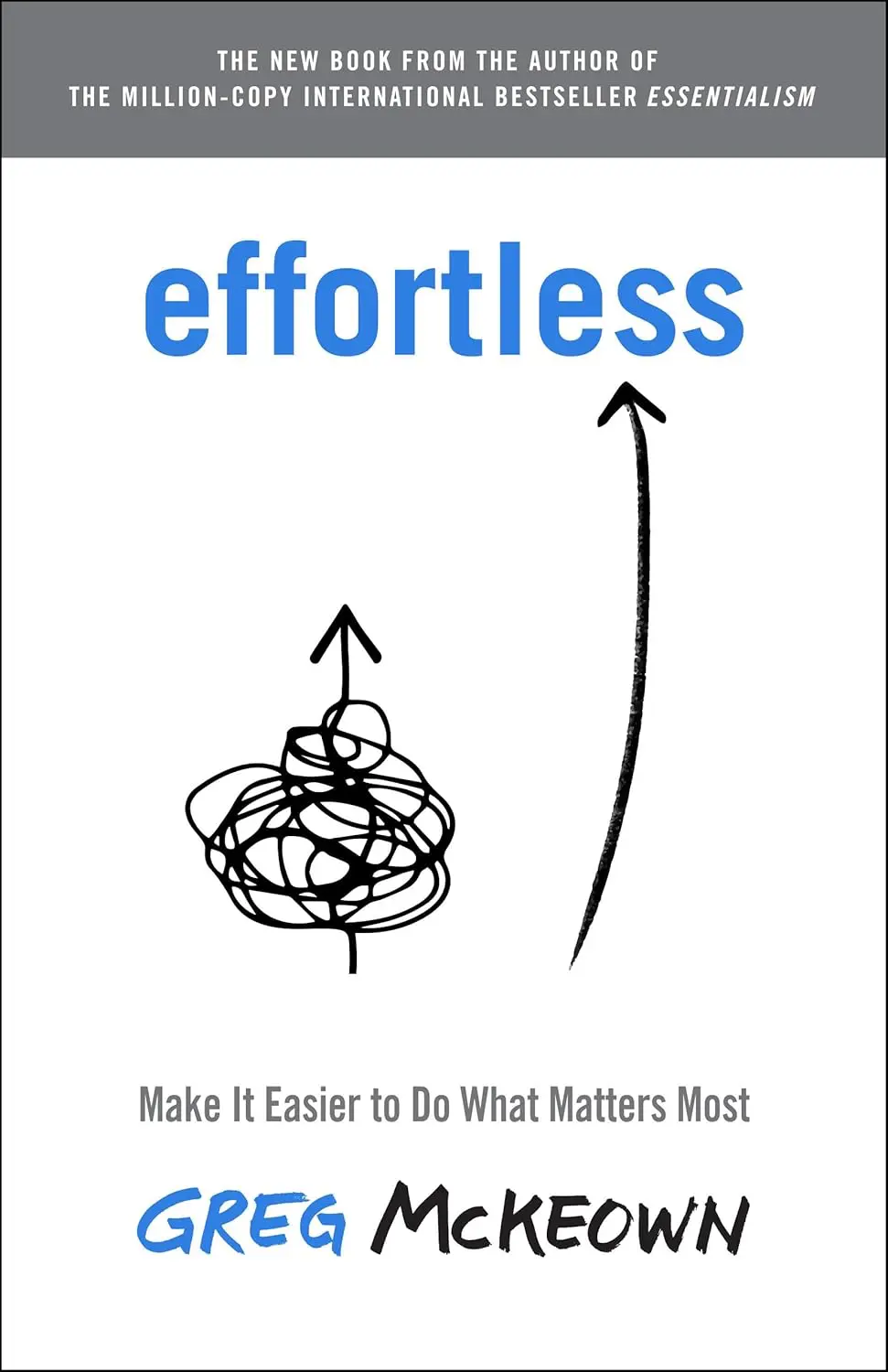
Effortless is Greg McKeown’s sequel to Essentialism. Where Essentialism focused on identifying the few things that truly matter and saying no to everything else, Effortless picks up the next question: once you know what matters, how do you do it without exhausting yourself?
McKeown’s argument is that most people assume hard results require hard work, and that the way to accomplish more is to push harder. He thinks this is wrong, or at least incomplete. Some of the most effective approaches involve making the work itself easier rather than forcing yourself to do difficult work with more willpower. He calls this “effortless action” and draws from a mix of behavioral science, workflow design, and philosophy to describe how it works.
The book is organized into three parts. “Effortless State” covers how to clear the mental clutter that makes everything feel harder than it needs to be, including perfectionism, overthinking, and the assumption that if something isn’t painful it isn’t worth doing. “Effortless Action” covers how to simplify processes, automate repetitive decisions, and find the minimum number of steps to achieve a result. “Effortless Results” covers how to create systems that produce ongoing returns from a single investment of effort, like teaching someone else to do a task rather than doing it yourself every time.
For founders, the book’s most useful contribution is its challenge to hustle culture’s assumption that more effort always equals better results. McKeown makes a compelling case that many founders work harder than they need to because they haven’t stopped to ask whether there’s a simpler way to get the same outcome. The sections on simplifying processes and building leverage into your work are particularly applicable.
The writing is clean and McKeown uses short, focused chapters. Some readers find the tone a bit too polished and the advice occasionally too abstract. If you read Essentialism and wanted more tactical follow-through, this delivers on that. If you haven’t read Essentialism, it works as a standalone, though reading them in order adds context.
