
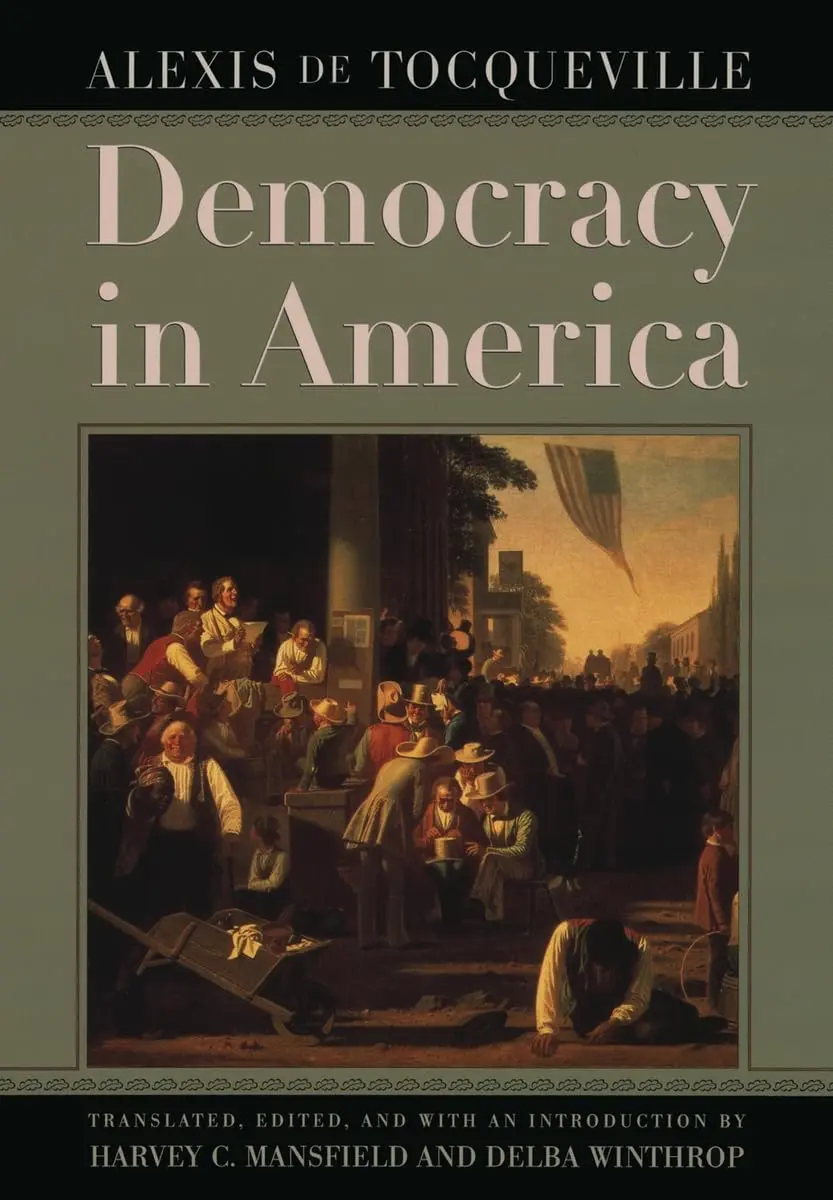
Democracy in America is Alexis de Tocqueville’s analysis of the United States, published in two volumes in 1835 and 1840. Tocqueville, a young French aristocrat, traveled across America for nine months in 1831, officially to study the prison system but actually to understand how democracy worked in practice. The result was a book that remains the most penetrating foreign analysis of American society ever written.
Tocqueville’s central observation is that America is defined by equality of conditions, a social reality where people see themselves as fundamentally equal regardless of wealth or status. He traces the consequences of this equality through every aspect of American life: politics, religion, family structure, commerce, intellectual habits, and social manners.
Many of his observations feel eerily current. He described how Americans are simultaneously obsessed with material success and anxious about whether they have enough. He noticed the tendency toward conformity in democratic societies, where the pressure to agree with the majority can be more oppressive than any tyrant. He predicted that democratic governments would tend toward centralized bureaucracy. And he identified voluntary associations, what we would now call civil society, as the mechanism Americans used to solve collective problems without relying on government.
The sections on individualism are particularly interesting. Tocqueville coined the term (or at least gave it its modern meaning) to describe the democratic tendency to withdraw into private life and lose interest in public affairs. He saw this as a serious risk, and his chapters on how Americans counteracted it through civic participation and local self-government are directly relevant to anyone thinking about community building.
For founders, the book offers perspective on the culture you’re building within. Democratic organizations face the same tensions Tocqueville identified: equality creates energy but also conformity. Freedom requires participation, or it degrades into apathy. Tocqueville saw these dynamics playing out at a national scale, but they apply wherever people try to govern themselves.
The Harvey Mansfield and Delba Winthrop translation is the standard modern English edition. The book is long and the prose can be dense, but individual chapters work well on their own.
