
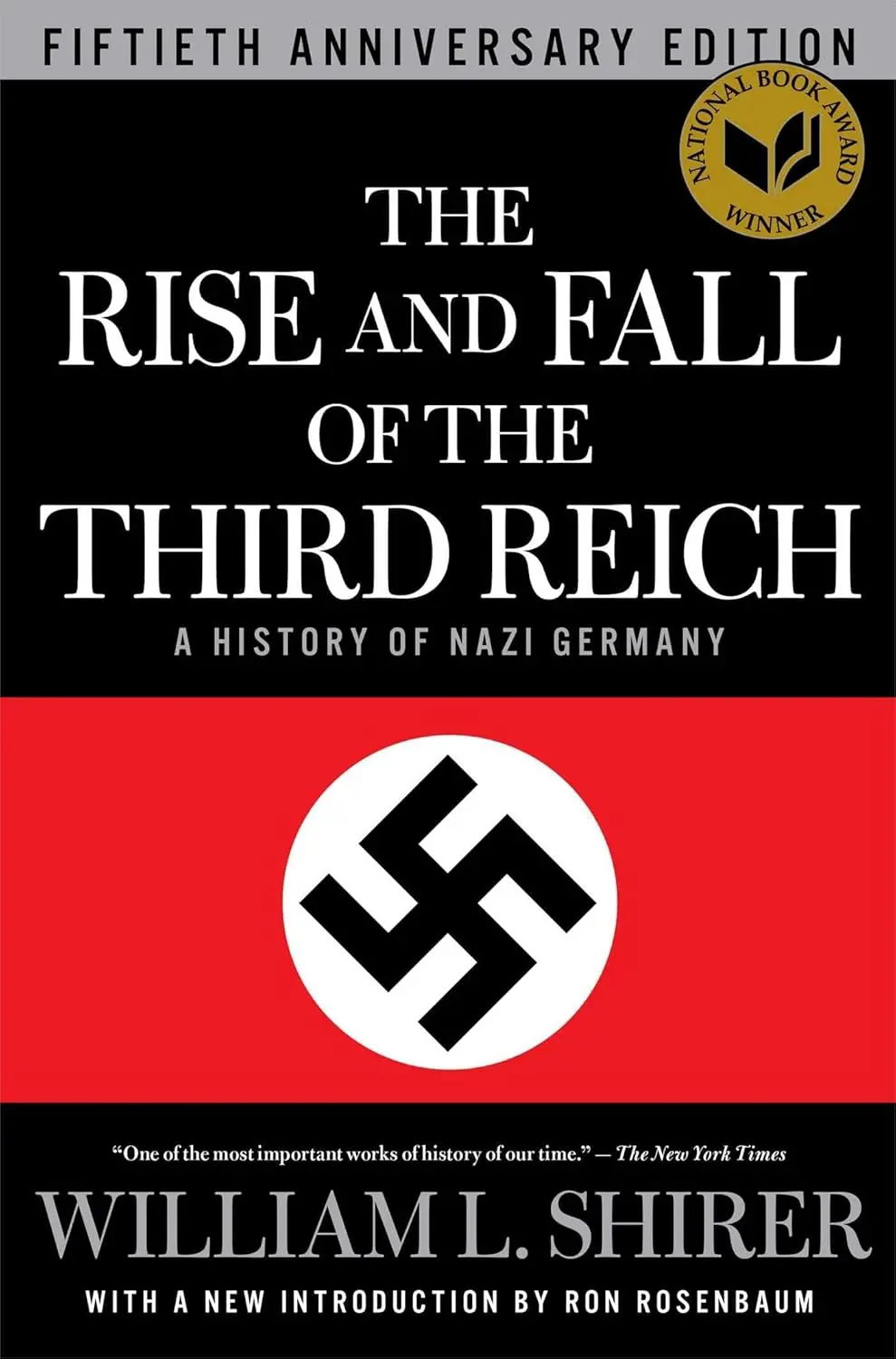
The Rise and Fall of the Third Reich is William Shirer’s 1,200-page history of Nazi Germany, published in 1960. Shirer was an American journalist who worked in Berlin from 1934 to 1940, giving him a firsthand perspective on the regime during its early years. After the war, he gained access to captured Nazi documents, diaries, and the records of the Nuremberg trials, which gave the book a documentary foundation that few other histories of the period could match.
The book is organized chronologically, beginning with Hitler’s early life and the political conditions in Weimar Germany that allowed his rise, continuing through the consolidation of power, the prewar diplomatic maneuvering, the military campaigns of World War II, and ending with the collapse of the regime in 1945. Shirer covers both the political and military history in detail, with long sections on specific battles, diplomatic negotiations, and the internal power struggles within the Nazi leadership.
The strength of the book is its scale and detail. Shirer quotes extensively from primary sources, including the diaries of Joseph Goebbels, the minutes of Hitler’s military conferences, and diplomatic cables that show exactly how decisions were made. The sections on how the German generals went along with Hitler’s increasingly irrational orders are particularly striking.
For founders and business readers, the book might seem like an unusual recommendation. But it is one of the most detailed case studies available of how institutions fail, how groupthink takes hold, and how intelligent people can be drawn into serving destructive systems. The chapters on the German establishment’s decision to support Hitler, believing they could control him, read like a warning about the consequences of short-term thinking.
The book has been criticized by some historians for relying too heavily on Shirer’s personal impressions and for occasionally oversimplifying complex political dynamics. These are fair points. But as a readable, comprehensive narrative history of the period, it has not been surpassed. It is long and demands commitment, but the writing is clear and the pacing is better than you’d expect for a book of this size.
