
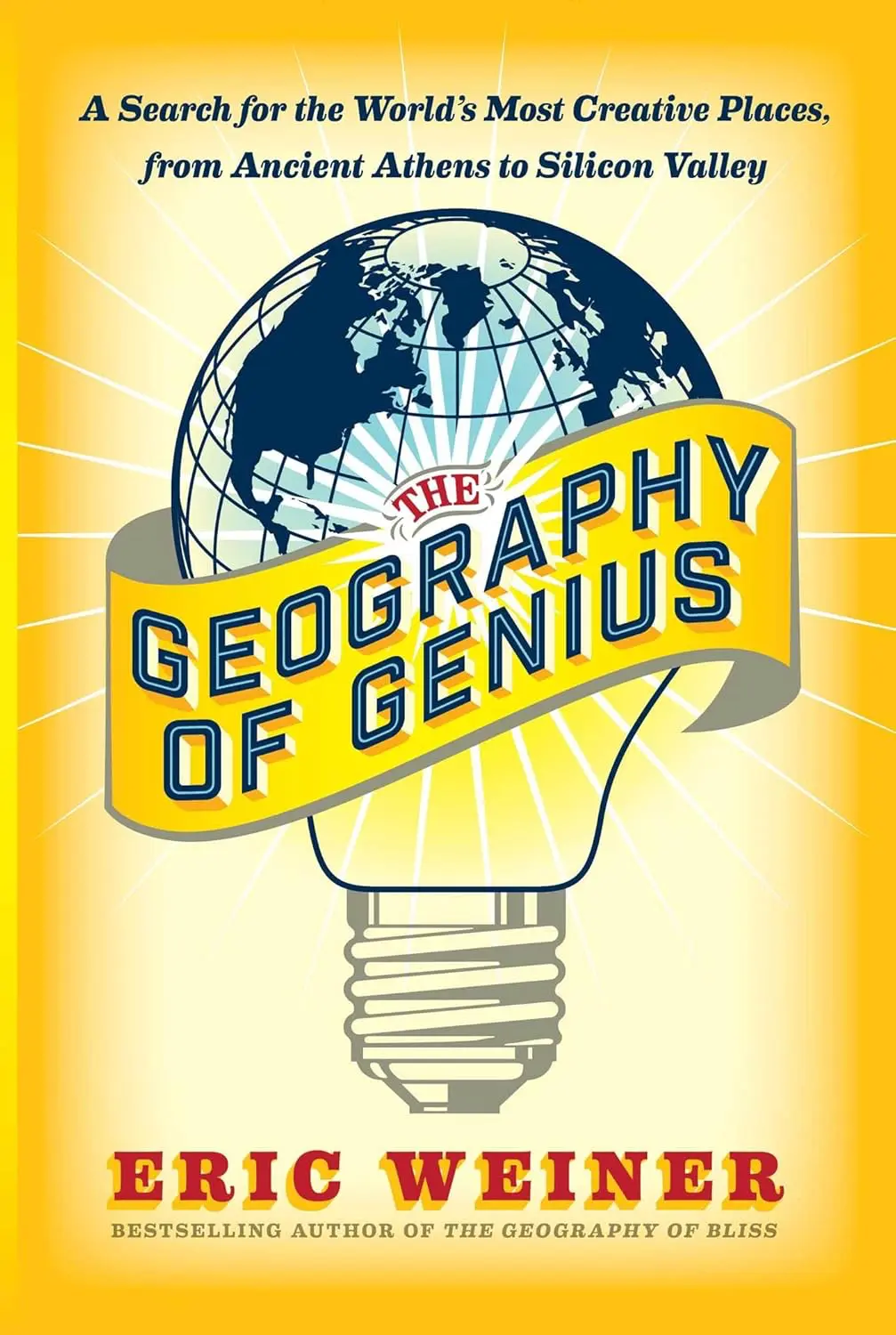
The Geography of Genius is Eric Weiner’s investigation into why creative breakthroughs tend to cluster in specific places and time periods rather than appearing evenly across history. Weiner travels to cities that experienced bursts of genius, including ancient Athens, Song Dynasty Hangzhou, Renaissance Florence, Enlightenment Edinburgh, fin-de-siecle Vienna, and modern Silicon Valley, looking for common patterns.
The argument that emerges is that genius is not primarily about individual talent. It is about the conditions that allow talented people to do their best work. Weiner identifies recurring factors: tolerance for eccentricity, exposure to diverse influences, enough wealth to support experimentation, a certain amount of chaos and instability, and social structures that bring different kinds of thinkers into contact with each other.
The Athens chapter examines how democracy, public debate, and the agora (a literal marketplace of ideas) created conditions for philosophical breakthroughs. The Florence chapter looks at how patronage, competition between workshops, and the mingling of art and science produced the Renaissance. The Vienna chapter explores how the collision of Freud’s psychology, Klimt’s art, and Wittgenstein’s philosophy all emerged from the same small, pressurized social world. The Silicon Valley chapter asks whether the current tech hub has more in common with historical genius clusters than its residents might think.
For founders, the book’s most useful insight is about environment. If genius clusters geographically, then where you build your company, who you surround yourself with, and the culture you create within your organization matter more than hiring the smartest individuals. Weiner’s research suggests that the best ideas come from places where different disciplines collide, where failure is tolerated, and where people are free to experiment.
The writing is engaging and often funny. Weiner travels to each location himself, mixing historical research with personal observations and interviews. The tone is closer to travel writing than academic history, which makes it readable but occasionally sacrifices depth for entertainment. Still, the central question, why here and why now, is one worth thinking about.
