
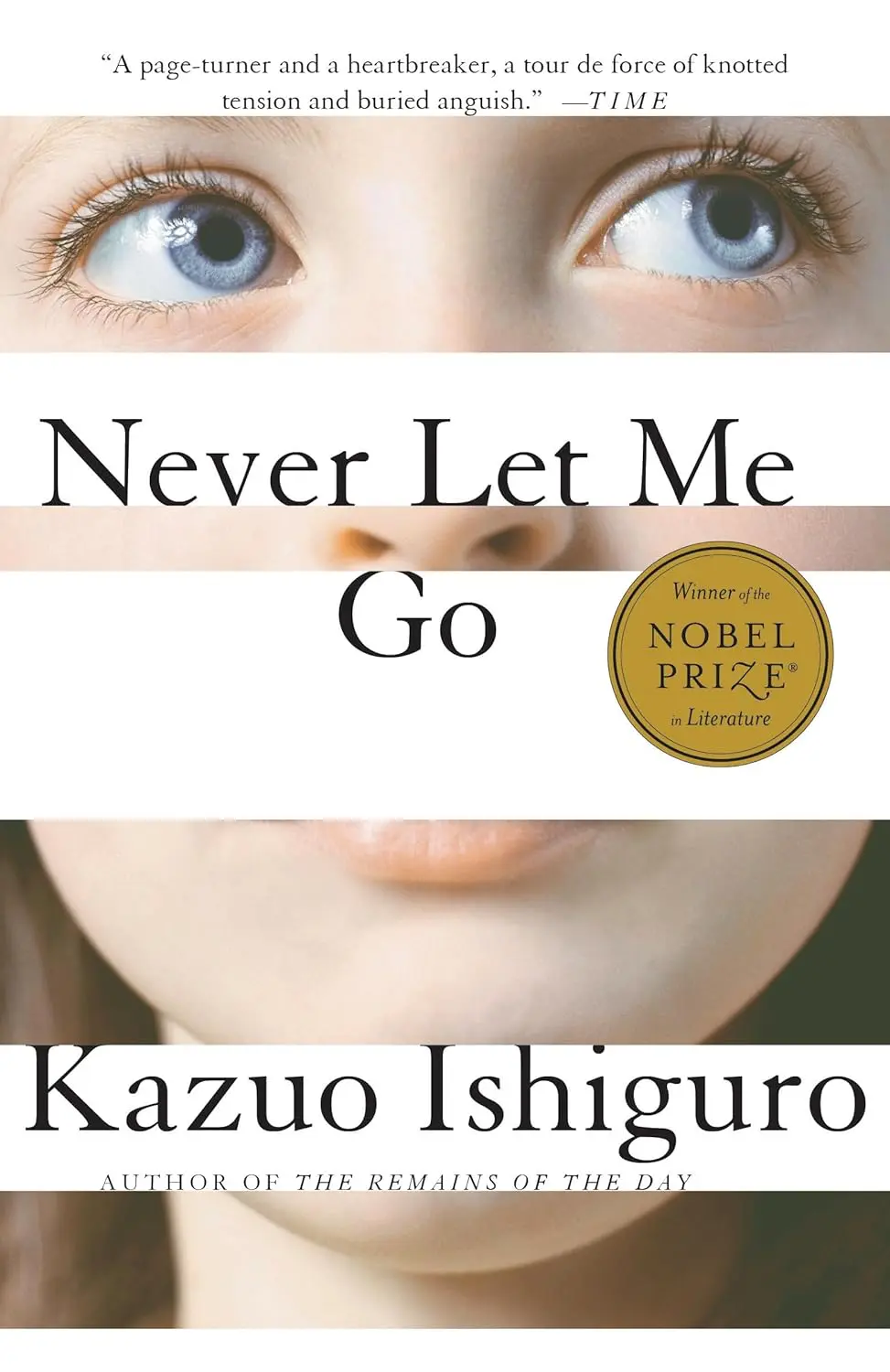
Never Let Me Go is narrated by Kathy H., who is looking back on her childhood at Hailsham, a boarding school in the English countryside where the students are cared for, educated, and encouraged to create art. The atmosphere is gentle and sheltered. But something is off, and the details accumulate slowly: the students are never visited by parents, they are unusually concerned with their health, and the teachers, called “guardians,” sometimes say things that don’t quite make sense.
Ishiguro reveals the truth gradually, and part of the book’s power comes from the gap between what the reader begins to suspect early on and the characters’ own slow acceptance of their situation. Describing the reveal would diminish the experience for first-time readers, so it is enough to say that the students were created for a specific purpose, and the novel follows Kathy and her two closest friends, Tommy and Ruth, as they leave Hailsham and confront what that purpose means for the time they have left.
The love triangle between Kathy, Tommy, and Ruth is drawn with Ishiguro’s characteristic restraint. These are people who express their deepest feelings through small gestures, misunderstandings, and things left unsaid. The emotional climax of the novel, when Kathy and Tommy finally confront the truth about Hailsham together, is devastating precisely because Ishiguro has spent the entire book showing how much they care through how little they say.
The book operates as science fiction, but barely. The dystopian premise is kept in the background, and the foreground is occupied by ordinary human emotions: jealousy, nostalgia, love, and the particular sadness of knowing that time is running out. Ishiguro has said that the book is less about its speculative premise than about the universal experience of mortality, the fact that all of us have a limited amount of time and must decide what to do with it.
For founders and readers living in a state of constant busyness, the book’s quiet insistence that time is finite and that the way you spend it is the only thing that matters is more pointed than it might appear.
The 2010 film adaptation with Carey Mulligan and Andrew Garfield captures the tone well, but the novel’s interiority is what makes it special.
