
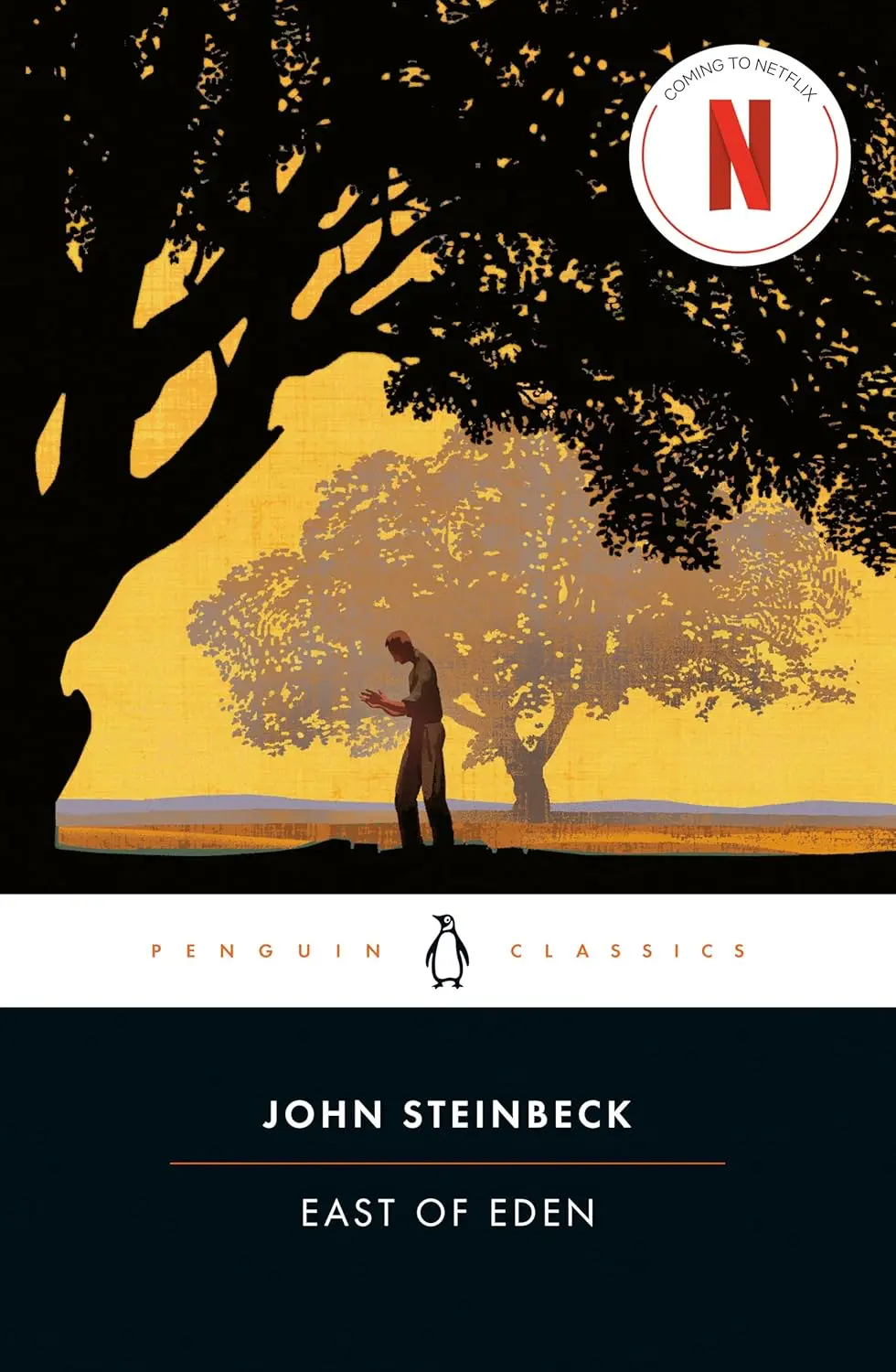
East of Eden is John Steinbeck’s retelling of the Book of Genesis, set in California’s Salinas Valley across two generations of two families: the Trasks and the Hamiltons. The Hamiltons are based on Steinbeck’s own family; the Trasks are fictional, and their story parallels the biblical narrative of Cain and Abel, played out twice across fathers and sons.
The book’s central idea is captured in the Hebrew word “timshel,” which Steinbeck translates as “thou mayest,” meaning that humans have the choice between good and evil and are not predestined to either. This idea runs through every major character’s arc. Adam Trask, his twin brother Charles, Adam’s sons Cal and Aron, and the enigmatic Cathy Ames (one of the most unsettling characters in American fiction) all face decisions about who they will become, and the novel tracks the consequences of those choices across decades.
Steinbeck’s prose is expansive and unhurried. He takes time to describe the Salinas Valley in detail, to digress into the Hamilton family’s daily life, and to let scenes develop at their own pace. The book is long, over 600 pages, and some readers find the pacing uneven. But the slower sections serve to ground the dramatic events in a sense of place and time that makes them feel real rather than allegorical.
The character of Lee, the Trask family’s Chinese American servant, is one of the book’s most compelling figures. He is the novel’s intellectual center, the person who introduces the “timshel” discussion and whose philosophical conversations with Adam and Samuel Hamilton are among the best passages in the book. Steinbeck uses Lee to challenge both his characters’ and his readers’ assumptions about intelligence, race, and the role of the outsider.
For founders and readers interested in questions about human nature, the book’s argument that everyone has the capacity for both good and evil, and that this capacity is what makes us human, is worth sitting with. Steinbeck called East of Eden the book he had been practicing to write for his entire career.
It reads well at any age but tends to hit differently depending on where you are in life. The parent-child dynamics and the questions about legacy and choice resonate more as you get older and start facing your own versions of the same decisions.
