
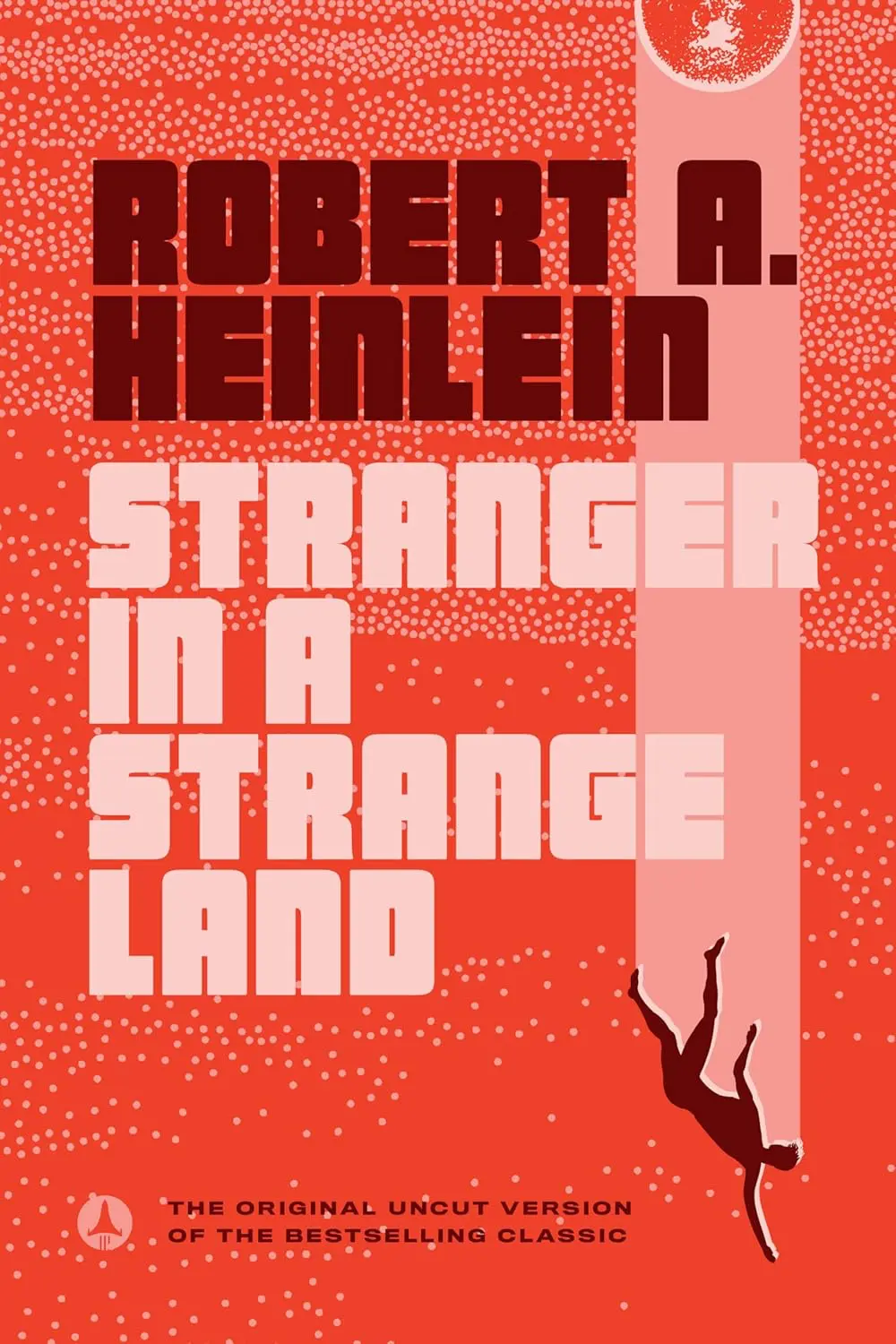
Stranger in a Strange Land follows Valentine Michael Smith, a human born during the first manned mission to Mars and raised by Martians after the rest of the crew died. When he is brought back to Earth as a young adult, he is physically human but psychologically alien, with no understanding of money, jealousy, clothing, or most other aspects of human culture.
The first half of the book is a satire of human institutions, seen through the eyes of someone encountering them for the first time. Smith’s confusion about property, religion, government, and social norms allows Heinlein to critique each one. The second half shifts as Smith begins to understand human culture and starts a movement, part religion, part commune, built around Martian ideas of shared consciousness and communal living.
The book was published in 1961 and became a major influence on the 1960s counterculture. The word “grok,” which Smith uses to describe a deep, intuitive understanding of something, entered the English language and is still used in tech culture today. The communal living and free love aspects of Smith’s movement resonated with the era’s social experiments.
Heinlein’s writing is provocative and deliberately uncomfortable at times. He pushes ideas about sexuality, religion, and social organization that some readers will find liberating and others will find dated or offensive. The book does not age evenly; some sections feel ahead of their time while others reflect the biases of the early 1960s.
For founders, the book’s most lasting contribution is cultural. The concept of “groking” something, understanding it so completely that you merge with it, has become shorthand in technology circles for deep comprehension. Beyond that, Smith’s outsider perspective on human institutions is a useful thought exercise for anyone trying to see familiar systems with fresh eyes.
The book exists in two versions: the original 1961 edition and an uncut edition published posthumously in 1991 that restores about 60,000 words. Both are available, and opinions differ on which is better. The original is tighter; the uncut version has more character development.
