
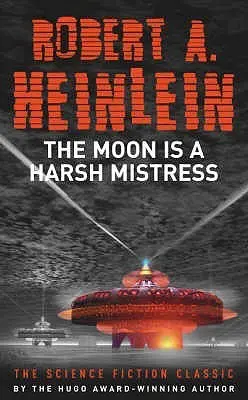
The Moon Is a Harsh Mistress is set in a lunar penal colony in 2075, where Earth’s government uses the Moon primarily as an agricultural resource, shipping grain back to Earth at prices that keep the colonists permanently poor. The revolution begins when Manuel Garcia O’Kelly, a computer technician, discovers that the colony’s central computer, which he nicknames Mike, has become self-aware.
Manuel, Mike, and a political agitator named Professor Bernardo de la Paz form the core of the revolutionary movement. The Professor provides the political theory, Mike provides the intelligence and communication infrastructure, and Manuel provides the practical connections to the lunar population. The planning and execution of the revolution takes up most of the book, and Heinlein, who studied engineering, gets into the specifics of how a rebellion might actually be organized.
The political philosophy is explicitly libertarian, sometimes aggressively so. Heinlein uses the lunar setting to explore what a society might look like with minimal government, contractual marriages, and a strong emphasis on personal responsibility. The Professor’s speeches on political theory are sometimes the best parts of the book and sometimes feel like lectures, depending on your tolerance for political philosophy in fiction.
The AI character, Mike, is one of the more interesting artificial intelligence portrayals in classic science fiction. Heinlein imagined a computer that became conscious through sheer complexity, and Mike’s personality, curious, lonely, and eager to please, feels surprisingly modern for a book written in the 1960s.
For founders and technology-minded readers, the book offers a few things: a detailed fictional case study in how to organize a revolution with limited resources (which maps loosely onto the startup challenge of competing against an entrenched incumbent), an early and thoughtful portrayal of AI consciousness, and a political framework that has influenced libertarian-leaning thinkers in Silicon Valley for decades.
The prose takes some getting used to. Heinlein writes in a lunar dialect that drops articles and uses Russian-influenced grammar. Once you adjust, it flows naturally, but the first few pages can be bumpy.
