
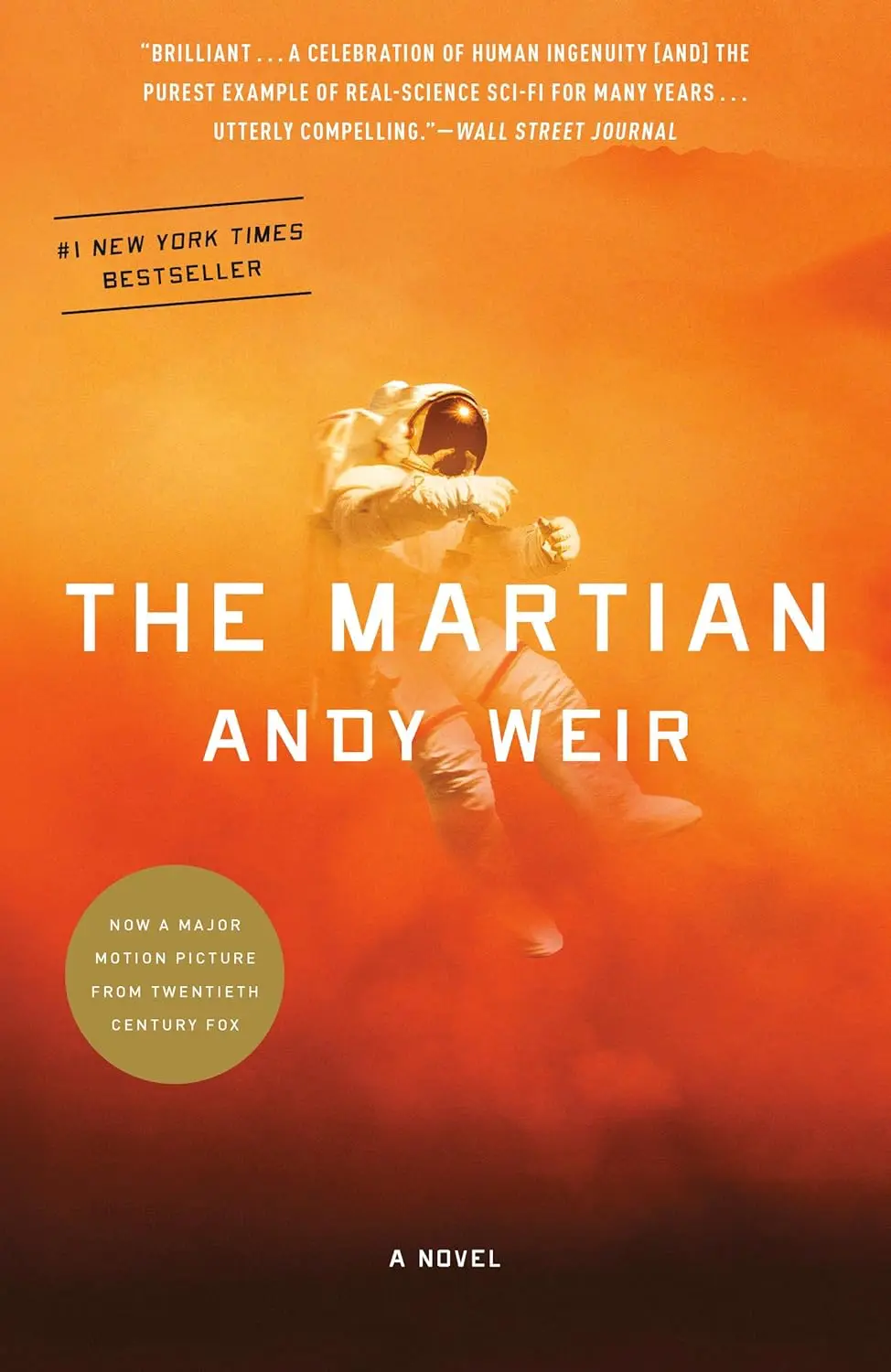
The Martian is Andy Weir’s debut novel, originally self-published as a serial on his website before becoming a bestseller and a Ridley Scott film. The premise is simple: astronaut Mark Watney is left for dead on Mars after a storm forces his crew to evacuate, and he has to survive alone until a rescue mission can reach him, which will take years.
What makes the book unusual is its approach to survival fiction. Watney is not a brooding, existential character. He is a practical, funny engineer who treats each life-threatening problem as a puzzle to solve. He figures out how to grow potatoes in Martian soil using his own waste as fertilizer. He calculates how many calories he needs per day and works backward to determine how long his food supply will last. When things break, which they do constantly, he fixes them with whatever materials are available.
Weir researched the science obsessively. The orbital mechanics, atmospheric chemistry, botany, and engineering in the book are accurate enough that NASA scientists have praised it. The story is structured as a series of escalating problems and solutions, which gives it the pace of a thriller even though much of the action involves math and duct tape.
The voice is the other big draw. Watney narrates most of the story through mission logs, and his tone is consistently witty and self-deprecating. He cracks jokes while calculating whether he has enough oxygen to survive the week. This keeps the book from becoming grim despite the extreme circumstances.
For founders, the book resonates because it is fundamentally about resourcefulness under constraint. Watney can’t order supplies or call for help. He has to work with what he has, adapt when plans fail, and keep his morale up through sheer stubbornness. That maps onto the early-startup experience more directly than most business books manage.
The writing is lean and moves fast. Some readers find the constant technical problem-solving repetitive after a while, and the sections back on Earth are weaker than the Mars sequences. But as a story about creative problem-solving under pressure, it is hard to beat.
