
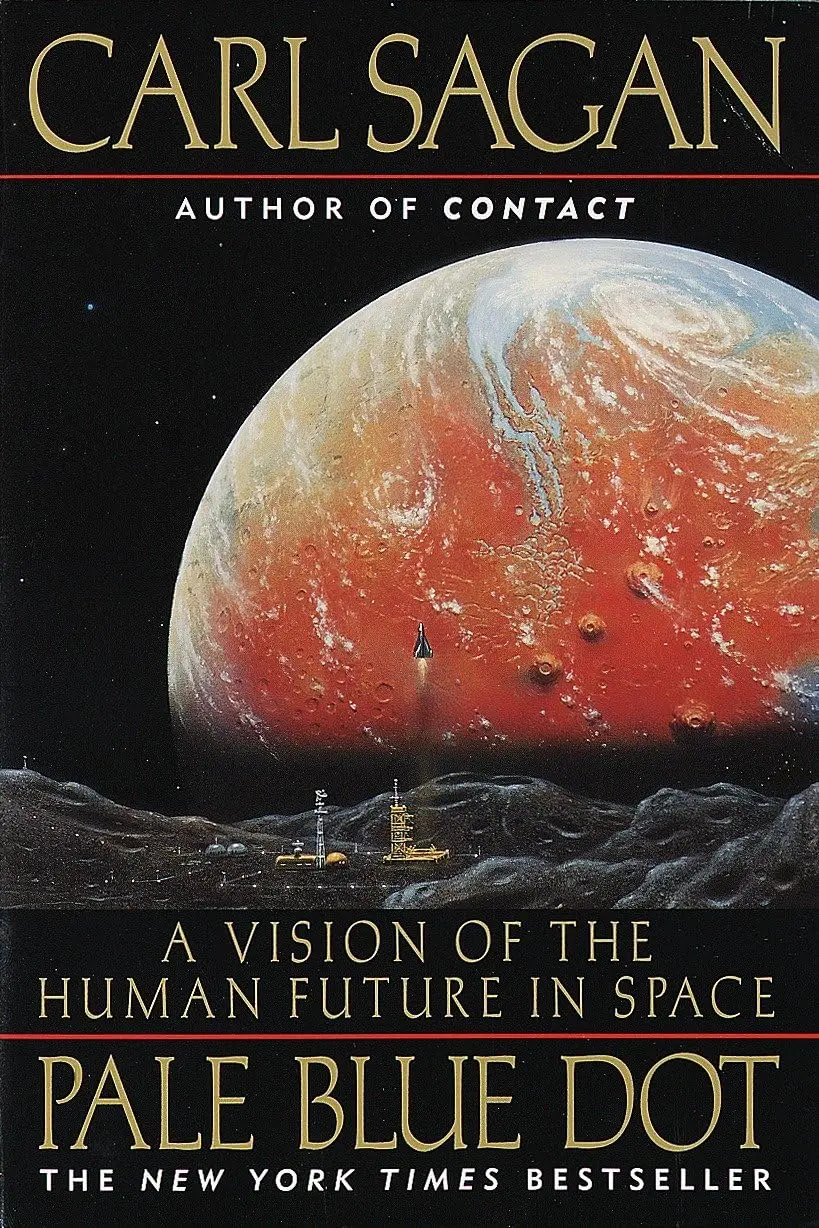
Pale Blue Dot takes its title from a photograph taken by Voyager 1 in 1990, at Sagan’s request, as the spacecraft was leaving the solar system. The image shows Earth as a tiny speck, less than a pixel, suspended in a beam of sunlight. Sagan uses this image as the starting point for a book about why space exploration matters and where it might take us.
The book covers the history of planetary exploration, from early observations of Mars and Venus through the Voyager missions and the early plans for Mars rovers. Sagan explains what we’ve learned about each planet in the solar system and why those discoveries matter, not just scientifically but for understanding Earth’s own fragility.
The philosophical core of the book is Sagan’s argument that seeing Earth from space changes how you think about everything. National borders disappear. Political conflicts look absurd. The environmental vulnerability of the planet becomes visceral rather than abstract. Sagan uses this perspective to argue for both better stewardship of Earth and more aggressive investment in space exploration and colonization.
The later chapters lay out a practical vision for human expansion into the solar system, covering lunar bases, Mars colonization, asteroid mining, and eventually interstellar travel. Some of these proposals have moved closer to reality since the book’s publication in 1994, while others remain speculative. Sagan is honest about the timescales involved, acknowledging that many of these projects are generational rather than immediate.
For founders and technologically minded readers, the book connects daily ambition to a much larger timescale. Sagan’s argument that human survival depends on expanding beyond one planet has influenced a generation of technology leaders, including several who have explicitly cited it as motivation for their space-related ventures.
The writing is classic Sagan: scientifically careful, philosophically expansive, and emotionally honest. The opening passage about the pale blue dot photograph is some of the best science writing of the 20th century.
