
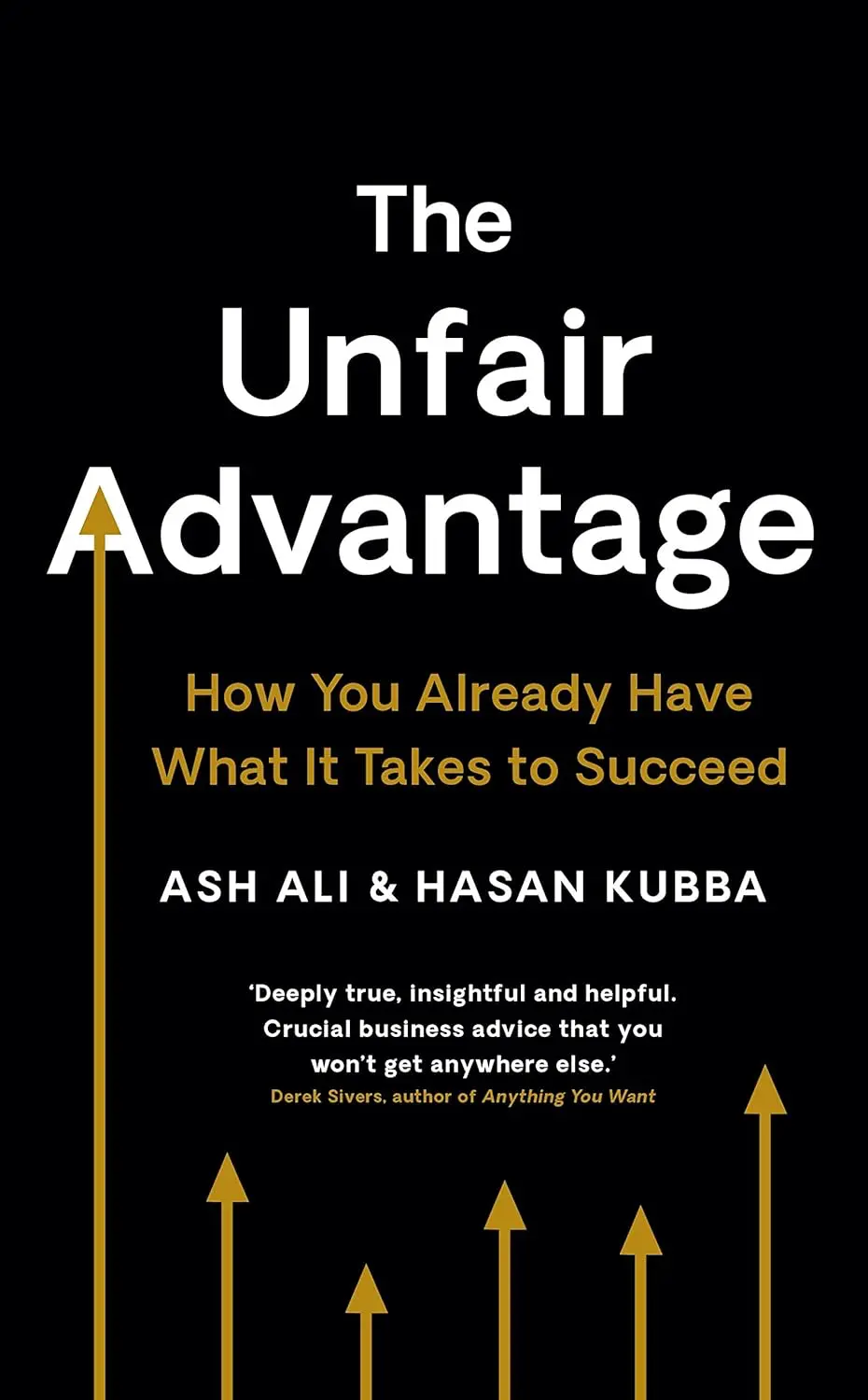
The Unfair Advantage is Ash Ali and Hasan Kubba’s honest take on what actually gives entrepreneurs an edge. Their argument is that the startup world’s obsession with hustle and hard work ignores the reality that everyone starts from a different position, and that the founders who succeed tend to be the ones who recognize and exploit the specific advantages they already have.
The book introduces the MILES framework, which breaks advantages into five categories: Money (access to capital or financial runway), Intelligence and Insight (not just IQ but pattern recognition and market understanding), Location and Luck (being in the right place or right network), Education and Expertise (specific knowledge or credentials), and Status (personal brand, social proof, and connections). The authors argue that you probably have at least one or two of these, and your strategy should be built around the ones you actually possess rather than copying someone else’s playbook.
What makes the book stand out from typical startup advice is its honesty about privilege and circumstance. Ali and Kubba don’t pretend that the playing field is flat, and they don’t sell the idea that sheer willpower is enough to overcome any disadvantage. At the same time, they avoid being defeatist. The point is not that some people can’t succeed, but that success strategies need to be personalized to your actual situation.
The profiles of founders throughout the book are well chosen. They cover people from wildly different backgrounds, from wealthy Silicon Valley founders to bootstrappers in developing countries, and show how each identified and leveraged their particular combination of advantages.
For founders, the practical value is in the self-assessment. Instead of asking “what should I build?” the book asks “what advantages do I actually have, and how can I build something that makes the most of them?” That reframing is more useful than most generic startup advice.
The writing is conversational and easy to follow. Some readers will find the MILES framework somewhat simplistic, and the book occasionally repeats its core points more than necessary. But as a tool for honest self-assessment before starting a company, it fills a gap that most entrepreneurship books ignore.
