
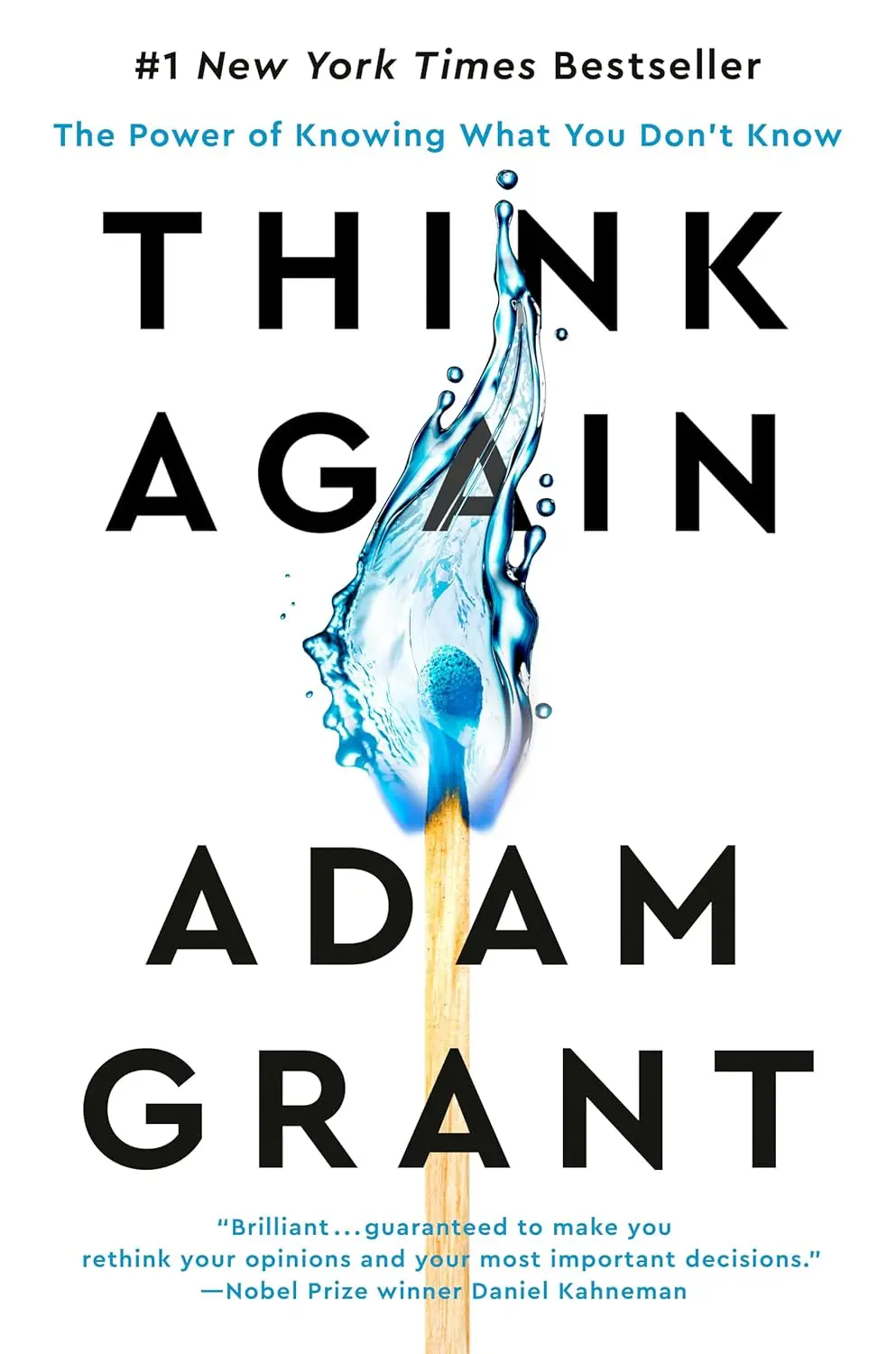
Think Again is Adam Grant’s book about intellectual humility, specifically the willingness to question your own assumptions, update your beliefs when the evidence changes, and resist the temptation to treat your opinions as part of your identity.
Grant organizes the book around three levels: individual rethinking, interpersonal rethinking (how to open other people’s minds), and collective rethinking (how to build learning cultures). The individual section covers why we get stuck in old beliefs, what he calls “thinking like a preacher, prosecutor, or politician” instead of thinking like a scientist who tests hypotheses. The interpersonal section covers the art of persuasive disagreement, including why asking genuine questions is more effective than presenting arguments. The collective section addresses how organizations can avoid groupthink and encourage dissent.
Some of the research is memorable. Grant profiles a superforecaster who beats experts by constantly updating his predictions based on new data. He tells the story of a Black musician who convinced over 200 white supremacists to leave the KKK by listening to them rather than arguing. He covers how NASA’s failure to rethink its assumptions contributed to the Challenger disaster.
For founders, the book is directly relevant because one of the biggest risks in building a company is falling in love with your original idea and refusing to update it when the market tells you something different. Grant’s framework for how to disagree productively is useful for co-founder relationships, board conversations, and team discussions where people have strong opinions.
The writing is vintage Grant: research-heavy but accessible, organized around compelling stories, with practical takeaways at the end of each chapter. The book can feel somewhat repetitive if you read it straight through, since the central message, stay open, question your assumptions, is reinforced from many angles. But any single chapter works well on its own.
