
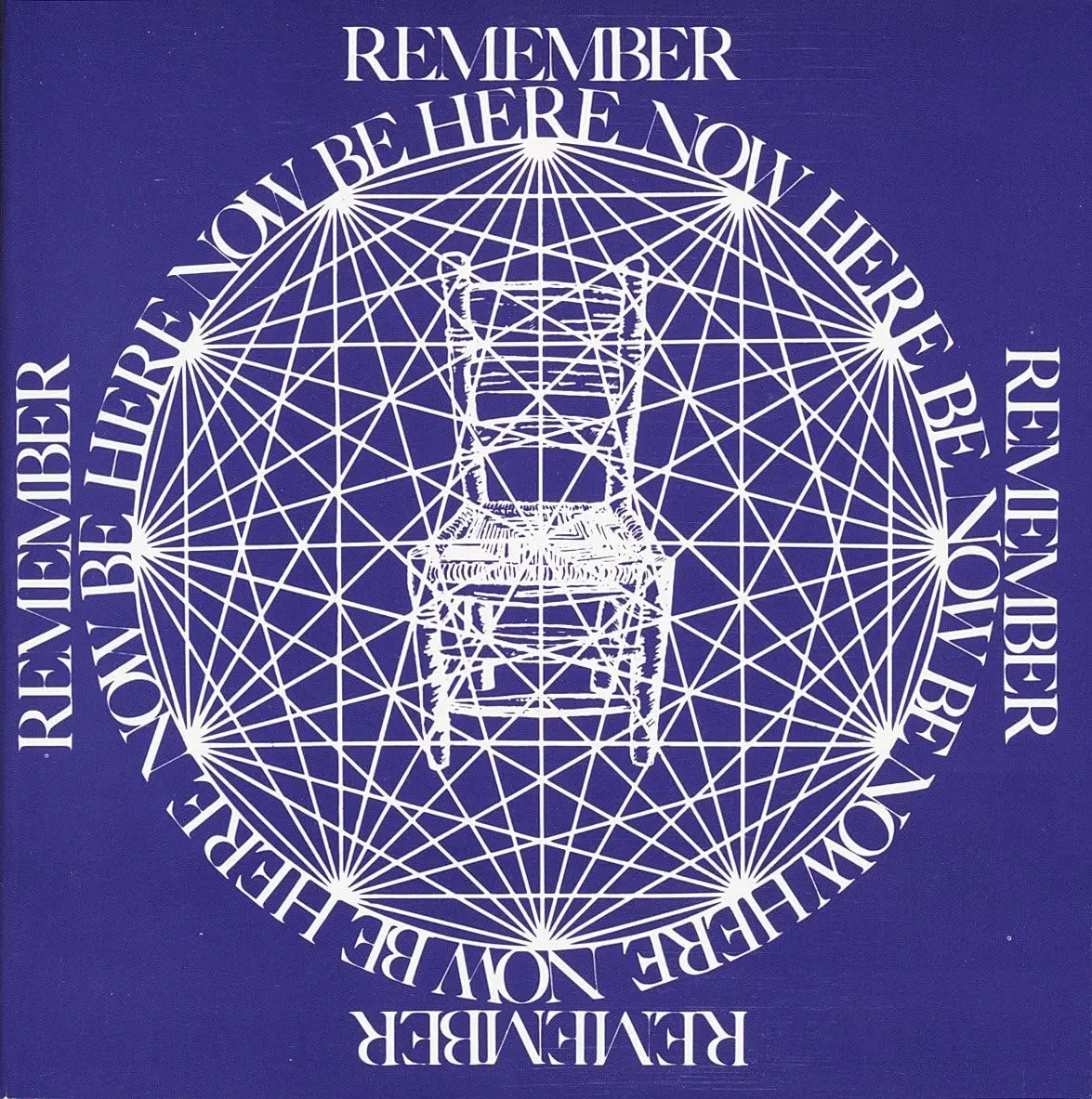
Be Here Now is divided into three sections, each with a completely different format. The first section, printed in brown ink on brown paper, is Ram Dass’s autobiography: how Richard Alpert, a successful Harvard psychology professor, experimented with LSD with Timothy Leary, got fired, traveled to India, met his guru Neem Karoli Baba, and experienced a shift in consciousness that changed the direction of his life.
The second section is a visual and textual collage. Pages are filled with hand-lettered aphorisms, illustrations from Hindu and Buddhist traditions, and instructions for spiritual practice. The typography is unconventional, with words spiraling across pages and mixing with images. This section is intended less as reading material and more as an experiential object.
The third section is a practical manual for spiritual practice: meditation techniques, yoga postures, dietary advice, mantras, and suggestions for integrating spiritual awareness into daily life.
The book sold over two million copies and became one of the defining texts of the 1960s counterculture. Its influence on Silicon Valley came through Steve Jobs, who read it as a young man and later traveled to India partly inspired by Ram Dass’s journey.
For business readers, the book is an outlier on any reading list. Its relevance is not in specific techniques but in the underlying question: is there more to life than achievement, status, and accumulation? Founders who burn out, who achieve their goals and feel empty, or who sense that something is missing despite external success sometimes find their way to this book.
The reading experience is unlike any other book on this list. It cannot be skimmed. The visual sections demand a different kind of attention than text. The spiritual framework may or may not resonate, depending on your disposition.
At about 420 pages (though many are visual rather than text), the book is physically large. It is more of an artifact than a conventional read. Either it connects with you or it does not, and there is no way to know which without opening it.
