
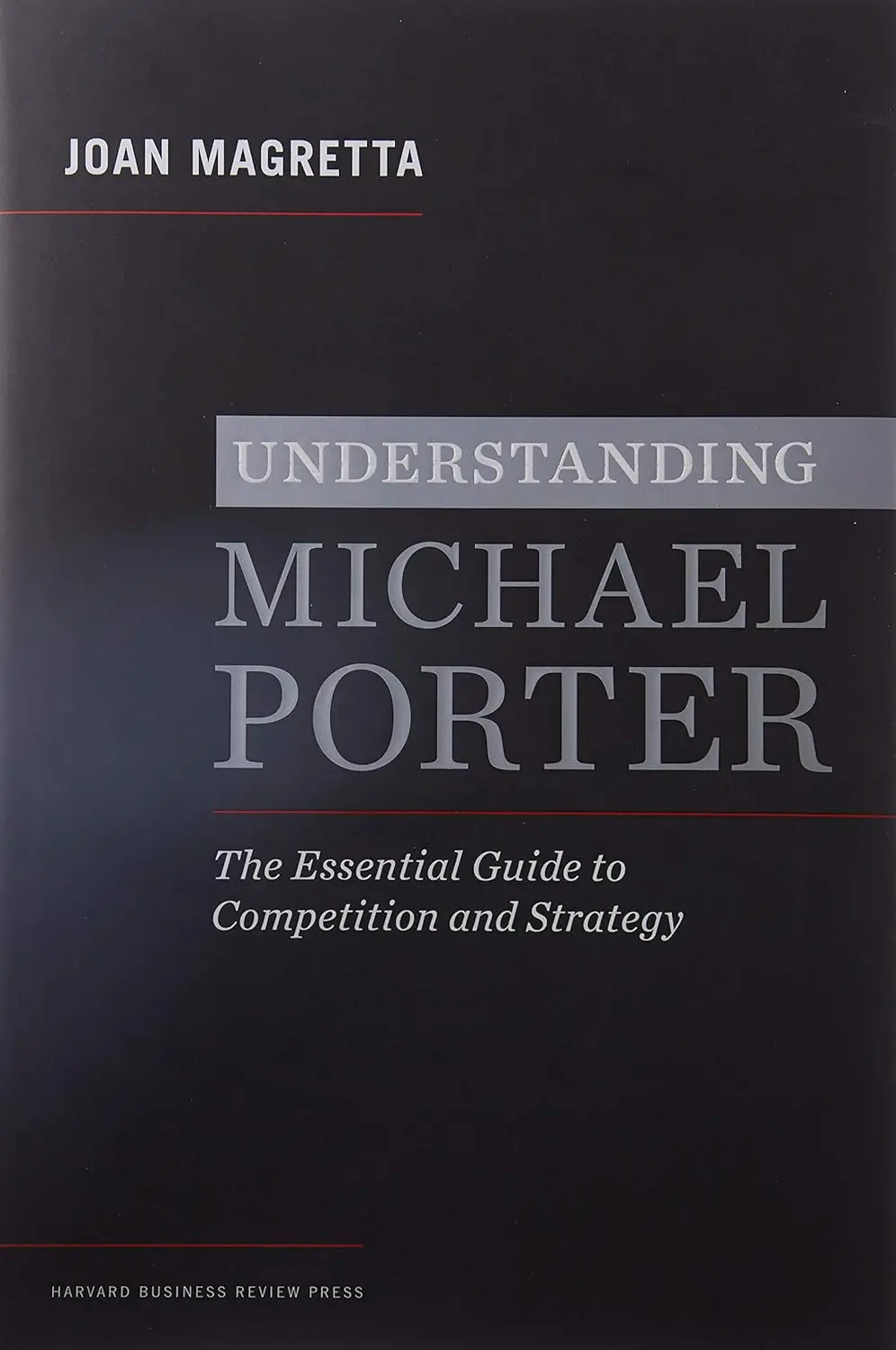
Michael Porter is probably the most influential strategy thinker in business academia, but his original works (Competitive Strategy, Competitive Advantage) are dense academic texts that most practitioners never finish. Magretta wrote this book as a clear, compressed guide to Porter’s ideas for people who want the frameworks without the 500-page textbook treatment.
The book covers Porter’s major concepts. The Five Forces framework analyzes the competitive dynamics of an industry: the threat of new entrants, the bargaining power of suppliers, the bargaining power of buyers, the threat of substitutes, and rivalry among existing competitors. Together, these forces determine how profitable an industry is and where the power lies.
Competitive advantage means performing different activities from rivals or performing the same activities differently. Porter distinguishes this from operational effectiveness (doing the same things better), which he argues is necessary but not sufficient for sustained competitive advantage. If your competitors can copy your improvements, operational effectiveness creates a race to the bottom, not a lasting edge.
The value chain analysis breaks a company into primary activities (inbound logistics, operations, outbound logistics, marketing, service) and support activities (infrastructure, HR, technology, procurement) to identify where value is created and where it leaks. This disaggregation helps you see which parts of your business drive profitability and which are commoditized.
Magretta writes clearly and uses examples that make the abstract frameworks concrete. She also addresses common misunderstandings of Porter’s work, including the assumption that strategy is about beating competitors (Porter argues it is about creating unique value) and that being the biggest player always wins (Porter shows that focused competitors often outperform broad ones).
For founders, Porter’s frameworks provide a structured way to think about your market, your competition, and your positioning. The five forces analysis in particular is a useful exercise before entering a market or raising capital.
At about 240 pages, the book is concise. It is the fastest way to get Porter’s core ideas without reading his original academic work.
