
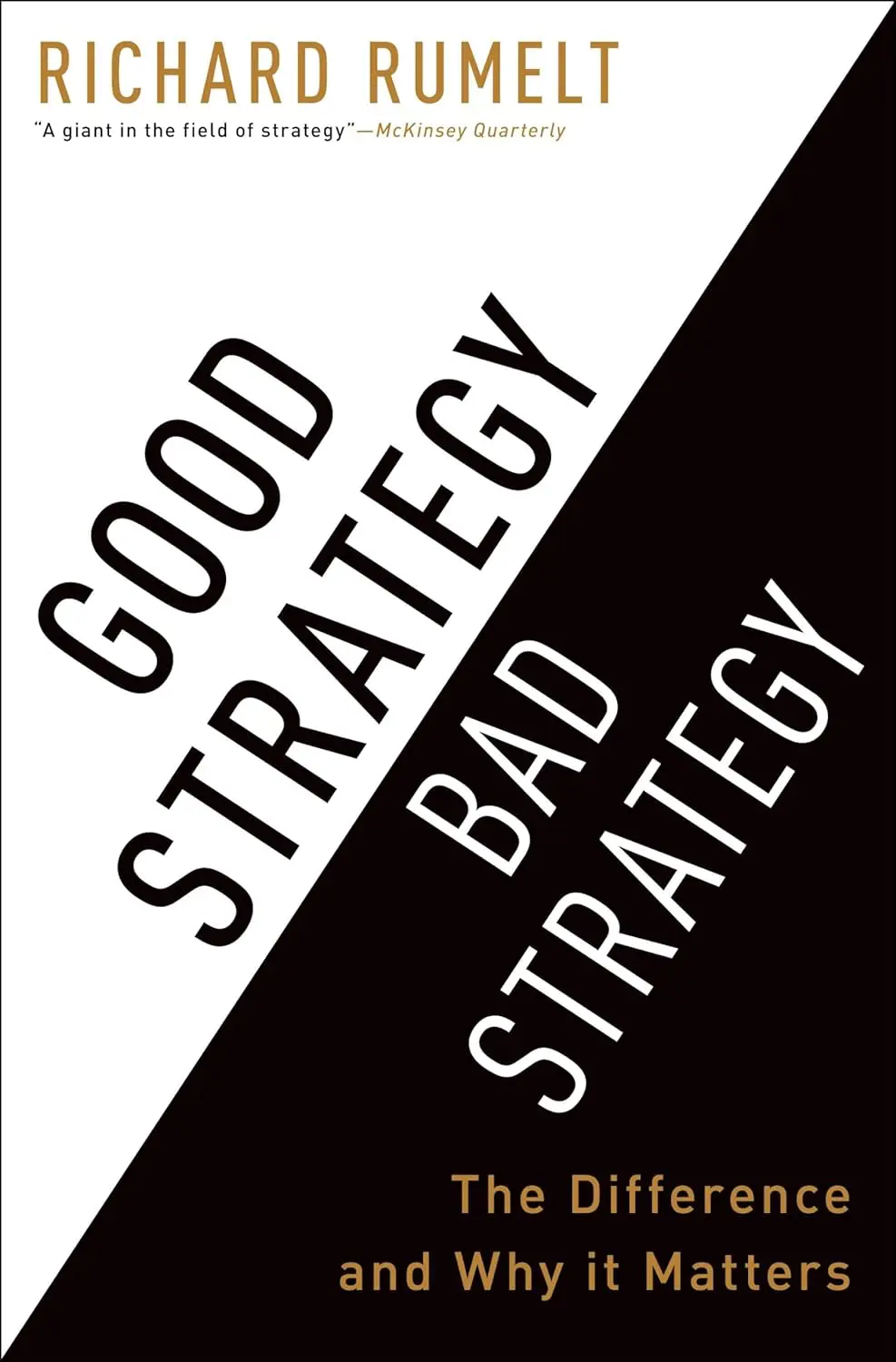
Rumelt opens with a provocation: most strategy documents he has seen during decades of consulting and teaching are not strategies. They are lists of goals and aspirations dressed up with mission statements and ambitious targets. “We will be the market leader in customer satisfaction” is not a strategy. It is a wish. A strategy requires explaining how you will get there and, more importantly, what you will not do.
Rumelt defines good strategy as having three elements. A diagnosis: a clear, honest assessment of the challenge you face. A guiding policy: an overall approach for dealing with that challenge. Coherent actions: specific, coordinated steps that implement the guiding policy. Each element depends on the one before it, and skipping the diagnosis (as most companies do) makes the rest meaningless.
Bad strategy, by Rumelt’s definition, has four hallmarks. Fluff: superficial restatement of the obvious disguised with buzzwords. Failure to face the problem: refusing to identify the actual challenge. Mistaking goals for strategy: stating what you want to achieve without saying how. Bad strategic objectives: objectives that are either unattainable or fail to address the real problem.
The book draws on examples from military history (the kernel of strategy concept), corporate strategy (Apple’s turnaround under Jobs, Nvidia’s focus on graphics processing), and geopolitics. Rumelt is an experienced teacher, and the examples are well-chosen to illustrate specific points.
For founders, the most useful section is on focus. Rumelt argues that good strategy concentrates resources on a few critical objectives rather than spreading them across many. This is not a new idea, but Rumelt explains why it is so hard to execute: saying no to reasonable opportunities feels wrong, and the political cost of focus (telling people their pet project is cut) is real.
At about 320 pages, the book is clearly written and well-organized. Rumelt is direct without being dogmatic. The first half (diagnosing bad strategy) is often considered more useful than the second half (creating good strategy), but both are worth reading.
