
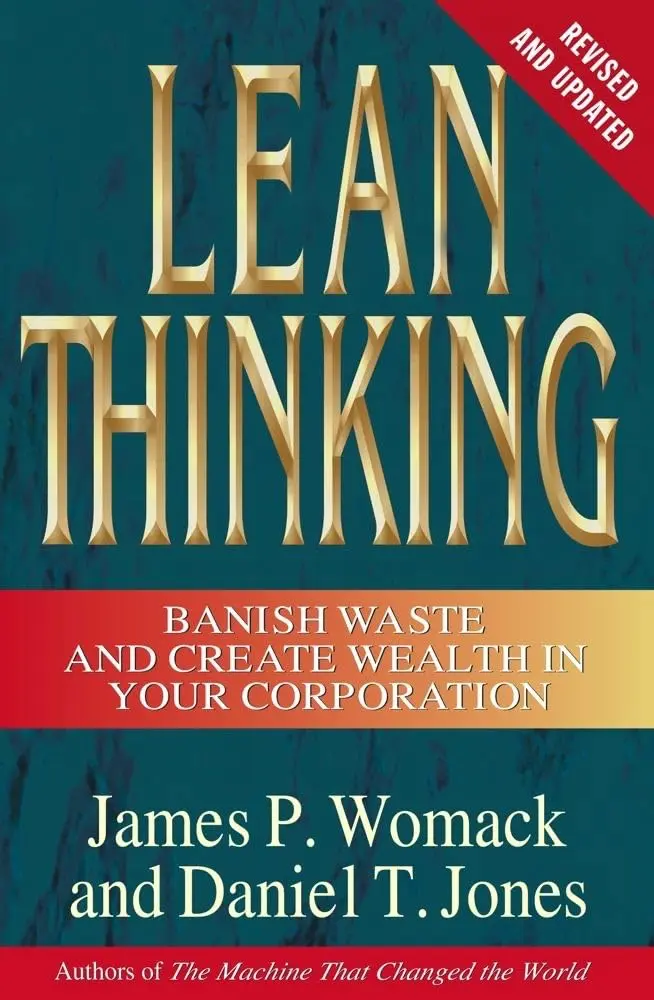
Womack and Jones wrote The Machine That Changed the World in 1990, which introduced lean manufacturing to a Western audience. Lean Thinking, published in 1996, took the next step: showing how lean principles apply beyond the factory floor to services, healthcare, government, and any process where work flows through steps.
The five principles form a sequence. First, specify value from the customer’s perspective (not what you think is valuable, but what the customer actually pays for). Second, identify the value stream (every step from raw material to finished product, then eliminate steps that do not add value). Third, make the remaining steps flow without interruption (eliminate batching, queuing, and waiting). Fourth, establish pull (produce only what customers have actually ordered, not what you forecast they will want). Fifth, pursue perfection (continuous improvement, because every process still contains waste).
The book uses case studies from manufacturing (Toyota, Pratt & Whitney), retail (Tesco), and service businesses to show how these principles work in practice. The before-and-after comparisons are striking: companies that applied lean thinking typically reduced lead times by 50-90%, reduced defects by similar percentages, and increased capacity without adding people or equipment.
The writing is clear and the examples are specific enough to learn from. Womack and Jones are academics who write for practitioners, which means they explain the theory briefly and spend most of their time on application.
For founders, lean thinking is directly applicable to product development, customer support, and operations. Most startup processes contain enormous amounts of waste: features nobody uses, meetings that produce no decisions, handoffs that introduce errors, and wait times that slow everything down. The five principles provide a systematic way to identify and remove this waste.
Jeff Bezos has cited lean principles. At about 400 pages, the book is comprehensive. The second edition includes updated case studies and reflections on how the field has evolved since the original publication.
