
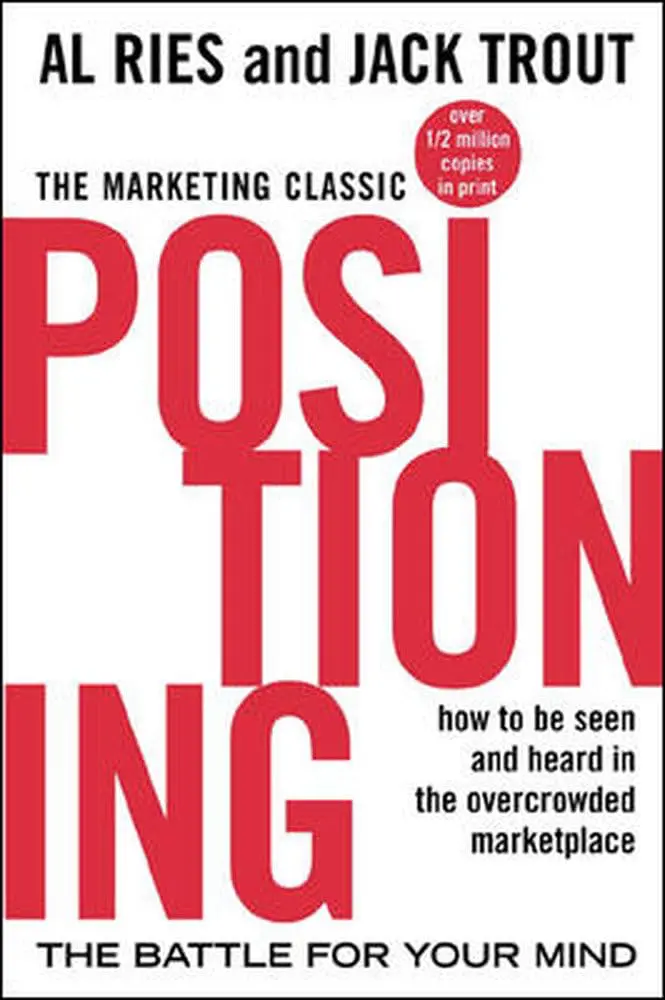
Ries and Trout’s central claim is that the human mind handles information overload by simplifying. People create mental categories and assign one or two brands to each category. The first brand to occupy a position in the mind is very difficult to dislodge. Hertz means rental cars. Coke means cola. Xerox means copiers. Once a position is taken, competitors are better off finding a new position than trying to take the existing one.
The book covers several principles. Be first in the category (if you cannot be first, create a new category where you can be). Own a word in the prospect’s mind (Volvo owns “safety,” FedEx owns “overnight”). Do not try to be everything to everyone (line extensions that dilute a brand’s position usually fail). Repositioning a competitor (changing how customers think about the alternative) is often easier than positioning yourself directly.
Ries and Trout wrote the book in 1981, and some of the examples are dated (they spend a lot of time on companies and products that no longer exist). But the underlying principles about how the mind categorizes brands have held up well. Modern brand strategy still uses the language they introduced.
The writing is clear and direct. Each chapter makes one point and illustrates it with examples. At about 210 pages, the book is short. Ries and Trout were advertising professionals, and they write like people who understand that attention is scarce.
For founders, positioning is one of the most important and least understood aspects of building a company. Your product can be excellent, but if it occupies the wrong position in customers’ minds (or no position at all), it will not sell. The concepts in this book directly apply to naming, messaging, landing pages, and pitch decks.
Various marketers and founders have recommended it as foundational reading. The 20th anniversary edition includes commentary and updated examples. It reads best as a companion to Obviously Awesome, which provides a more step-by-step process for the same problem.
