
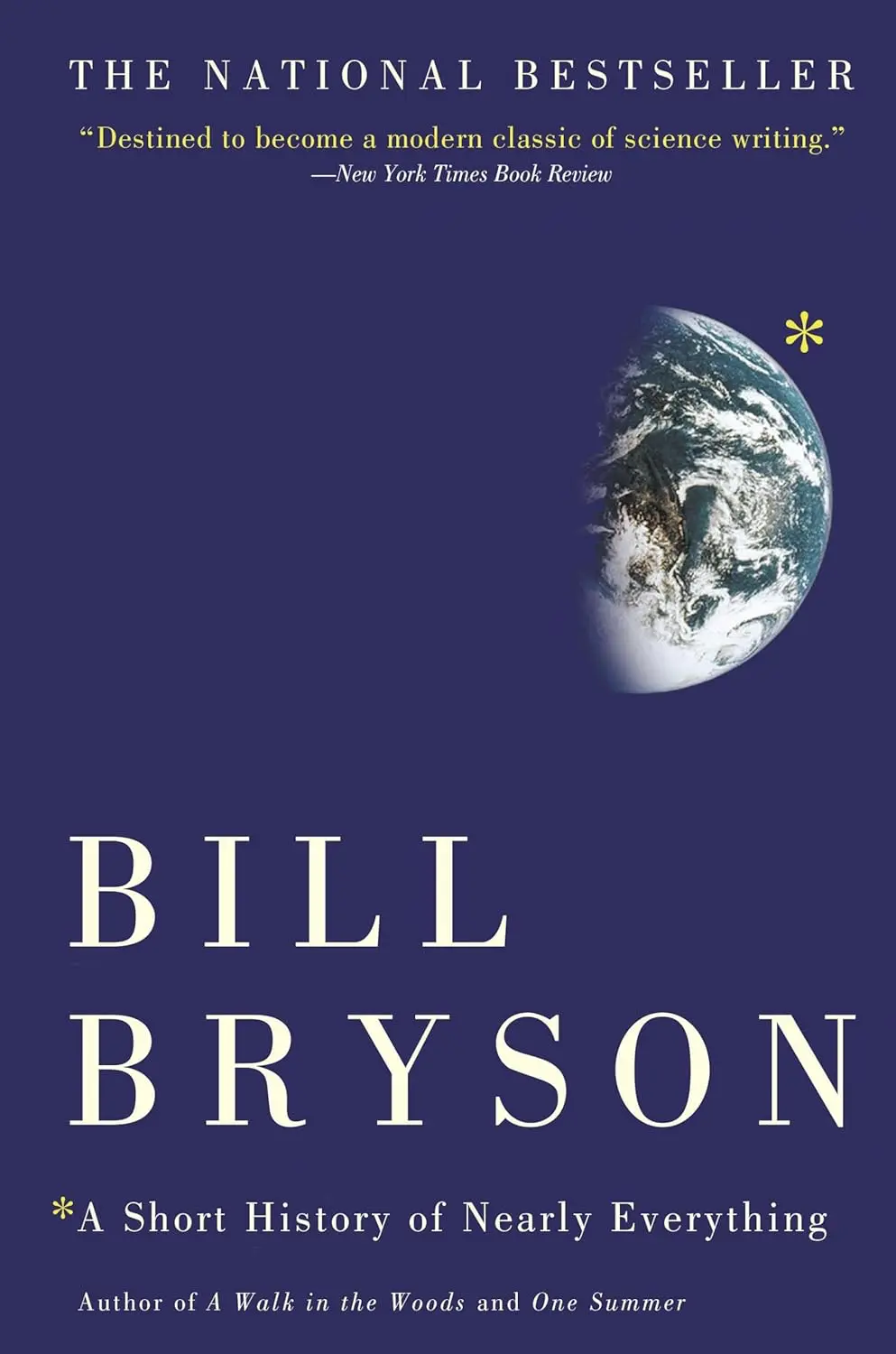
Bryson was motivated by a simple frustration: science textbooks are boring, and most people leave school knowing very little about how the universe works. He spent three years reading, interviewing scientists, and visiting labs to write a book that would explain the major discoveries in science in a way that was actually enjoyable to read.
The book covers an enormous range: the Big Bang, the formation of the solar system, plate tectonics, evolution, the atom, quantum mechanics, relativity, the discovery of cells, genetics, and the emergence of humans. Each topic gets a chapter or two, organized roughly by scale (from the very large to the very small) and by chronology within each topic.
What makes the book work is Bryson’s focus on the people behind the discoveries. Scientists are presented not as abstract geniuses but as eccentric, competitive, sometimes petty humans who happened to figure something out. Henry Cavendish, who weighed the Earth, was so shy he communicated with his servants by notes. Mary Anning, who discovered some of the most important fossils in history, was a working-class woman who never received academic credit. The stories make the science stick.
Bryson is also good at conveying scale. The distances between planets, the age of the Earth, the number of atoms in a human body: these numbers are easy to type but hard to comprehend. Bryson uses analogies that make them feel real.
For business readers, the book is not directly applicable to building a company. But it provides the kind of broad scientific literacy that helps you understand the world you are operating in. Many founders have cited general curiosity about how things work as a source of ideas and competitive advantage.
Bill Gates has recommended it. At about 540 pages, the book is long but reads fast because Bryson’s writing is conversational and funny. It is one of the best-selling science books ever written, and it works as both an education and an entertainment.
