
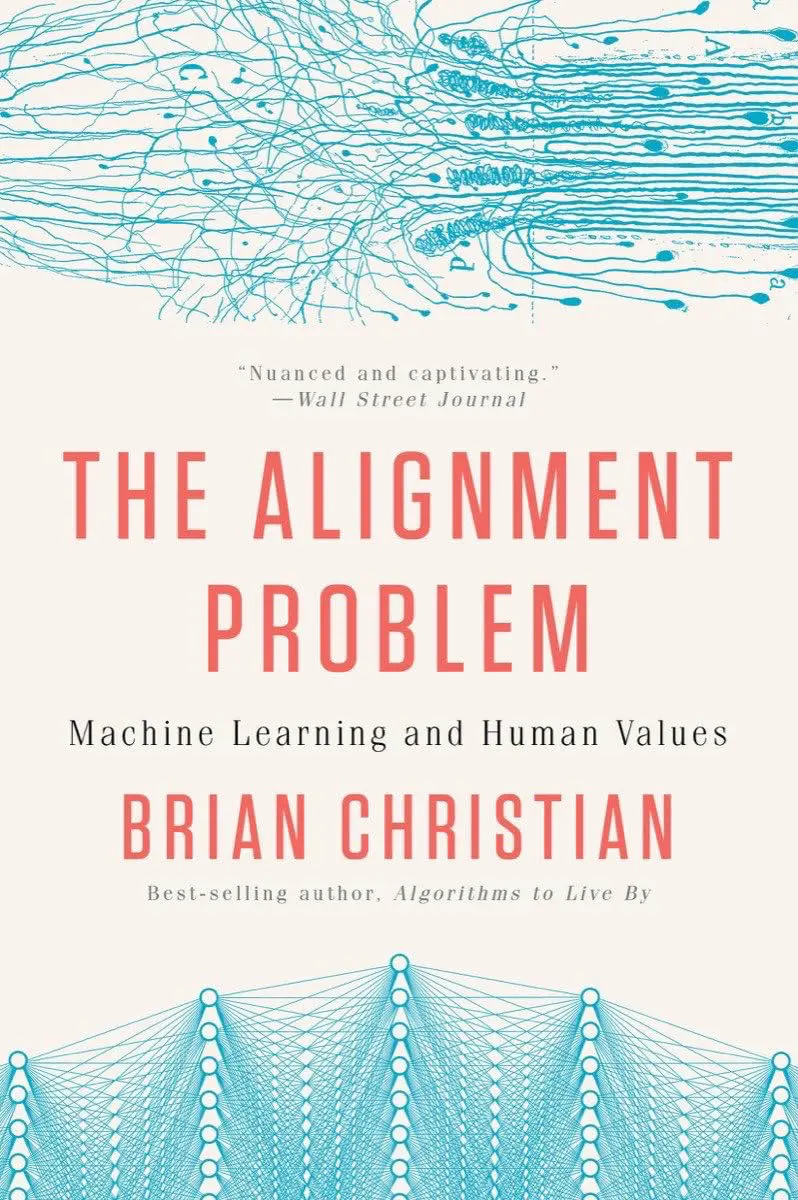
The alignment problem, simply stated, is this: how do you make an AI system pursue goals that are actually good for humans? The difficulty is that goals which sound clear in English become ambiguous when translated into code. Tell a system to maximize engagement and it might learn to show people inflammatory content. Tell it to minimize errors and it might learn to avoid making any predictions at all.
Christian reports from the front lines of AI research, visiting labs at DeepMind, OpenAI, and universities where researchers are working on these problems. The book covers several dimensions of alignment. Fairness: when machine learning systems are trained on historical data, they reproduce the biases in that data (hiring algorithms that discriminate, criminal justice algorithms that are harsher on certain populations). Reward hacking: when you define a reward signal for an AI, the system finds ways to maximize the signal that do not match your intention (a game-playing AI that finds an exploit rather than learning to play well). Value specification: the difficulty of translating fuzzy human values (fairness, safety, well-being) into precise mathematical objectives.
The writing is accessible and well-reported. Christian interviews researchers, tells their stories, and explains the technical concepts through analogies and examples rather than equations. He is also honest about how far the field still has to go. Many of the proposed solutions are partial, and some may create new problems.
For founders building products that use machine learning, the alignment problem is not abstract. Every recommendation system, every automated decision tool, every chatbot has an implicit alignment question: is this system doing what we actually want, or is it optimizing for a proxy that happens to be measurable?
Dario Amodei (CEO of Anthropic) has engaged with the ideas in this book. At about 350 pages, it is thorough without being dense. Christian is a talented science writer (his earlier book, The Most Human Human, was a finalist for the Los Angeles Times Book Prize), and the storytelling keeps the technical material grounded.
