
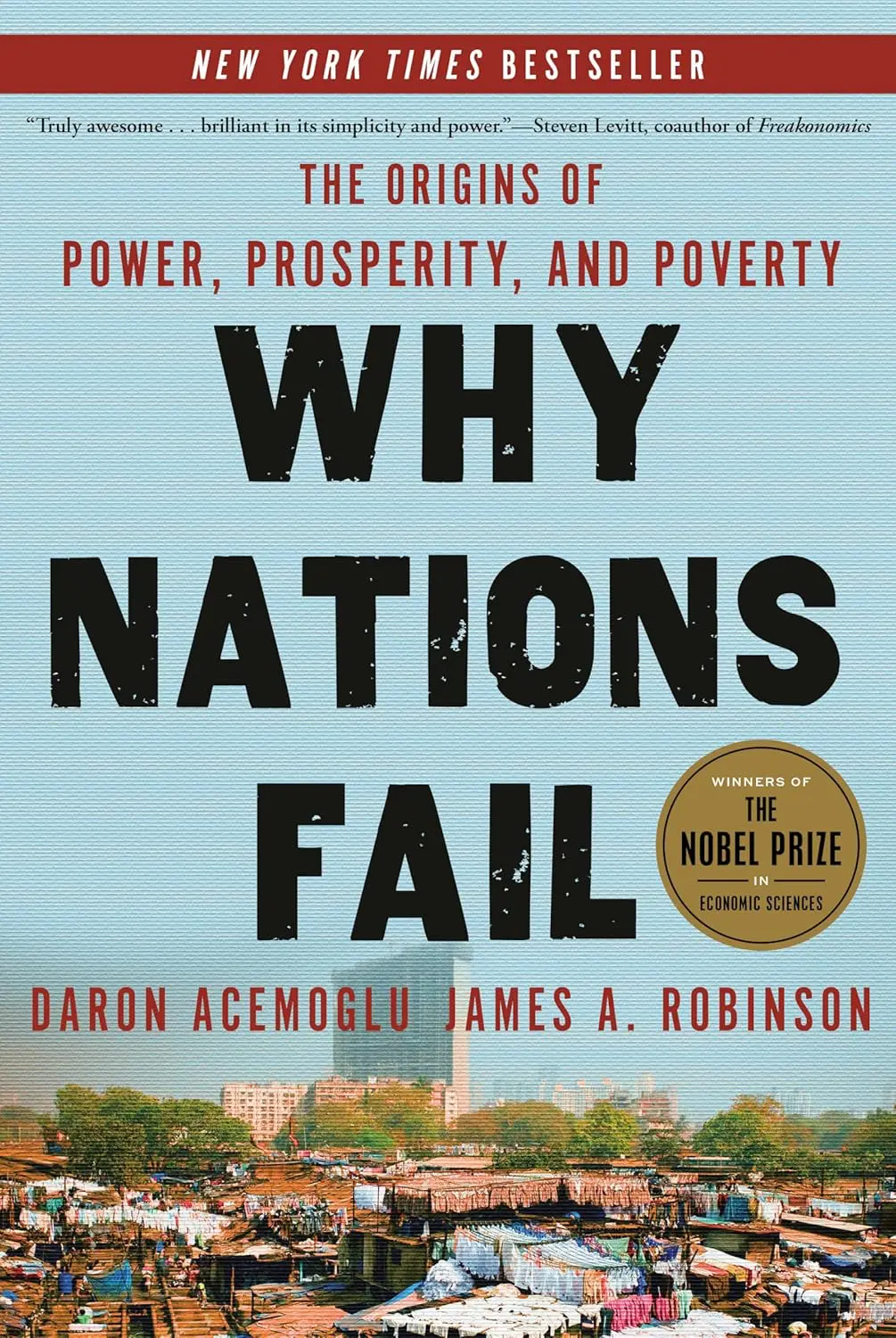
The book’s central argument is straightforward: nations succeed when their political and economic institutions are inclusive (allowing broad participation in economic activity and political decision-making) and fail when those institutions are extractive (concentrating power and wealth in the hands of a small elite).
Acemoglu and Robinson illustrate this with comparative case studies. Why is Nogales, Arizona, prosperous while Nogales, Mexico, just across the border, is not? Same geography, same culture, same people. Different institutions. Why did England industrialize while Spain did not? Not because the English were smarter, but because England’s political institutions (constrained monarchy, property rights, rule of law) rewarded innovation, while Spain’s extractive institutions rewarded rent-seeking.
The book covers historical examples spanning centuries and continents. The Roman Empire, the Mayan civilization, the Soviet Union, colonial Africa, and contemporary China all appear as case studies. The authors trace how specific institutional choices, some made centuries ago, create path dependencies that persist today.
The “inclusive vs. extractive” framework is powerful because it is simple and explains a lot. But critics have noted that it may be too simple. Some extractive regimes (China being the obvious example) have produced rapid economic growth, at least in the short term. The authors address this by arguing that extractive growth is inherently limited and eventually collapses, but the counterexamples complicate the theory.
For founders, the institutional lens is useful for thinking about markets. Countries with strong rule of law, property rights protection, and competitive markets are better environments for building businesses than those without, regardless of other factors. Understanding why some markets are dysfunctional helps you avoid building in environments where the deck is structurally stacked against you.
Mark Zuckerberg and Bill Gates have recommended it. At about 530 pages, the book is long. The historical examples are engaging, but the argument can feel repetitive because every chapter demonstrates the same thesis in a different setting.
