
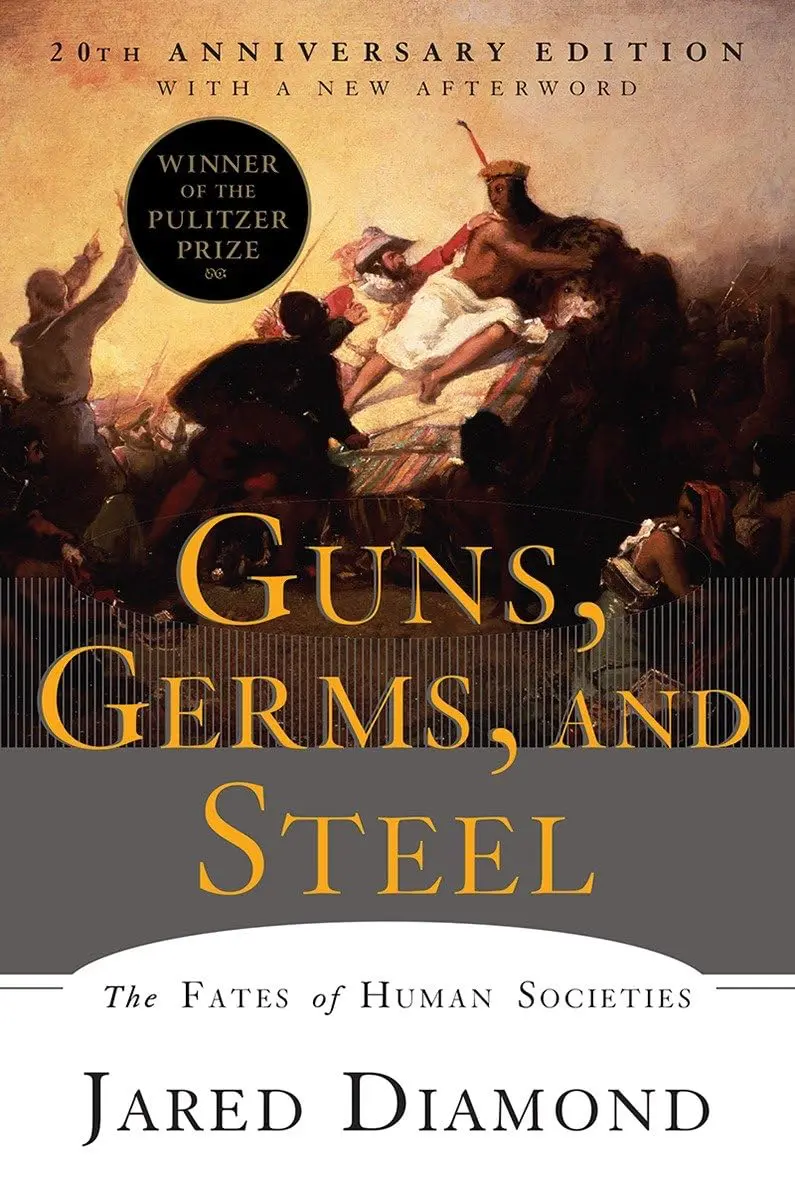
The book starts with a question from a New Guinean politician named Yali: “Why is it that you white people developed so much cargo and brought it to New Guinea, but we black people had little cargo of our own?” Diamond spent the rest of his career trying to answer that question without resorting to racist explanations.
His answer is environmental. Eurasia had more domesticable plants and animals than other continents. Wheat, barley, rice, cattle, horses, sheep, and pigs were available to early farmers in the Fertile Crescent and East Asia. Sub-Saharan Africa, the Americas, and Australia had far fewer species that could be domesticated. Agriculture allowed population density. Population density allowed specialization. Specialization allowed technology. Technology allowed military conquest.
Eurasia also had a geographic advantage: its major axis runs east-west, meaning crops and livestock could spread across similar latitudes and climates. The Americas run north-south, with climate zones that blocked the spread of domesticated species. A crop suited to Mexico could not easily be grown in Peru or Canada.
Germs played a parallel role. Dense agricultural populations living with livestock developed immunity to diseases that jumped from animals to humans. When Europeans arrived in the Americas, smallpox and other diseases killed far more indigenous people than weapons did.
The book is ambitious and sweeping. Diamond covers 13,000 years of human history across every continent. Some specialists have criticized specific claims (the role of geography is overstated, the treatment of individual cultures is too thin), but the broad argument about the importance of environmental factors in shaping which societies industrialized first has been influential.
For business readers, the book provides a framework for thinking about competitive advantage that goes beyond individual talent or strategy. Just as some civilizations had geographical advantages, some companies have structural advantages (access to talent, capital, distribution, timing) that matter more than execution alone.
Bill Gates and Mark Zuckerberg have recommended it. At about 480 pages, the book is long but readable. Diamond writes for a general audience, and his storytelling keeps the historical arguments engaging.
