
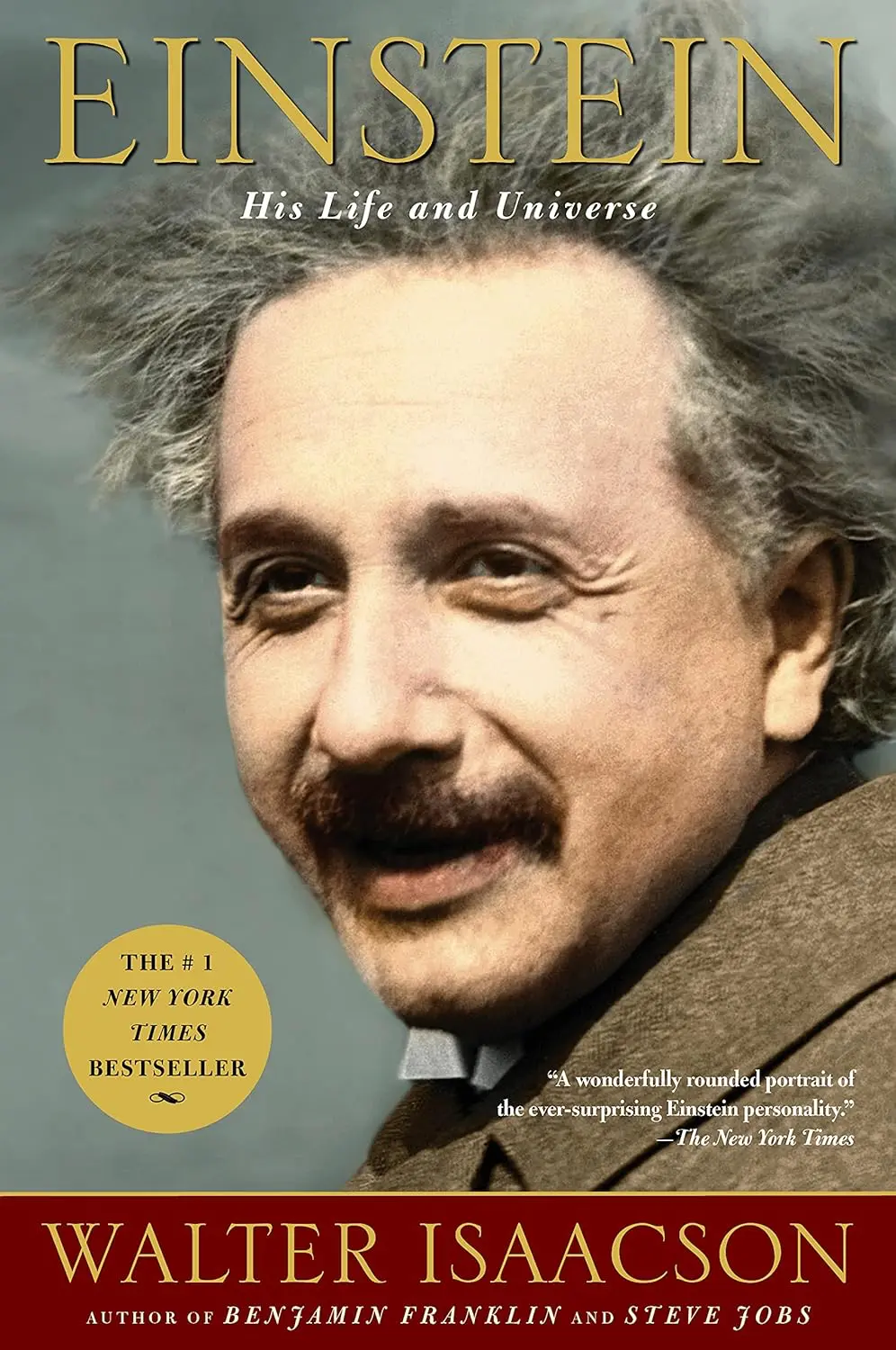
Isaacson had access to Einstein’s personal correspondence, which was released publicly after decades of being restricted. The letters reveal a more complex person than the benign genius of popular imagination: Einstein could be cold to his family, manipulative in his personal relationships, and stubborn to the point of self-sabotage in his later scientific work.
The scientific sections are the book’s highlight. Isaacson explains Einstein’s breakthroughs, including special relativity, general relativity, and the photoelectric effect, in terms accessible to non-physicists. More importantly, he explains how Einstein arrived at these ideas. The famous thought experiments (riding alongside a beam of light, falling in an elevator) were not illustrations added after the fact. They were the actual method by which Einstein did physics. He visualized scenarios and followed their logical consequences, often arriving at conclusions that contradicted accepted theory.
Einstein’s career also illustrates the relationship between outsider status and original thinking. When he wrote his 1905 papers (which included special relativity and launched modern physics), he was not a professor. He was a patent clerk in Bern who could not get an academic job. His distance from the physics establishment may have been an advantage: he was not constrained by the assumptions his colleagues took for granted.
The later chapters cover Einstein’s decades-long, ultimately unsuccessful attempt to develop a unified field theory, his complicated relationship with quantum mechanics, and his role in the development of the atomic bomb (he signed the letter to Roosevelt that started the Manhattan Project but was excluded from the project itself).
For founders, the most transferable ideas are about first-principles thinking, the productive value of being an outsider, and the danger of becoming so committed to an approach that you cannot see when it has stopped working. Einstein’s later career is a cautionary tale about a mind that was right about everything for twenty years and then spent the next thirty refusing to accept that the field had moved on.
Elon Musk has cited it. At about 680 pages, the biography is a commitment. Isaacson’s writing carries it, and the personal letters add a dimension that earlier Einstein biographies lacked.
