
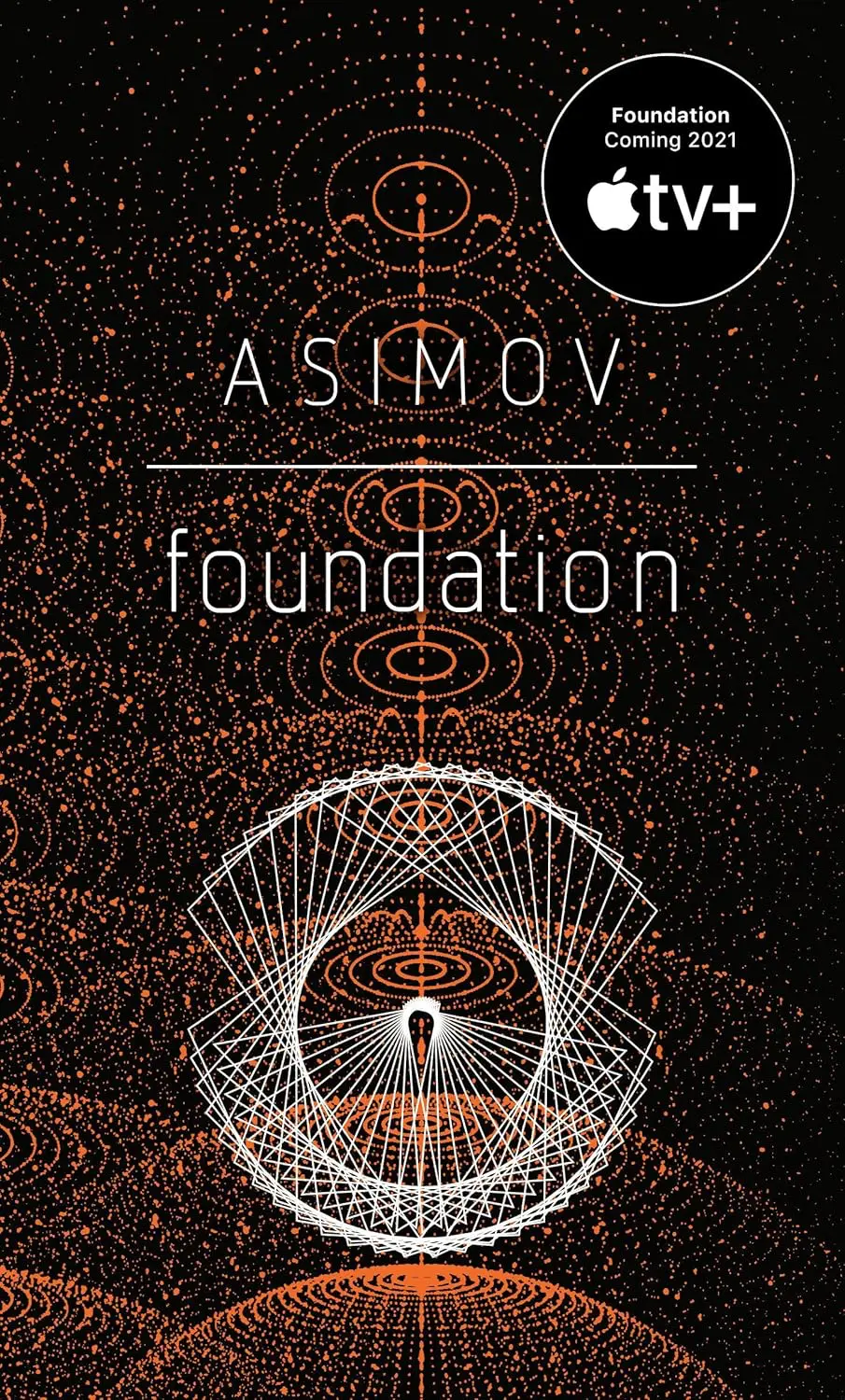
Foundation opens with Hari Seldon, a mathematician who has developed “psychohistory,” a discipline that uses statistical models to predict the behavior of large populations over centuries. His models show that the Galactic Empire, which has lasted 12,000 years, will collapse within 300, followed by 30,000 years of barbarism before a new empire rises.
Seldon cannot prevent the collapse. The forces are too large. But he can shorten the dark age to 1,000 years by creating the Foundation, a small colony of scientists on the edge of the galaxy tasked with preserving human knowledge and guiding civilization’s recovery. The rest of the book, and the series, follows the Foundation through a series of crises that Seldon predicted, each requiring a different response.
The novel is structured as a series of connected novellas rather than a continuous narrative. Each section jumps forward decades and introduces new characters facing a new crisis. The connecting thread is Seldon’s plan and the question of whether it will hold.
Asimov wrote Foundation during World War II, and the influence shows. The book is about the rise and fall of civilizations, the limits of individual action against historical forces, and whether planning can reduce the chaos of transition. Seldon is not a hero in the action sense. He is a planner who trusts the model and accepts that he will not live to see the results.
For founders, the book raises interesting questions about long-term strategy, institutional design, and the difference between predicting the future in broad strokes versus controlling it in detail. The Foundation’s approach to each crisis is essentially adaptive strategy: prepare the conditions, then let the people on the ground figure out the specifics.
Elon Musk has cited Foundation as one of the books that shaped his thinking about civilization-scale problems. Paul Krugman has said it inspired his career in economics. Naval Ravikant has also recommended it. The original trilogy (Foundation, Foundation and Empire, Second Foundation) is the core of the series. The first book is about 240 pages and reads quickly despite being 70 years old.
