
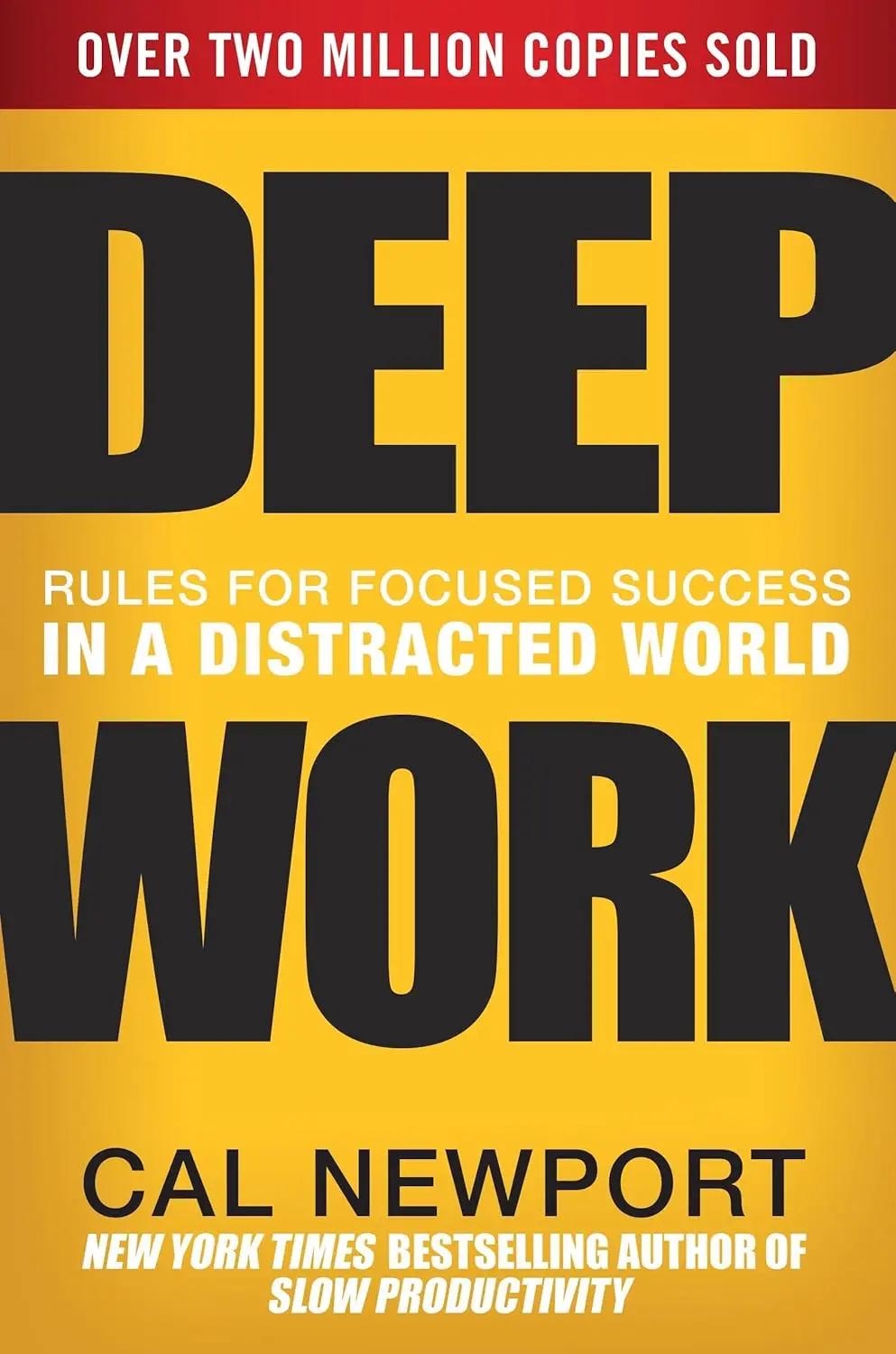
Newport defines deep work as professional activity performed in a state of distraction-free concentration that pushes your cognitive abilities to their limit. Shallow work, by contrast, is logistical, low-value, and easily replicated: email, meetings, administrative tasks, social media. Most knowledge workers spend most of their time on shallow work and wonder why they are not producing anything meaningful.
The book is divided into two parts. Part one argues that deep work is valuable (the people who can focus will thrive), rare (our environments are designed to prevent it), and meaningful (it produces a sense of purpose and satisfaction that shallow work cannot). Part two provides rules for cultivating it.
The rules include: work deeply (schedule blocks of uninterrupted time and protect them), embrace boredom (train your brain to tolerate boredom rather than reaching for your phone at every idle moment), quit social media (or at least evaluate each platform against specific professional benefits rather than assuming it is all useful), and drain the shallows (schedule every minute of your day and ruthlessly limit time spent on low-value tasks).
Newport practices what he preaches. He is a computer science professor at Georgetown who publishes academic papers, writes books, and maintains no social media accounts. He attributes his productivity not to working longer hours but to protecting extended periods of concentration.
For founders, the tension is real. Running a company requires a lot of shallow work: email, Slack, meetings, phone calls. But the most important work, strategy, product thinking, writing, creative problem-solving, requires deep concentration. Newport does not argue that you should eliminate all shallow work, but he makes a strong case for ring-fencing significant time for deep work and treating that time as non-negotiable.
The book is about 290 pages. James Clear, Tim Ferriss, Ryan Holiday, and Adam Grant have recommended it. Newport’s writing is clear and well-organized, though some readers find his tone professorial. The strategies are practical and immediately applicable.
