
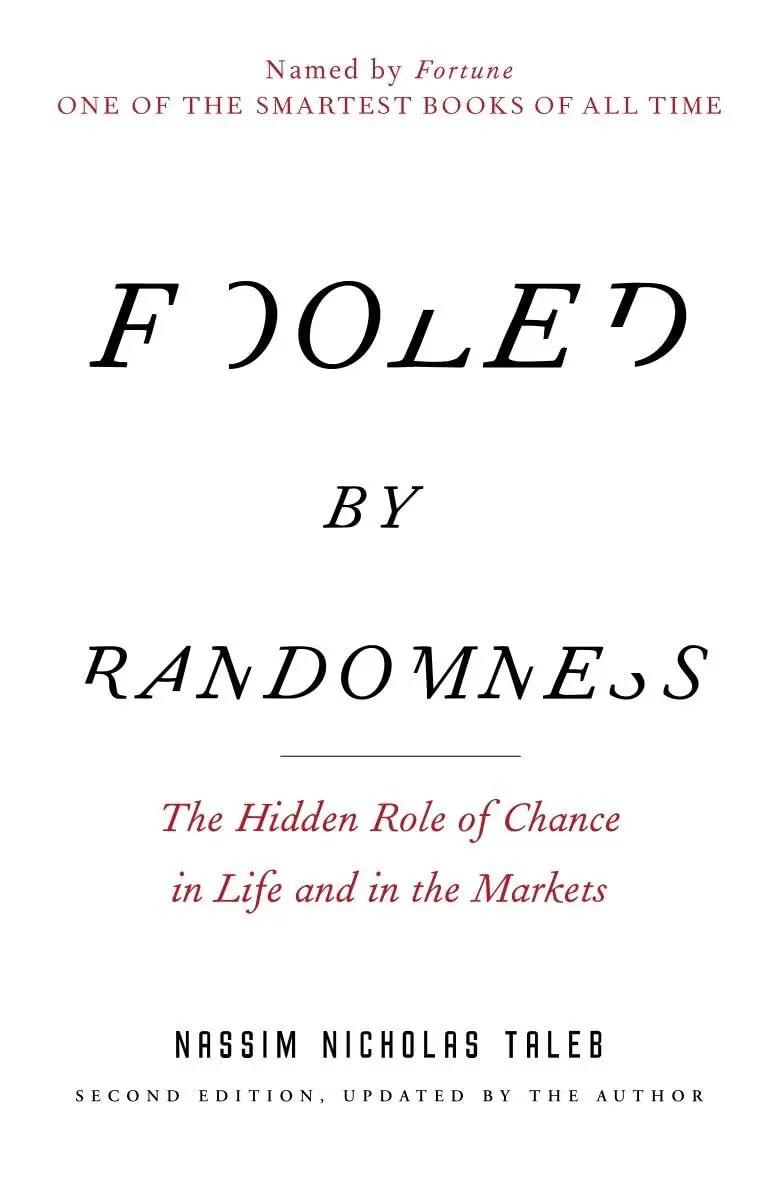
Fooled by Randomness is the first book in Taleb’s Incerto series, and it is the most personal. Written as a mix of memoir, philosophy, and probability theory, it follows a fictional trader named Nero Tulip (loosely based on Taleb himself) who is skeptical of his own success because he understands how much of it may be random.
The core argument is that in any field with enough participants and enough variance, some people will perform spectacularly well by pure luck. Those lucky individuals are then studied, interviewed, and asked for their secrets, as if their success proved the effectiveness of their methods. Taleb calls this “survivorship bias on steroids.” We see the winners and build narratives around their skills while ignoring the thousands who used the same methods and failed.
Taleb applies this to financial markets, where traders who made money during a bull market are treated as geniuses until the market turns and they blow up. But the principle extends to business, sports, publishing, and any domain where outcomes are influenced by factors outside the participant’s control.
The book also covers the emotional difficulty of living with uncertainty. Taleb describes how even knowing intellectually that outcomes are partly random does not prevent the emotional sting of losses or the seductive high of gains. Understanding probability is a cognitive exercise; living with it is an emotional one.
For founders, this is relevant because startups operate in an environment where luck plays an enormous role. Market timing, early hires, competitor moves, and regulatory changes all affect outcomes in ways that are hard to attribute to skill. Fooled by Randomness does not say that skill is irrelevant. It says that skill and luck are much harder to separate than most people think, and that humility about this distinction leads to better long-term decisions.
The writing is idiosyncratic. Taleb mixes philosophical asides, literary references, and personal anecdotes in a way that some readers find charming and others find disorganized. At about 300 pages, the book is lighter than his later works. Naval Ravikant and Shane Parrish have both cited it as a book that changed how they think about success and risk.
