
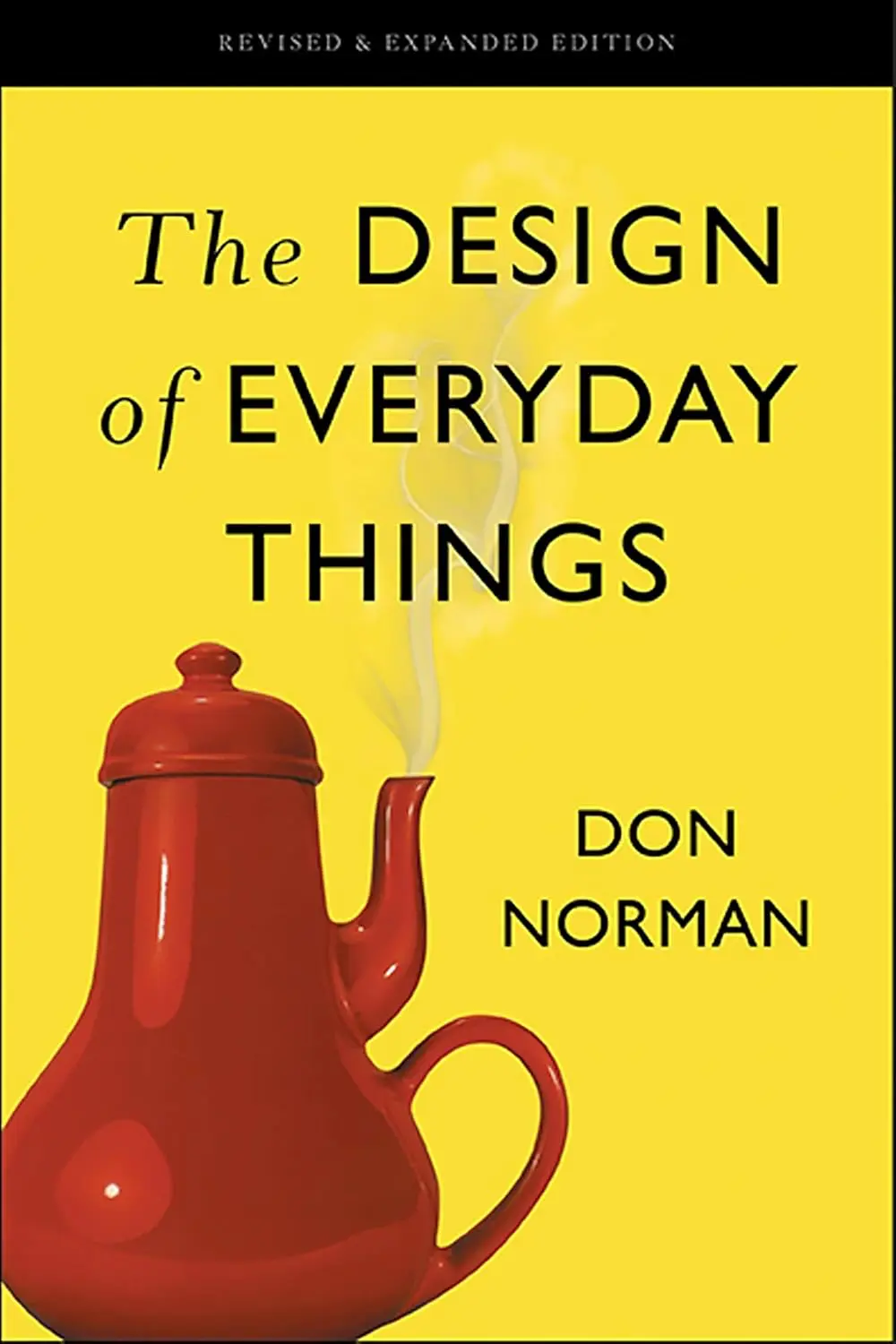
Originally published in 1988 as “The Psychology of Everyday Things,” this book argued that when people have trouble using a product, the problem is usually bad design, not bad users. Norman, a cognitive scientist, examines doors you push when you should pull, stove controls that do not map to burners, and technology interfaces that confuse even smart people.
The book introduces several concepts that are now standard vocabulary in product design. Affordances are the properties of an object that suggest how it should be used (a handle affords pulling, a flat plate affords pushing). Signifiers are the cues that communicate where the action should take place (an arrow on a button, a blinking light). Feedback is the information users get about whether their action worked. Mapping is the relationship between controls and their effects (a well-designed stove has controls arranged in the same layout as the burners).
Norman argues that most design failures stem from designers who understand how their product works and assume everyone else will too. This is the “knowledge in the head vs. knowledge in the world” distinction. Good design puts the information users need in the world (visible, accessible, intuitive) rather than requiring users to remember it.
The revised 2013 edition updates the examples and adds material about design thinking as a process for solving problems. Norman’s framework applies beyond physical products to software, services, and organizational processes. Any system that humans interact with benefits from the principles in this book.
For founders, the book is useful whether you are building software, physical products, or even internal processes. Understanding why users get confused, where friction lives, and how to make interactions intuitive is a competitive advantage. The book is about 350 pages and reads well despite being rooted in cognitive science. Jason Fried, Evan Spiegel, and Jeff Bezos have recommended it. It remains the most widely cited book in the field of human-centered design.
