
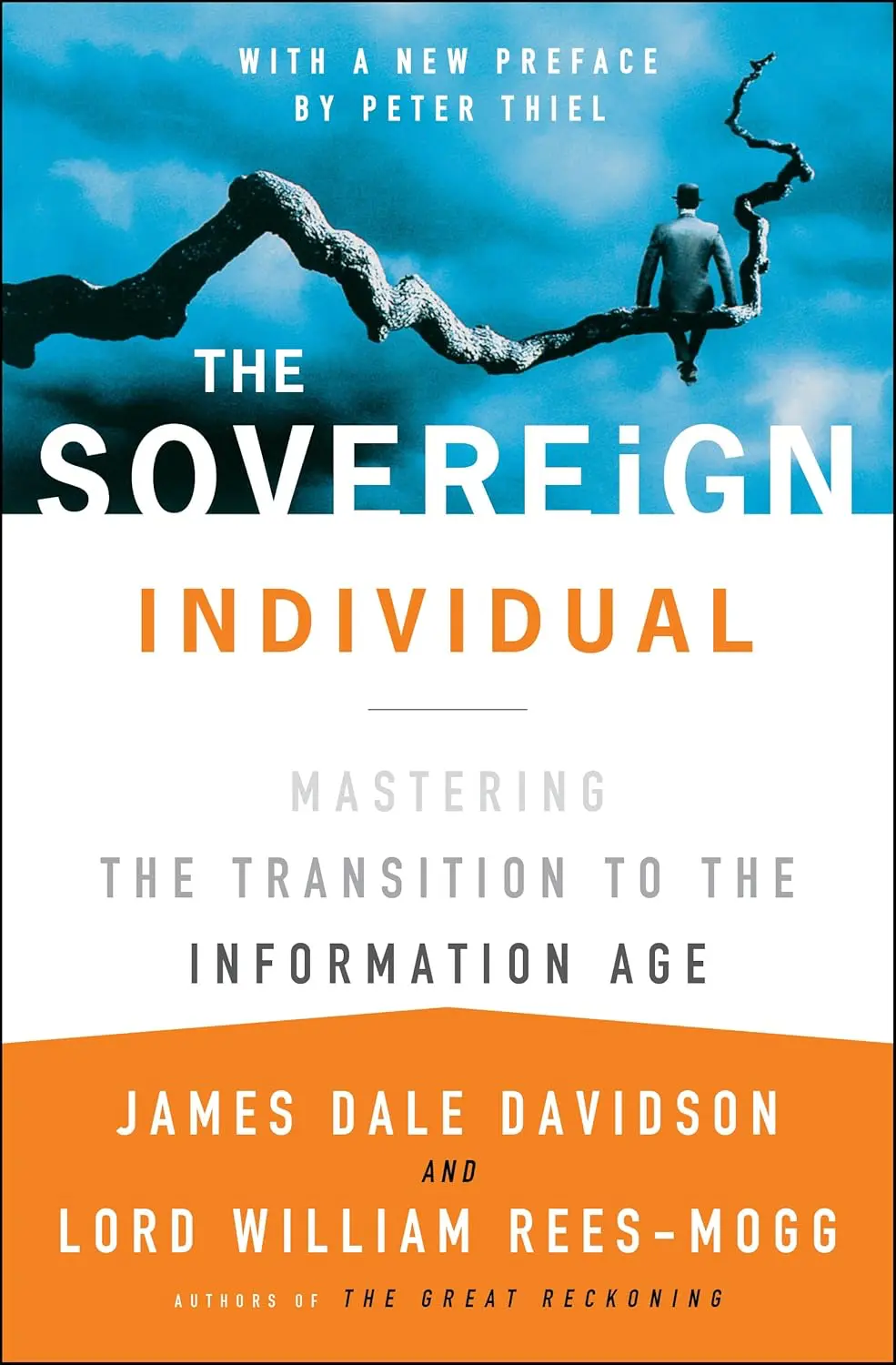
The Sovereign Individual was published in 1997, before Google existed, before smartphones, and long before cryptocurrency. Davidson and Rees-Mogg argued that information technology would fundamentally change the relationship between individuals and governments, just as gunpowder changed the relationship between feudal lords and knights, and the printing press changed the relationship between the Catholic Church and the literate public.
Their central thesis is that as commerce moves online and wealth becomes digital, governments will lose their ability to tax and regulate effectively. Talented, mobile individuals will be able to choose which jurisdiction offers them the best terms, forcing governments to compete for citizens rather than extracting from captive populations. The authors predicted the emergence of digital currencies, the rise of remote work, the decline of physical borders as economic barriers, and the growth of private services replacing public infrastructure.
Written nearly 30 years ago, the book has an eerie track record. Bitcoin, which launched in 2009, matches their prediction of non-governmental digital money. The explosion of remote work after 2020 matches their prediction that location would become optional for knowledge workers. The rise of sovereign wealth strategies among the globally mobile matches their prediction about jurisdictional competition.
The book is not without problems. The writing is dense and sometimes grandiose. The authors can be dismissive of the people who will be left behind as traditional employment structures erode. Some predictions have not materialized (the nation-state has proved more resilient than they expected). And the political implications of their thesis are uncomfortable regardless of where you sit on the ideological spectrum.
For founders, the book is useful as a long-range map of where technology-driven power shifts are heading. It provides a framework for thinking about how the internet changes bargaining power between individuals, companies, and governments. Peter Thiel, Marc Andreessen, and Brian Armstrong have all cited it as influential in shaping their thinking about technology and society.
The book is about 400 pages and reads more like a political philosophy treatise than a business book. It requires patience, but the ideas repay the effort.
