
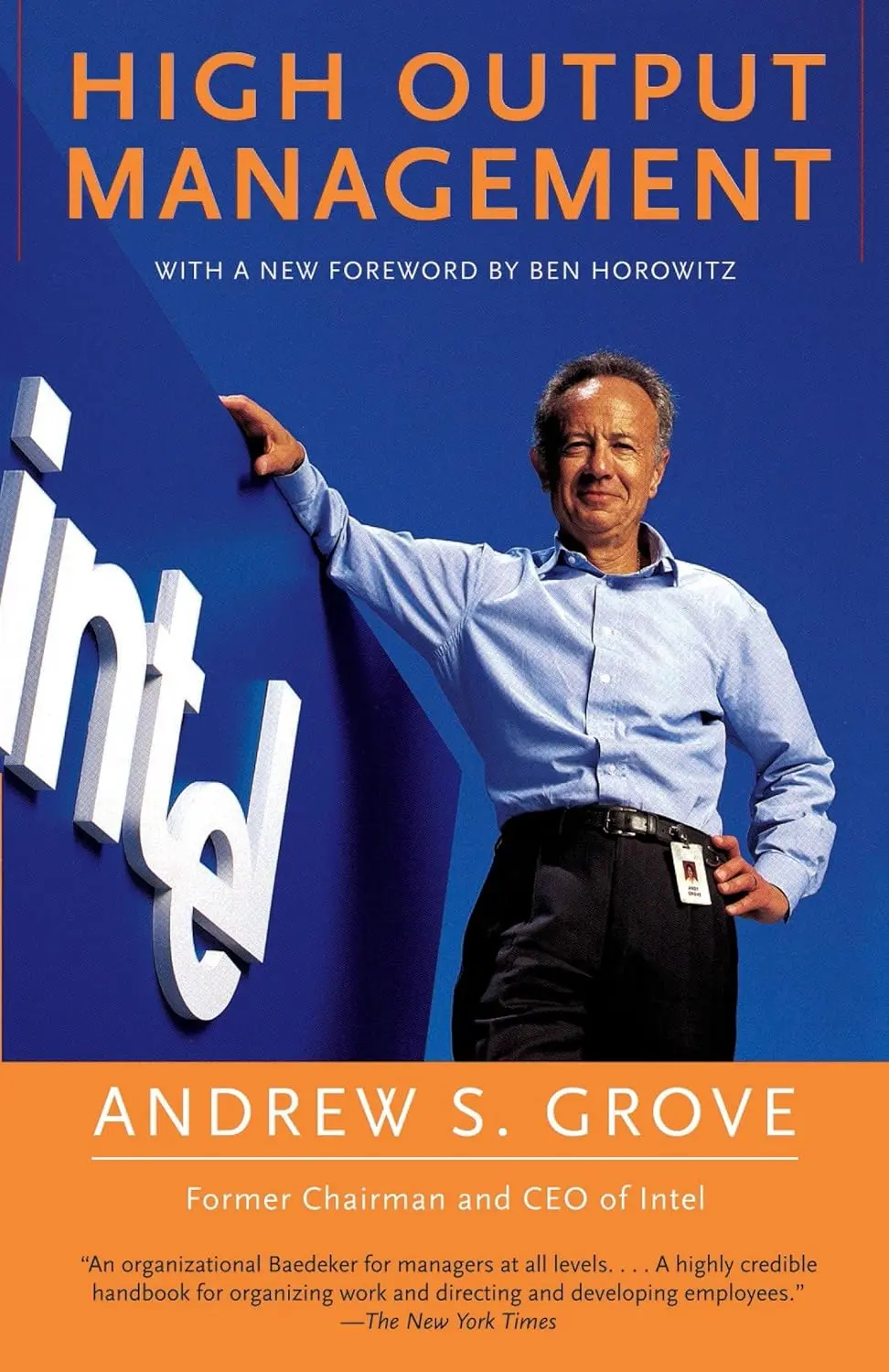
High Output Management was written by Andy Grove in 1983, while he was running Intel. The book treats management as an engineering problem: given limited inputs (time, people, attention), how do you produce the maximum output?
Grove starts with a metaphor: a breakfast factory that produces soft-boiled eggs, toast, and coffee. He uses this to explain production concepts like limiting steps, batch processing, and quality control, then applies them to knowledge work. The effect is unusual. By the time he gets to topics like meetings and performance reviews, you are already thinking about them as production problems rather than administrative chores.
The section on meetings is particularly useful. Grove distinguishes between process-oriented meetings (one-on-ones, staff meetings, operational reviews), which provide information and coordination, and mission-oriented meetings (ad hoc decision meetings), which should produce a specific decision. Most companies run too many of the second kind and too few of the first.
On one-on-ones, Grove argues they should be the subordinate’s meeting, not the manager’s. The subordinate sets the agenda, raises problems, and drives the discussion. The manager’s job is to listen, ask questions, and teach. This approach has been widely adopted in Silicon Valley, especially at companies like Facebook (now Meta) and Coinbase, where one-on-ones follow Grove’s model closely.
The book also covers performance reviews (do them, make them specific, tie them to task-relevant maturity), motivation (distinguishing between achievement-driven and competence-driven employees), and how to think about leverage (a manager’s output is the output of their organization).
At around 250 pages, the book is concise. Grove writes with the precision of an engineer and the pragmatism of someone who ran a company through multiple industry cycles. There is no fluff, no motivational padding, and very few stories. Just frameworks and their applications.
Marc Andreessen, Ben Horowitz, Brian Chesky, and Sam Altman have all publicly recommended this book. It is often the first management book given to new managers at tech companies, and for good reason: almost every page contains something you can use the next day.
