
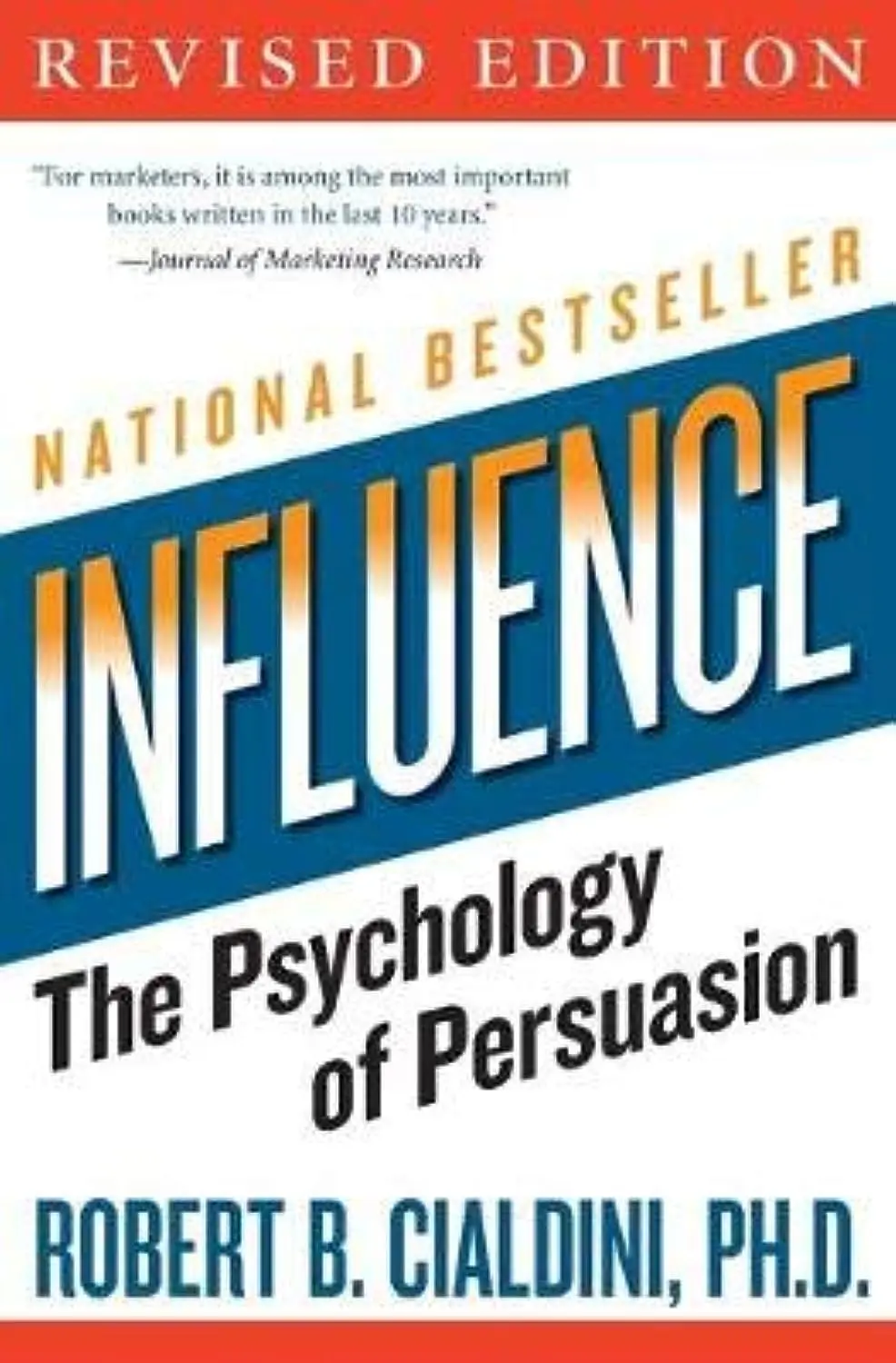
Cialdini, a social psychologist, spent years studying compliance professionals, the people whose livelihood depends on getting others to say yes. He went undercover with car salesmen, fundraisers, advertisers, and cult recruiters to understand the techniques they used. The result is a framework built around six principles of influence.
Reciprocity: people feel obligated to return favors, even uninvited ones. Give someone a free sample and they are more likely to buy. Commitment and consistency: once people take a small step in a direction, they tend to continue in that direction to remain consistent with their self-image. Social proof: when uncertain, people look at what others are doing. This is why testimonials, user counts, and waitlists work. Authority: people defer to perceived experts, even when the expertise is superficial (a lab coat, a title). Liking: people are more easily persuaded by those they like, and liking is driven by similarity, compliments, and familiarity. Scarcity: things become more desirable when they are rare or about to become unavailable.
Each principle gets its own chapter with research studies, real-world examples, and an explanation of both how to use it ethically and how to defend against it when others use it on you. Cialdini is not teaching manipulation. He is cataloguing how persuasion works so that readers can make more deliberate choices about when they are being influenced.
For founders, the applications are direct: pricing strategy (scarcity and anchoring), conversion optimization (social proof and commitment), sales processes (reciprocity and liking), and brand building (authority). Marketing teams have been using Cialdini’s framework for decades, and the concepts have held up well since the book was first published in 1984.
A revised edition adds a seventh principle, unity, which refers to shared identity. People are more persuadable when they feel the persuader is part of their group. The book is accessible and well-written, with enough stories to keep it interesting without diluting the substance.
