
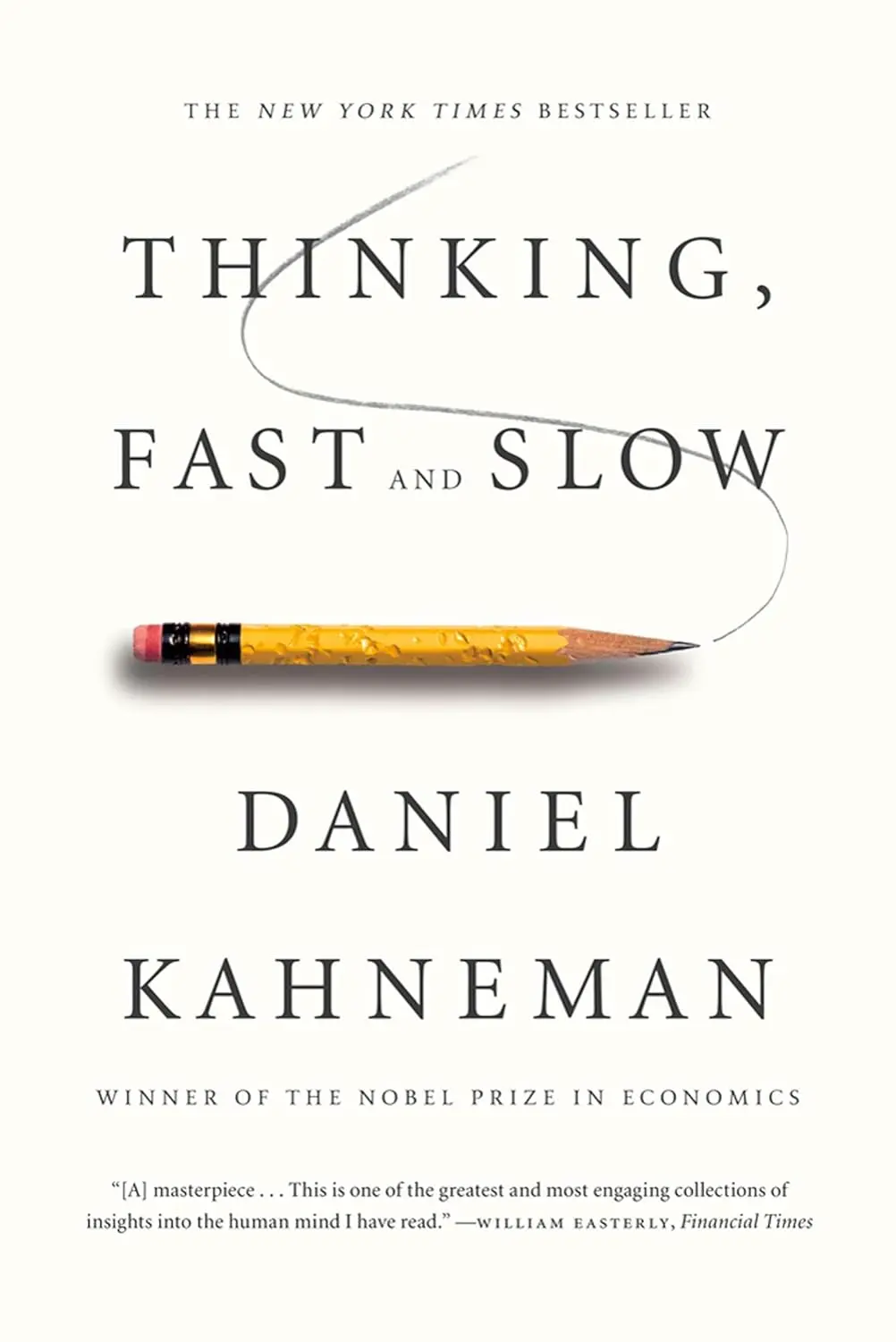
Kahneman spent decades studying how people actually make decisions, as opposed to how economists assumed they did. This book is a summary of that work, organized around the metaphor of two mental systems. System 1 is fast, automatic, and intuitive. It handles most of your daily decisions without conscious effort. System 2 is slow, deliberate, and logical, but also lazy. It only kicks in when System 1 cannot handle the task, and even then, it often accepts whatever System 1 suggests.
The book walks through dozens of cognitive biases and illusions that result from this setup. Anchoring, where people’s estimates are pulled toward whatever number they encounter first. Loss aversion, where losing $100 feels roughly twice as bad as gaining $100 feels good. The planning fallacy, where people consistently underestimate how long projects will take. Overconfidence, where experts are often no better than random guessing at predicting the future but feel certain they are right.
For founders and business people, the relevance is direct. Every pricing decision, hiring call, investment, and product bet is shaped by these biases. Kahneman does not claim you can eliminate them, but knowing they exist allows you to build processes that compensate. For example, reference class forecasting (looking at how similar projects actually turned out instead of relying on your own optimistic plan) is a concrete tool from the book that many companies now use.
The book is long, about 500 pages, and parts of it are academic. Kahneman is a researcher, not a storyteller, and some chapters require concentration. But the ideas themselves are some of the most practically useful in all of psychology. If you read it and internalize even a handful of the biases, you will make better decisions.
The 2011 publication changed how a lot of business people think about judgment and risk. Some of the specific studies cited have been debated or failed to replicate in the years since, which is worth knowing. But the core framework, that human thinking has predictable flaws and that awareness of those flaws is the first step toward compensating, remains solid.
