
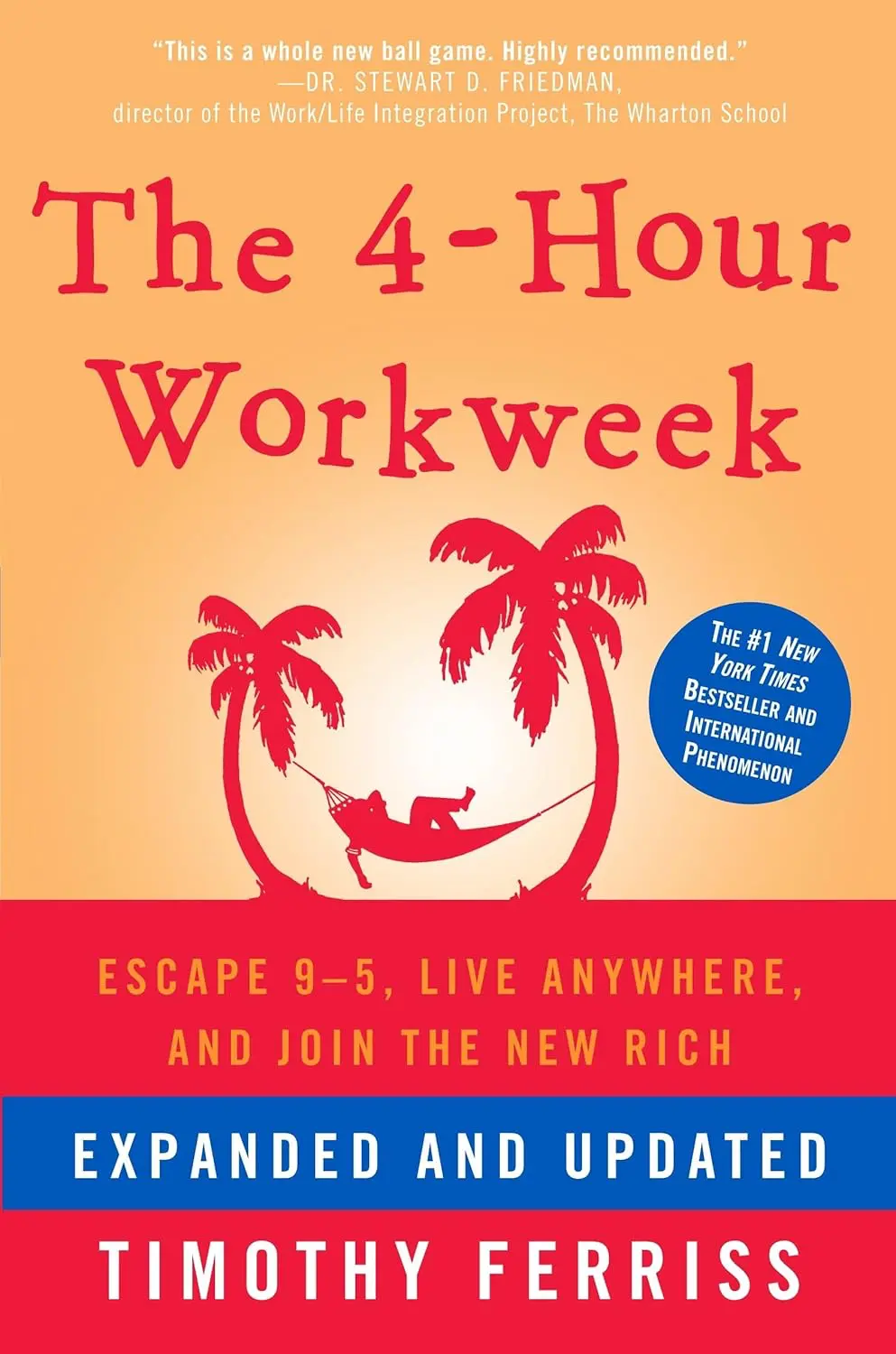
The 4-Hour Workweek was published in 2007 and became the handbook for a generation of location-independent entrepreneurs. Ferriss structures the book around what he calls DEAL: Definition, Elimination, Automation, and Liberation. Each section builds on the last.
Definition is about questioning the assumption that you need to work 40 years, save, and then enjoy life in retirement. Ferriss argues this model is broken and that most people can redesign their work to free up time now, not in 30 years.
Elimination covers productivity, but not in the usual “do more in less time” sense. Ferriss focuses on doing less, period. He applies the Pareto principle (80/20 rule) to identify which 20% of activities produce 80% of results, and then advocates cutting or ignoring the rest. He also promotes a “low-information diet,” deliberately avoiding news and non-essential input.
Automation is about building income streams that run without constant attention. Ferriss describes how he built a supplements business that largely ran itself through outsourced fulfillment and virtual assistants. The playbook involves creating or finding a product, testing demand cheaply, and then delegating operations.
Liberation is the endgame: negotiating remote work arrangements, taking “mini-retirements” throughout your career instead of waiting for one big retirement, and building a life around experiences rather than accumulation.
The book is polarizing. Some readers find it life-changing, while others see it as unrealistic or only applicable to a narrow type of business. The specific tactics (like hiring virtual assistants from overseas for $5/hour) have aged, and some of the case studies feel dated. But the underlying philosophy, that you should design your lifestyle first and your business around it, still holds up.
For founders and business builders, the most useful parts are the sections on elimination and automation. Ferriss is particularly good at challenging the idea that being busy equals being productive. The expanded edition includes reader case studies and updated templates.
