

You can have the best affiliate software, the most competitive commission rates, and a perfectly designed program page. None of it matters if you do not have affiliates actively promoting your products.
Recruitment is the engine that drives affiliate program growth. The businesses that build successful programs treat it as an ongoing, strategic effort, not something they do once at launch and then forget about. This guide covers every major recruitment channel, how to approach potential affiliates, and how to build a repeatable system that keeps your partner pipeline full.
Before You Start Recruiting: Get the Foundation Right
Recruitment efforts fail when the program itself is not ready to receive affiliates. Before you send a single outreach message, make sure these elements are in place:
→ A competitive commission rate that is in line with or above industry standards for your product type
→ A professional affiliate program page that clearly communicates your offer, terms, and resources
→ A working tracking system that has been tested end to end
→ Creative assets (banners, product images, copy) ready for affiliates to use immediately
→ Terms and conditions that are clear, fair, and publicly accessible
Your affiliate program page is especially critical because it is the first thing potential partners see when you send them a link. If the page is vague, unprofessional, or missing key details, your outreach will fall flat no matter how good the email is.
Channel 1: Your Existing Customers
Your customers are the lowest-hanging fruit for affiliate recruitment, and too many businesses overlook them entirely. These are people who have already bought your product, experienced the value, and are the most likely to give an authentic, credible endorsement.
How to activate them:
→ Send a dedicated email to your customer list announcing the affiliate program. Focus on the earning opportunity and explain how simple it is to get started.
→ Add a “Become an Affiliate” call to action on your order confirmation page and in your post-purchase email sequence. Customers who just bought are in their highest-satisfaction moment and most likely to say yes.
→ Include a mention in your packaging or delivery follow-up emails. A simple note like “Love our product? Earn commissions by sharing it with your audience” plants the seed.
→ Identify your most engaged customers (repeat buyers, product reviewers, social media taggers) and reach out personally with a tailored invitation.
Not every customer will be an effective affiliate. Many will sign up, share their link once, and never promote again. That is fine. The ones who do engage tend to be your most authentic and persuasive partners because they speak from genuine experience with your product.
Channel 2: Niche Bloggers and Content Creators
Content creators are often the highest-value affiliates because they produce SEO-optimized content that drives traffic for months or years. A single well-written review or comparison article can generate consistent sales long after it is published.
How to find them:
→ Search Google for keywords your customers would use. Look for bloggers ranking on page one for terms like “best [product category],” “[product type] review,” or “[your product] vs [competitor].”
→ Search YouTube for video reviews, tutorials, and unboxing content in your niche. Creators with 5,000 to 100,000 subscribers often deliver the best ROI because their audiences are engaged and they are accessible for partnerships.
→ Browse podcast directories for shows in your industry. Hosts who already discuss products and tools similar to yours are natural affiliate candidates.
→ Check who is already linking to your competitors. Tools like Ahrefs or SEMrush can show you which websites link to competing products, giving you a ready-made list of creators who are already monetizing content in your space.
For a deeper dive into sourcing strategies specific to content creators, our guide on how to find affiliate partners in your niche covers additional research methods and tools.
Channel 3: Social Media Outreach
Social media platforms are where many potential affiliates spend their time and build their audiences. Each platform has its own recruitment dynamics.
The strongest platform for B2B affiliate recruitment. Search for industry consultants, marketing professionals, and niche newsletter writers. LinkedIn outreach tends to have higher response rates than cold email because the platform signals professionalism and intent. For a complete playbook on this channel, our guide on how to use LinkedIn to recruit affiliate partners covers the full process.
Instagram and TikTok
Best for consumer product brands. Search hashtags related to your product category and identify micro-influencers (5K to 50K followers) who already create content in your niche. DM outreach works, but keep it short and lead with the value proposition. Mention your commission rate and what makes your product worth promoting.
X (Twitter)
Useful for finding niche experts and thought leaders. Search for people discussing topics related to your product. Engage genuinely with their content before pitching. A cold DM from someone who has never interacted with the creator feels transactional and gets ignored. Build rapport first.
Channel 4: Affiliate Directories and Marketplaces
Affiliate directories are websites where professional affiliates actively browse for new programs to join. Listing your program on these directories creates a passive recruitment channel that works around the clock without ongoing effort from you.
Some directories are free to list on, while others charge a fee. If your affiliate software includes a built-in marketplace (tools like UpPromote and Refersion offer this), enable it immediately. If you are on an affiliate network like Awin, CJ Affiliate, or Impact, your program is automatically listed in the network’s marketplace.
The quality of affiliates from directories varies. You will get some serious, experienced publishers alongside a larger number of casual applicants. Use your vetting process to filter effectively and approve only partners who meet your quality standards.
Channel 5: Competitor Affiliate Programs
One of the most effective recruitment tactics is identifying who is already promoting your competitors and offering them a reason to promote you as well (or instead). These affiliates already understand your market, create content for the right audience, and know how affiliate marketing works.
How to find them: Search Google for “[competitor name] review” or “best [product category]” and note which blogs and sites rank for those terms. These publishers are already monetizing content in your niche. Check whether they include affiliate links (look for tracking parameters in their URLs or disclosure statements on the page). If they are promoting a competitor, they are a candidate for promoting you.
When you reach out, position your program as an addition to their portfolio rather than asking them to drop a competitor. Most professional affiliates promote multiple products in the same category. Your pitch should focus on what makes your program uniquely valuable: higher commissions, longer cookies, better conversion rates, or a product that fills a gap their audience is looking for.
What Makes Affiliates Say Yes (and No)
Understanding what motivates affiliates to join a program helps you position your offer more effectively. Experienced affiliates evaluate programs the way investors evaluate opportunities. They are looking for the highest return on their time and effort.
What Makes Them Say Yes
→ Competitive commission rates
→ A product with strong reviews and a proven conversion rate
→ Long cookie duration (60+ days is a strong draw)
→ Ready-to-use creative assets and promotional materials
→ Fast, reliable payouts with transparent reporting
What Makes Them Say No
→ Below-market commission rates
→ An unknown brand with no reviews or social proof
→ Short cookie windows (7 days or less)
→ No creative assets or promotional support
→ Delayed or unreliable payments
If you are getting low response rates on your outreach, audit your program against this list before blaming the outreach itself. Often the issue is not how you are asking. It is what you are offering.
Channel 6: Industry Communities and Events
Online communities, forums, and industry events are fertile ground for finding potential affiliates who are already deeply engaged in your niche.
Join Facebook groups, Reddit communities (subreddits related to your product category), Slack channels, and Discord servers where your target audience congregates. Become a genuine, helpful member first. Answer questions, share insights, and build credibility before mentioning your affiliate program. People in communities can spot a sales pitch from a distance and will ignore anyone who shows up solely to recruit.
Industry conferences, trade shows, and meetups are excellent for in-person recruitment. Face-to-face conversations build trust faster than any email or DM. Bring a simple one-pager about your affiliate program to these events and be ready to explain the value proposition in thirty seconds.
How to Write an Outreach Message That Gets Responses
The difference between outreach that works and outreach that gets ignored comes down to personalization and clarity. Affiliates receive recruitment pitches regularly. Generic, copy-paste messages end up in the trash.
Outreach Best Practices
→ Reference something specific about their content. Mention a particular article they wrote, a video they published, or a topic they cover regularly. This shows you actually know who they are and have a reason for reaching out.
→ Lead with the value to them. Open with what they will get (commission rate, cookie duration, product quality), not with your company history or mission statement. Affiliates want to know what is in it for them.
→ Keep it short. Your first message should be under 150 words. Introduce yourself, explain what you are offering, and include a link to your affiliate program page. Save the details for the follow-up conversation.
→ Explain why their audience would benefit. Connect your product to their specific audience. If they write about productivity tools and you sell a project management app, make that connection explicitly.
→ Include a clear next step. End with a simple ask: “Would you be open to trying it out?” or “Can I send you more details?” Make it easy for them to say yes without committing to anything immediately.
Follow up if you do not hear back within five to seven days. One polite follow-up is expected and often necessary because busy creators simply miss messages. Two follow-ups is the maximum before moving on.
Channel 7: Referrals From Existing Affiliates
Your best affiliates know other potential affiliates. Once you have a few active partners generating results, ask them for referrals. A simple message like “Do you know any other bloggers or creators in your space who might be interested in our program?” can open doors to partners you would never find through cold outreach.
Some programs formalize this by offering a referral bonus: a one-time payment or small ongoing commission for every new affiliate a current partner refers who goes on to generate sales. This creates a self-reinforcing recruitment loop where your affiliate base grows organically through partner referrals.
Building a Repeatable Recruitment System
One-off recruitment bursts are not sustainable. The programs that grow consistently treat recruitment as a weekly operational habit, not a one-time project. Here is how to systematize it:
Weekly Recruitment Routine
→ Monday: Research and identify 10 to 15 new potential affiliates (bloggers, creators, influencers in your niche).
→ Tuesday/Wednesday: Send personalized outreach messages to each prospect. Use email, LinkedIn DMs, or social media DMs depending on the channel where they are most active.
→ Thursday: Follow up on messages sent the previous week that did not receive a response.
→ Friday: Review new applications, approve qualified affiliates, and send welcome emails with onboarding resources.
→ Ongoing: Track all outreach in a simple spreadsheet or CRM: who you contacted, when, which channel, their response, and their status (prospect, contacted, applied, approved, active).
Consistency matters more than volume. Sending 10 personalized, well-researched outreach messages per week consistently outperforms sending 100 generic messages in a single burst. Over the course of a year, that steady cadence adds up to over 500 targeted outreach attempts, which translates to a substantial and growing affiliate base.
Recruitment Is an Ongoing Investment
The biggest mindset shift for most business owners is understanding that affiliate recruitment never stops. Your best programs will always have a mix of top performers, mid-tier contributors, and inactive partners. To maintain growth, you need a continuous pipeline of new affiliates coming in to replace those who go dormant and to expand your overall reach.
The channels outlined above work together. Customers provide authentic grassroots promotion. Content creators drive long-term SEO traffic. Social media influencers generate bursts of visibility. Directories provide passive discovery. Competitor analysis uncovers experienced partners. Referrals create organic growth. And all of these channels feed into a professional, well-maintained program page that converts visitors into applicants.
For the complete strategic framework that recruitment plugs into, our guide on how to create an affiliate marketing program covers every step of the process. And for a broader look at how affiliate marketing fits into your overall growth strategy, our affiliate marketing for business guide provides the high-level perspective.
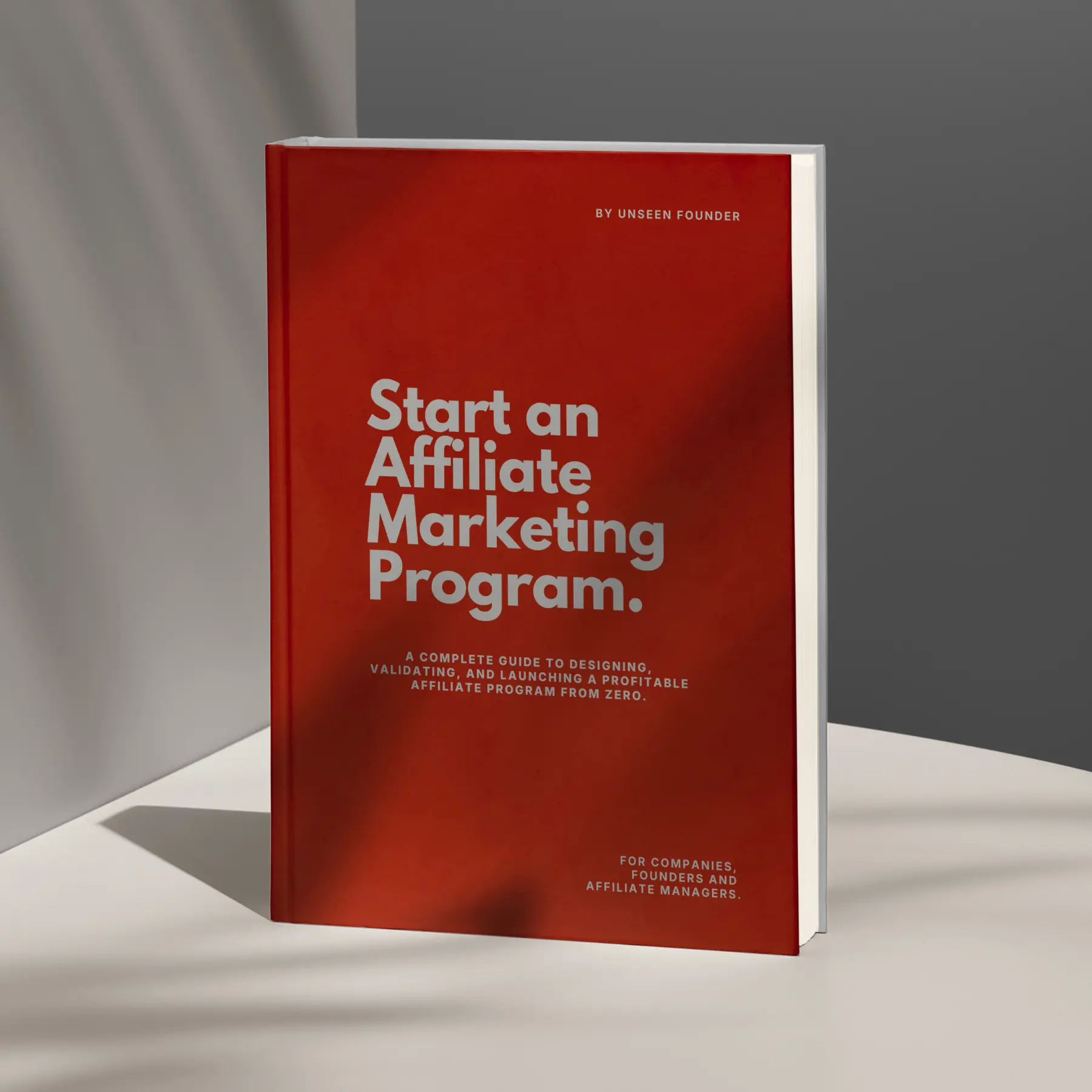
How To Start Affiliate Marketing Program
The Complete Launch Framework
eBook by Unseen Founder
How to Start an Affiliate Marketing Program is a structured, no-fluff framework for companies that want to design, validate, and launch a profitable affiliate program from scratch. It is not a collection of tips.
It is a complete operational blueprint built for founders, marketing leaders, and affiliate managers to launch a profitable affiliate program from zero.
