

Your affiliate program page is the first impression potential partners have of your program. It is where bloggers, content creators, and marketers decide whether your program is worth their time and effort. A strong page turns visitors into applicants. A weak one sends them to a competitor.
Most businesses treat this page as an afterthought, throwing up a basic form with a few lines of text. That is a missed opportunity. Your affiliate signup page is a sales page, and the product you are selling is your program. It deserves the same attention you give to any customer-facing landing page.
This guide walks through every element of a high-converting affiliate program page, from headline to application form, so you can build one that attracts quality partners consistently.
What Affiliates Want to Know Before They Apply
Before writing a single word of copy, understand what is going through an affiliate’s mind when they land on your page. They are evaluating your program the same way you evaluate a business opportunity. They have specific questions, and your page needs to answer all of them clearly.
Questions Every Affiliate Asks
→ How much will I earn per sale or per lead?
→ How long does the tracking cookie last?
→ When and how do I get paid?
→ Does this product actually convert? Is the brand reputable?
→ What promotional resources will I get (banners, copy, product data)?
→ Is this a real program or something that will waste my time?
→ How do I sign up?
Every element on your page should work toward answering these questions. If an affiliate finishes reading your page and still has unanswered questions, the page is not doing its job.
The Anatomy of a High-Converting Affiliate Program Page
Here is the structure that works, broken down section by section. Each element builds on the one before it, guiding the visitor from curiosity to application.
1. A Headline That Speaks to Affiliates, Not Customers
Your headline is the first thing a potential affiliate reads. It needs to communicate the core value of joining your program in a single sentence. The most common mistake is writing a headline that sounds like a customer-facing marketing message. Affiliates are not your customers. They are business partners evaluating an earning opportunity.
Headline Examples
Weak: “Welcome to Our Affiliate Program” (generic, says nothing about value)
Better: “Earn 15% Commission Promoting Products Your Audience Already Wants”
Best: “Join Our Affiliate Program: Earn 15% on Every Sale, 60-Day Cookie, Monthly Payouts” (leads with the numbers affiliates care about)
Lead with the financial incentive. Affiliates scan pages quickly and will leave if the headline does not immediately signal earning potential.
2. A Short Program Overview
Immediately below the headline, include two to three sentences that describe what your program is, who it is for, and why it is worth joining. This is your elevator pitch to affiliates. Keep it concise and benefit-focused.
Mention your product category, the type of audience your products serve, and the core program benefits (commission rate, cookie duration, quality of creative assets). The goal is to help the visitor quickly determine whether your program is relevant to their audience and worth exploring further.
3. The Key Program Details
This is the section where you spell out the specifics. Present them in a scannable format so affiliates can find the numbers they care about instantly. A card layout or highlighted box works well here:
Commission
State the exact percentage or flat fee. If you offer tiered rates, show the range (for example, “10% to 15% based on volume”). If you offer recurring commissions, highlight that prominently.
Cookie Duration
Show the tracking window clearly. “30-day cookie” or “90-day tracking window” tells affiliates exactly how long they have to earn credit after a click. Longer is more attractive.
Payouts
When and how affiliates get paid. “Monthly payouts via PayPal, $25 minimum.” Reliable, transparent payout information builds immediate trust.
4. Why Affiliates Should Promote Your Products
This section sells your product to the affiliate as something worth recommending. Remember, affiliates put their reputation on the line every time they endorse a product. They need to believe your product is good before they will promote it.
Include a brief description of your product or product range, who your target customer is, any notable social proof (customer count, ratings, press mentions, awards), and what makes your brand stand out from competitors. If your website has a strong conversion rate, mention it. Affiliates care deeply about whether the traffic they send actually turns into sales.
5. What You Provide to Affiliates
Affiliates want to know what tools and resources they will have access to. List the specific materials you provide:
→ Banner ads in multiple sizes
→ Product images and lifestyle photography
→ Pre-written email and social media copy
→ Exclusive discount codes for their audience
→ Real-time performance dashboard
→ Dedicated affiliate support contact
The more comprehensive your resource list, the more professional and serious your program appears. Affiliates who see a well-stocked creative library know they can start promoting quickly without creating everything from scratch.
6. Social Proof and Testimonials
Once you have a few active affiliates, ask your best performers for a short testimonial about their experience with the program. A quote like “I joined three months ago and have earned over $2,000. The creative assets are excellent and payouts always arrive on time” is incredibly persuasive to potential applicants.
If you do not have testimonials yet because your program is new, use other forms of social proof. Mention the number of affiliates who have already joined, reference any notable brands or publications that have featured your products, or highlight your product’s customer satisfaction metrics. Any credibility signal that makes your program feel established and trustworthy helps.
7. A Clear, Simple Application Form
The application form is where the conversion happens. Keep it as short as possible while collecting the information you need to evaluate applicants. Every unnecessary field reduces completion rates.
Essential Form Fields
→ Name and email address
→ Website URL or primary social media profile
→ How they plan to promote your products (dropdown or short text field)
→ Checkbox agreeing to the affiliate terms and conditions
→ Submit button with clear action text (“Apply Now” or “Join the Program”)
Avoid asking for PayPal details, tax information, or other sensitive data at the application stage. Collect that information after approval during the onboarding process. The goal of the form is to get the application submitted with minimal friction.
8. A Link to Your Terms and Conditions
Link to your full affiliate agreement on the signup page, and require applicants to check a box confirming they have read and agree to the terms before submitting. This is both a legal protection and a professionalism signal. Serious affiliates expect to see terms and will be suspicious of a program that does not have them.
Page Design and Placement Tips
The content on your page matters most, but design and placement influence how many people actually see it and how they experience the information.
Keep it clean and scannable. Affiliates are busy. They scan pages, not read them word for word. Use clear headings, short paragraphs, and visual elements (cards, icons, highlighted numbers) to make key information easy to find. The commission rate, cookie duration, and payout schedule should be visible without scrolling on most screens.
Make it easy to find. Add a “Become an Affiliate” or “Partner With Us” link in your website footer. Consider adding it to your main navigation as well. Some brands also link to the program from their order confirmation page and post-purchase emails to capture customers who might also be potential affiliates.
Use a dedicated URL. Give your affiliate page its own URL like yoursite.com/affiliates or yoursite.com/partners. This makes it easy to share in outreach emails and link to from social profiles. When you are actively recruiting affiliates, you will send this URL hundreds of times, so make it memorable and professional.
Optimize for mobile. Many affiliates will first discover your program on their phone, whether through social media, email, or a quick search. Ensure the page looks good and the application form works properly on mobile devices. A form that breaks on mobile costs you applicants.
Common Mistakes That Kill Conversions
Hiding the Commission Rate
Some programs bury the rate deep in their terms or do not mention it at all until after signup. This destroys trust instantly. Affiliates will not apply to a program where they cannot see the earning potential upfront.
Asking Too Much on the Form
Long forms with 10+ fields scare off applicants. Every additional field reduces completion rates. Collect only what you need to evaluate the application. Save everything else for post-approval onboarding.
Writing for Customers, Not Partners
Your affiliate page should speak the language of marketers and publishers. Focus on earnings potential, tracking reliability, and creative resources. Affiliates do not care about your product’s ingredient list; they care about whether it converts.
No Social Proof
A page with no testimonials, no affiliate count, and no brand credibility signals feels like a gamble. Even if your program is new, find something that demonstrates legitimacy: product reviews, customer count, media mentions, or industry recognition.
Your Page Is a Recruitment Tool
Your affiliate program page is not a formality. It is an active recruitment tool that works for you around the clock. Every time an affiliate discovers your brand, gets sent a link by a colleague, or searches for programs in your niche, this page is what convinces them to apply or sends them elsewhere.
Invest the time to make it clear, compelling, and easy to use. Lead with the numbers, back them up with product credibility, show what resources you provide, and make applying effortless. Then use the page as the foundation of your recruitment strategy.
Optimize Your Page Over Time
Your affiliate program page is not a one-time project. Treat it as a living asset that improves as your program grows and you gather data.
Track your application rate. If you drive 100 visitors to the page per month and only 3 apply, something is not working. Test different headlines, reorder the information, or simplify the form. Even small changes in application rate compound over time into significantly more affiliates.
Add social proof as you earn it. When you get your first positive affiliate testimonial, add it to the page. When you pass 50 or 100 active affiliates, show that number. Social proof has a snowball effect: the more partners you display, the more new partners want to join.
Update program details when they change. If you increase your commission rate, extend your cookie duration, or add new creative assets, update the page immediately. Outdated information creates confusion and can cause you to lose applicants who compare your listed rate with a competitor’s more current offering.
Ask new affiliates how they found you. Add a “How did you hear about our program?” field to your application form. The answers will tell you which recruitment channels are sending the most qualified applicants, so you can double down on what is working.
Review competitor pages periodically. Check your competitors’ affiliate signup pages every few months. If they have updated their commission rates, added new features, or redesigned their pages, you need to know so your page stays competitive.
For the complete approach to finding and attracting the right partners once your page is live, our guide on finding affiliate partners in your niche covers where to look and how to reach out. And for the broader program-building framework, our guide on how to create an affiliate marketing program ties everything together.
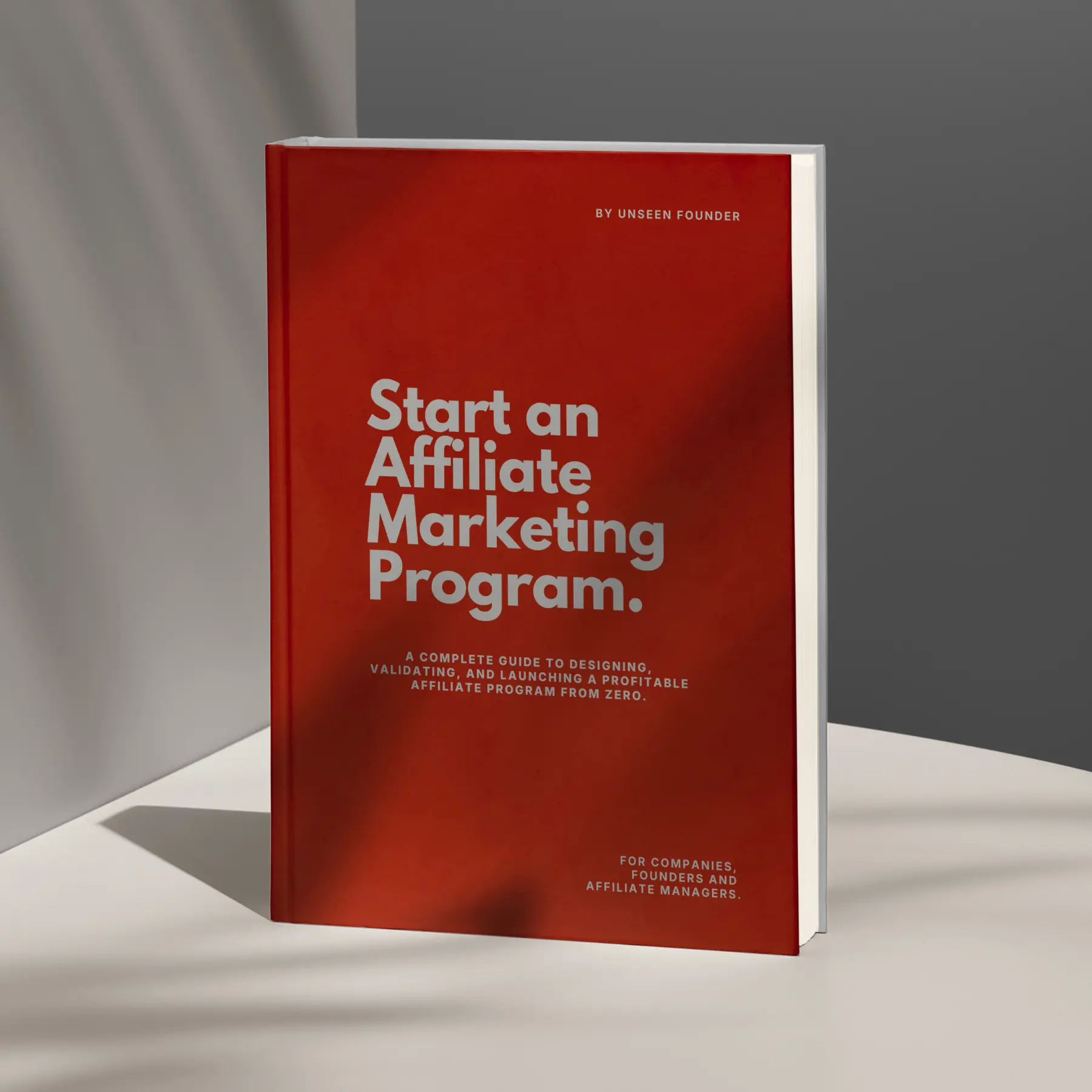
How To Start Affiliate Marketing Program
The Complete Launch Framework
eBook by Unseen Founder
How to Start an Affiliate Marketing Program is a structured, no-fluff framework for companies that want to design, validate, and launch a profitable affiliate program from scratch. It is not a collection of tips.
It is a complete operational blueprint built for founders, marketing leaders, and affiliate managers to launch a profitable affiliate program from zero.
