

This is a deep, long form guide, and it is meant to be used intentionally, not read in one sitting.
Use the table of contents to jump directly to the sections that matter most to you. Whether you are evaluating affiliate marketing for the first time or refining an existing program, each section is written to stand on its own.
Even at this length, we are barely scratching the surface. Affiliate marketing is a broad, nuanced discipline, and this article focuses on how it works in real businesses, not on shortcuts or tactics. Think of this as a practical foundation you can return to as your understanding and your business grow.
- 1. Affiliate marketing is not a side hustle tactic
- 2. What affiliate marketing really is from a business perspective?
- 3. Basic affiliate marketing mechanics explained simply
- 4. The affiliate ecosystem around your business
- 5. How affiliate marketing generates sales, not just traffic
- 6. How affiliate marketing creates exposure without upfront risk
- Why affiliate marketing scales better than most channels
- 8. How businesses structure profitable affiliate programs
- 9. The real costs businesses should expect
- 10. When affiliate marketing makes sense for a business
1. Affiliate marketing is not a side hustle tactic
Affiliate marketing still suffers from a reputation problem. It is often framed as a side hustle, a beginner online income trick, or something bloggers do on the weekends. That framing is not just inaccurate, it actively hides how affiliate marketing actually works inside serious companies.
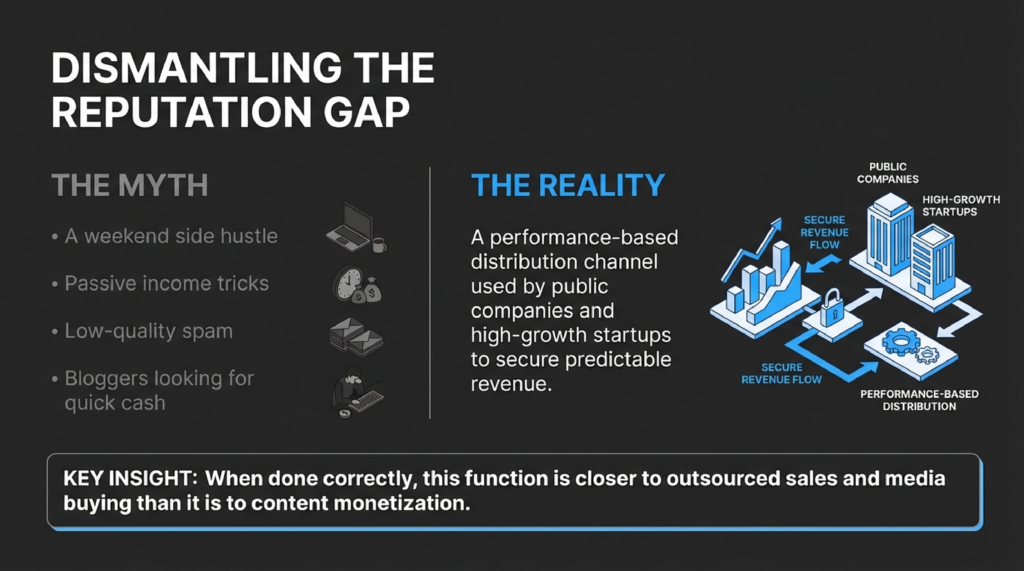
In reality, affiliate marketing is a performance based distribution channel used by established brands, fast growing startups, and public companies alike. When done correctly, it functions much closer to outsourced sales, media buying, and partnerships than to casual content monetization. The difference is simple but powerful: businesses only pay when a real result happens.
This is why affiliate marketing has quietly become one of the most capital efficient growth channels available to modern businesses.
Why serious businesses use affiliate marketing?
Serious businesses care about predictable revenue, controlled risk, and efficient customer acquisition. Affiliate marketing aligns with all three.
Unlike paid advertising, affiliate marketing does not require upfront media spend. Unlike sponsorships, it does not lock brands into fixed fees with uncertain outcomes. Unlike many brand campaigns, it is directly tied to measurable sales or leads.
For a business, this means three things.
First, affiliate marketing shifts risk away from the brand. You are not paying for impressions, clicks, or exposure. You are paying for outcomes. That alone makes it attractive to companies that are focused on unit economics and profitability.
Second, affiliates often reach buyers at the exact moment of intent. Review sites, comparison articles, newsletters, and educational content capture demand that already exists. Instead of interrupting users like ads do, affiliates intercept customers who are already deciding.
Third, affiliate marketing allows businesses to scale distribution without scaling headcount. Affiliates act as independent operators who invest their own time, audience, and platforms to promote your product. You get leverage without adding payroll.
This is why affiliate marketing is used by e-commerce brands, SaaS companies, marketplaces, and subscription businesses that are well past the “experiment” phase.
How affiliate marketing fits next to paid ads, SEO, email, and partnerships?
Affiliate marketing does not replace other growth channels. It complements them.
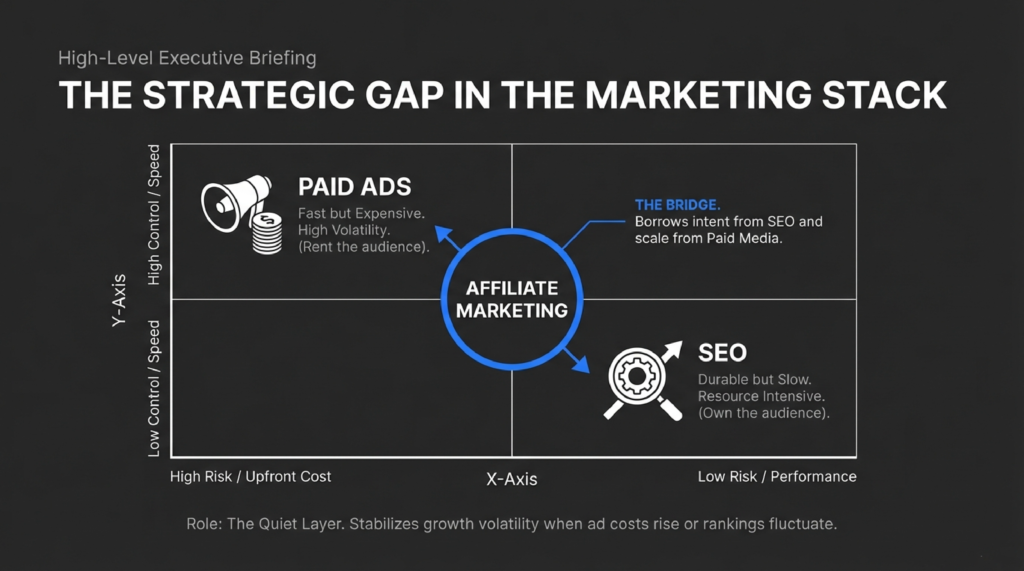
Paid ads are fast and controllable, but expensive and sensitive to competition and platform changes. SEO is durable and high margin, but slow and resource intensive. Email is powerful for retention, but limited by list size. Partnerships are effective, but hard to scale one by one.
Affiliate marketing sits in a unique position among these channels.
It borrows the intent capture of SEO, because many affiliates rank for product comparisons and problem aware searches. It borrows the scalability of paid media, but without the upfront spend. It amplifies email and content marketing by letting others build audiences and trust on your behalf. It formalizes partnerships into a measurable, performance based system.
In practice, strong affiliate programs often stabilize growth. When ad costs rise or SEO rankings fluctuate, affiliates continue driving sales through independent channels. For many businesses, affiliate revenue becomes the quiet layer that smooths volatility across the entire marketing stack.
Common misconceptions that stop brands from using it correctly
The biggest mistake brands make is misunderstanding what affiliate marketing actually requires.
One common misconception is that affiliate marketing is just influencer marketing with links. Influencers focus on reach and branding. Affiliates focus on conversion and intent. Treating affiliates like influencers leads to wrong incentives, weak performance, and frustration on both sides.
Another misconception is that affiliates will magically appear once a program is launched. In reality, high quality affiliates choose partners carefully. They look at conversion rates, commissions, brand trust, and long term viability. If the offer is weak, no amount of software will fix it.
Some brands also assume affiliate marketing is “free traffic.” It is not. While there is no upfront media spend, there are real costs in commissions, program management, creative assets, and infrastructure. The advantage is not zero cost, but efficiency and accountability.
Finally, many businesses expect instant results. Affiliate marketing compounds. The strongest programs are built over months and years, as content ranks, audiences grow, and trust deepens.
2. What affiliate marketing really is from a business perspective?
From a business point of view, affiliate marketing is not a content tactic or a monetization trick. It is a distribution model. More specifically, it is a performance based distribution channel where external partners are financially incentivized to drive measurable outcomes for your business.
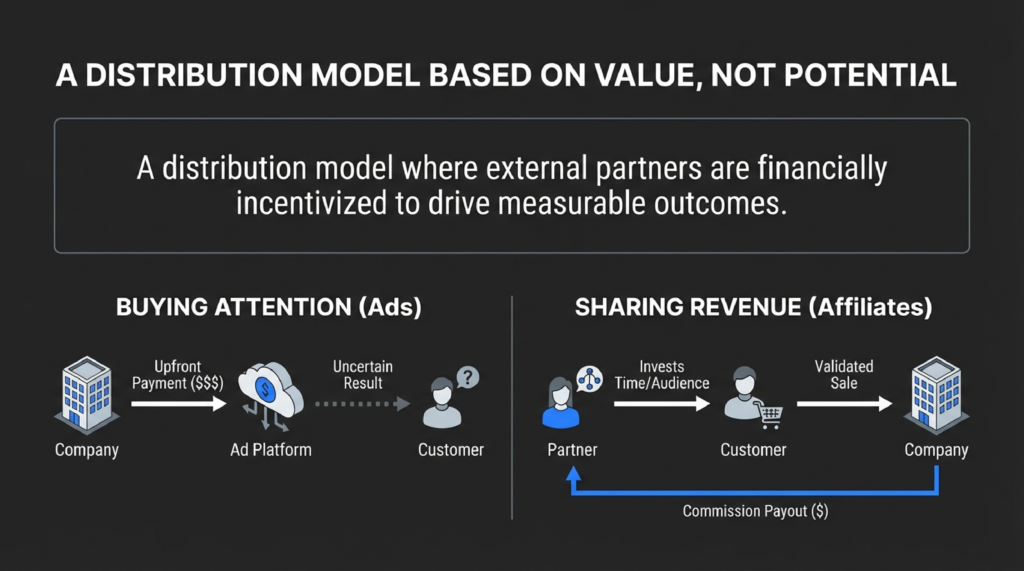
Instead of buying attention upfront, as you do with ads or sponsorships, you are opening your product or service to a network of independent operators who promote it through their own channels. These partners decide how to position your offer, where to place it, and how much effort to invest. Your role as the brand is to provide a product that converts, a clear offer, and a fair share of the revenue when a sale happens.
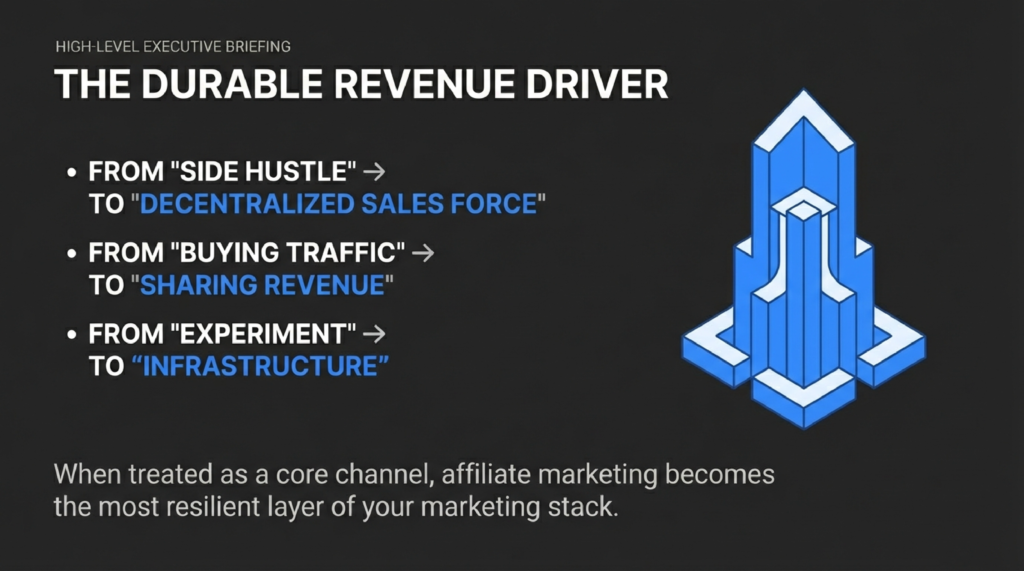
Seen this way, affiliate marketing is closer to building a decentralized sales force than running a campaign.
Affiliate marketing as a performance based distribution channel
Every growth channel distributes your offer in some way. Paid ads distribute it through platforms. SEO distributes it through search results. Partnerships distribute it through direct relationships.
Affiliate marketing distributes your offer through third party properties that already have attention, trust, and intent.
The defining characteristic is performance based payment. Affiliates are paid only when a predefined action occurs. Most often that action is a sale, but it can also be a qualified lead, trial signup, or subscription activation.
This payment model aligns incentives perfectly. Affiliates are motivated to optimize for conversion and quality traffic, not vanity metrics. Businesses are protected from spending money on exposure that does not turn into revenue. Over time, this alignment creates a self correcting ecosystem where the best partners scale and the ineffective ones disappear naturally.
How it differs from influencers, sponsorships, and paid advertising
Affiliate marketing is often confused with adjacent channels, but the differences matter.
Influencer marketing is primarily about reach and brand association. Brands pay for visibility, content creation, or access to an audience. Sales may happen, but they are not guaranteed, and the cost is usually fixed.
Sponsorships work similarly. A brand pays for placement, mentions, or naming rights. The outcome is exposure, not performance. Measuring true ROI is often difficult or indirect.
Paid advertising requires upfront spend for impressions or clicks. You take the risk that traffic will convert. When costs rise or platforms change, profitability can disappear quickly.
Affiliate marketing flips this model. There is no guaranteed payment for exposure. There is no upfront media spend. Compensation is tied directly to results. If no revenue is generated, no commission is paid.
This is why affiliate marketing is attractive to businesses that care about margin discipline and predictable unit economics.
Why affiliates are closer to outsourced sales and media than marketers
Affiliates are often described as marketers, but that label is misleading.
In practice, strong affiliates behave more like independent sales operators combined with media owners. They invest in content, SEO, email lists, video production, and audience building with the explicit goal of converting users into buyers. They test messaging, compare products, and refine positioning based on what actually sells.
They are not executing your marketing plan. They are running their own businesses, aligned with your revenue through commissions.
This is also why top affiliates are selective. They care about conversion rates, customer satisfaction, refund rates, and brand credibility, because those factors directly affect their income. In many cases, affiliates understand your buyer’s objections and decision process as deeply as your internal sales team, sometimes more.
For a brand, this means access to real world market intelligence and distribution leverage that would be expensive to build internally.
The core promise for brands: pay only when revenue happens
At the heart of affiliate marketing is a simple promise: you only pay when value is created.
You are not buying traffic. You are not renting attention. You are sharing revenue.
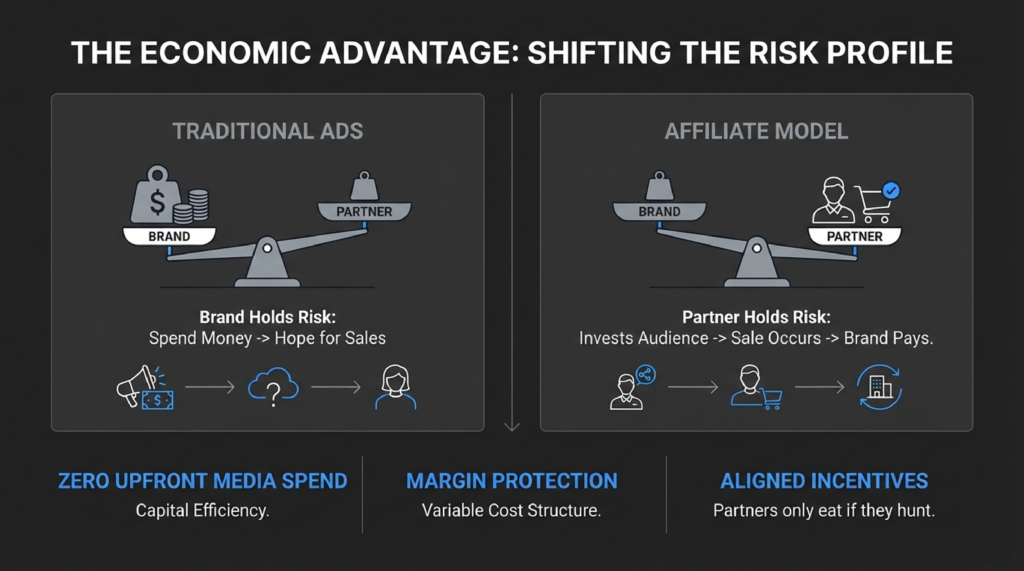
This model protects cash flow, limits downside risk, and creates accountability on both sides. Affiliates are rewarded for driving real customers. Brands keep control of margins and can scale partnerships without scaling fixed costs.
For businesses that want growth without betting the company on ad budgets or speculative campaigns, affiliate marketing offers a rare combination of flexibility, leverage, and measurable returns. When treated as a core distribution channel rather than an experiment, it becomes one of the most durable revenue drivers a business can build.
3. Basic affiliate marketing mechanics explained simply
At its core, affiliate marketing is mechanically simple. A partner sends a potential customer to your business. If that customer completes a predefined action, the partner gets paid. Everything else exists to track that interaction accurately and fairly.
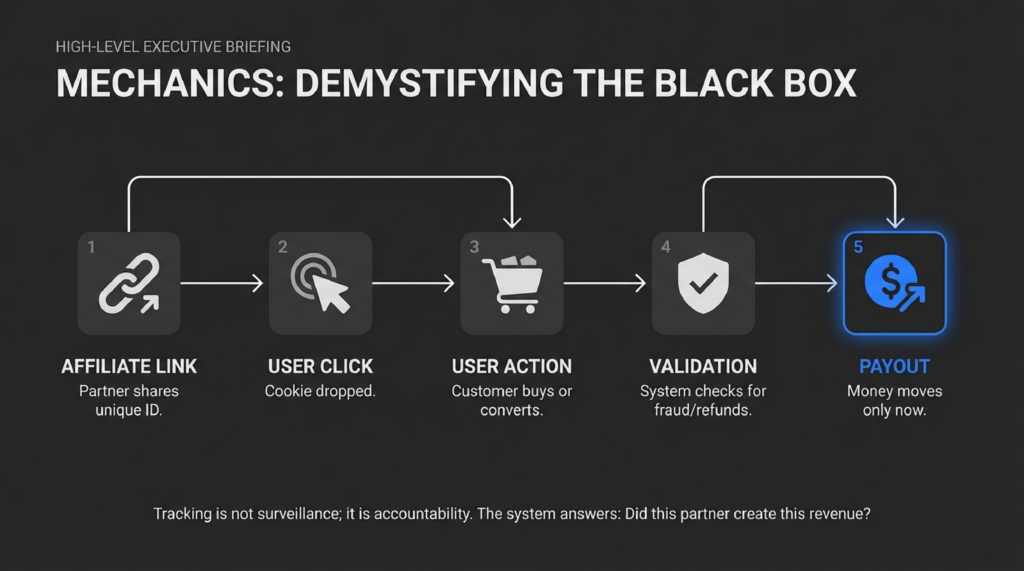
What makes affiliate marketing powerful is not complexity, but precision. The system is designed to answer one question with confidence: did this partner help create this revenue?
How tracking works at a high level
Affiliate tracking works by assigning each partner a unique identifier. When an affiliate shares a link, that identifier travels with the click to your website.
When a visitor arrives, the system records key information such as the affiliate ID, the time of the click, and the destination page. If the visitor later completes the target action, the system checks whether a valid affiliate interaction exists and attributes the conversion accordingly.
Modern tracking is typically handled by affiliate software or networks that integrate directly with your website, checkout, or backend systems. This allows businesses to see which partners drive revenue, how customers behave after clicking, and how profitable each affiliate relationship actually is.
From a business standpoint, the goal of tracking is not surveillance. It is accountability.
Clicks, cookies, attribution windows, and conversions
When someone clicks an affiliate link, a cookie or similar tracking mechanism is stored in their browser. This cookie links the visitor to the affiliate who referred them.
The attribution window defines how long that connection remains valid. Common windows range from 7 to 30 days, though some businesses use shorter or longer periods depending on their sales cycle.
If the visitor completes a conversion within that window, the affiliate is credited. A conversion is whatever action the business decides to reward. Most often it is a completed purchase, but it can also be a lead submission, trial signup, or subscription activation.
If multiple affiliates interact with the same customer, attribution rules decide who gets credit. Many programs use last click attribution, where the most recent affiliate interaction before conversion receives the commission. Others use first click or more advanced multi touch models.
The key point is that attribution rules shape affiliate behavior. Affiliates optimize for whatever gets rewarded.
Commission structures and payout logic
Commission structure is how a business translates revenue into partner incentives.
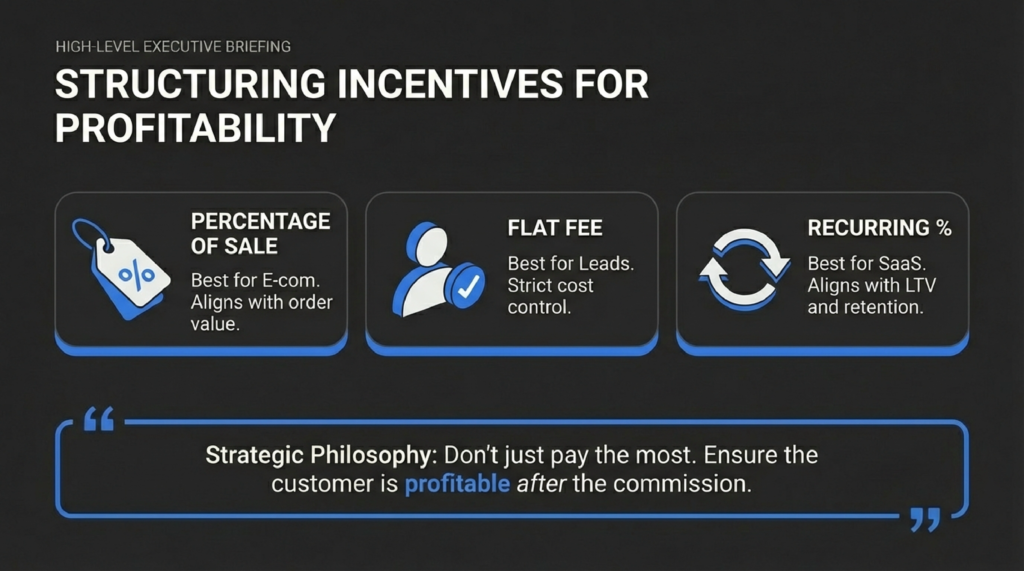
The simplest model is a percentage of sale. This works well for e-commerce and digital products where margins are predictable. Flat fee commissions are common for leads, trials, or fixed value actions.
Subscription and SaaS businesses often use recurring commissions. In this model, the affiliate earns a percentage of each payment as long as the customer remains active. This encourages affiliates to focus on quality customers, not just quick signups.
Payout logic typically includes validation steps. Businesses may delay commissions until refunds, chargebacks, or cancellations are accounted for. This protects margins and discourages low quality traffic.
From a business perspective, commissions are not a cost center. They are a variable revenue share that only exists because a sale happened.
Why attribution matters more than traffic volume
One of the biggest mistakes brands make is focusing on how much traffic affiliates send instead of what that traffic actually does.
High traffic volume is meaningless if it does not convert. A single affiliate sending a few hundred high intent visitors can outperform dozens of partners sending thousands of low quality clicks.
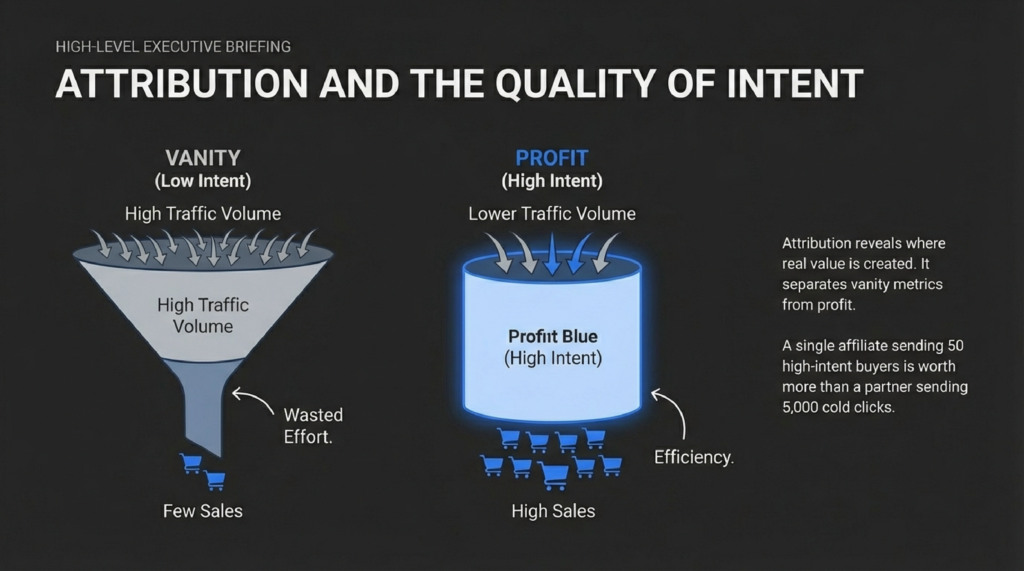
Attribution reveals where real value is created. It shows which affiliates influence buying decisions, which content formats drive conversions, and which partners bring customers with high lifetime value.
When attribution is clear and trusted, affiliate programs become self optimizing. Affiliates adjust their strategies to what converts. Businesses allocate attention and resources to the partners who actually grow revenue.
In affiliate marketing, accuracy beats scale. The companies that win are not the ones with the most clicks, but the ones that reward the right actions and measure them correctly.
4. The affiliate ecosystem around your business
When a business launches an affiliate program, it is not just adding a marketing channel. It is opening itself to an ecosystem of independent partners who participate in different parts of the buying process.
Affiliates are not interchangeable. Each type creates value in a different way, reaches customers at a different moment, and influences decisions differently. Understanding this ecosystem is essential if you want affiliate marketing to drive real revenue rather than scattered traffic.
Types of affiliates and how they create value
At a high level, affiliates fall into a few broad categories. What separates them is not platform choice, but intent.
Some affiliates create awareness and education. Others capture buyers who are already comparing options. Some close the sale by reducing friction at the final decision point. The strongest affiliate programs intentionally support all of these roles instead of expecting one partner type to do everything.
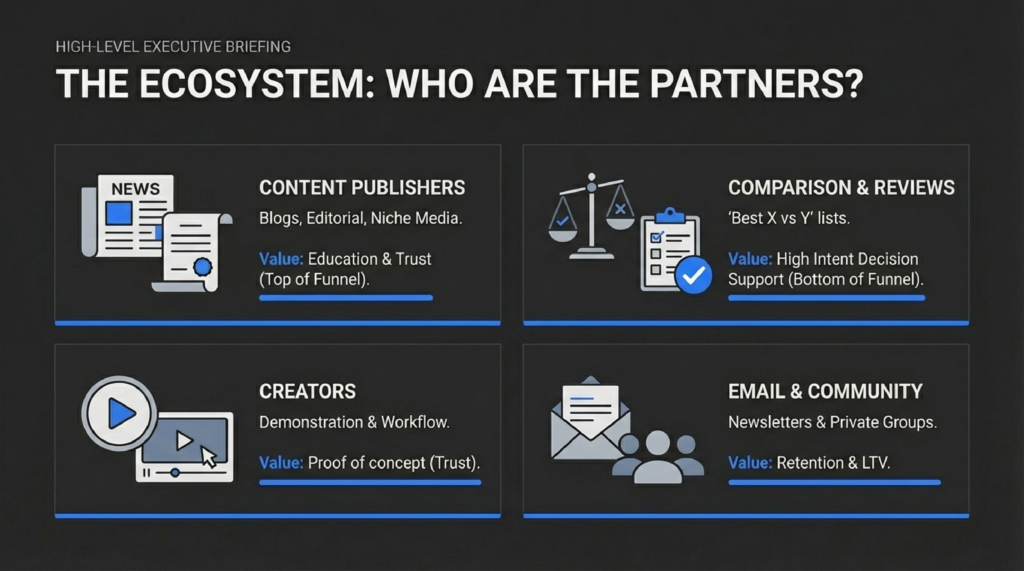
Content publishers and niche media sites
Content publishers are often the backbone of mature affiliate programs. These are blogs, editorial sites, YouTube channels, and niche publications that focus on a specific problem, industry, or audience.
Their value comes from education and trust. They publish long form guides, tutorials, case studies, and thought leadership content that helps buyers understand a problem before they ever choose a product. By the time a reader clicks an affiliate link, they are already informed and confident.
From a business perspective, these affiliates support the top and middle of the funnel. They introduce your brand in context, shape perception, and pre sell your value proposition. This content often ranks in search or lives for years, creating a compounding effect that paid ads cannot replicate.
Comparison and review platforms
Comparison and review affiliates operate closer to the point of purchase. These include review sites, “best of” lists, software comparison tools, and product roundups.
Their audience already knows what they want. They are evaluating options, prices, features, and trade offs. The affiliate’s job is to reduce uncertainty and help the buyer justify a final decision.
These partners are extremely valuable because they capture high intent traffic. Conversion rates are often higher than average, and the sales cycle is shorter. However, they are also highly competitive. If your offer, pricing, or positioning is weak, it will be exposed quickly.
For businesses, review and comparison affiliates function like an external sales desk that handles objections and alternatives at scale.
Email list owners and communities
Email based affiliates and community owners play a different role. They control direct access to an audience through newsletters, private groups, forums, or paid communities.
Their strength is relationship depth. Unlike search driven affiliates, they can recommend products repeatedly, explain use cases over time, and follow up after initial exposure. This is especially powerful for higher priced products, subscriptions, and tools with learning curves.
From a business standpoint, these affiliates support both consideration and retention. They often drive repeat purchases, upgrades, and long term customers, not just one off sales.
Creators who drive intent, not just reach
Not all creators are influencers. The most effective affiliate creators focus on intent rather than popularity.
These are YouTubers, podcasters, and social creators who build content around solving specific problems. They show workflows, comparisons, tutorials, and real world usage. Their audience is smaller, but more qualified.
They create value by demonstrating the product in action. Instead of saying “this is good,” they show why and when it is good. This dramatically increases trust and conversion, especially for complex or unfamiliar products.
For brands, these creators often outperform large influencers because their content answers real buying questions instead of generating passive awareness.
How each type supports different stages of the buyer journey
Affiliate ecosystems mirror the buyer journey.
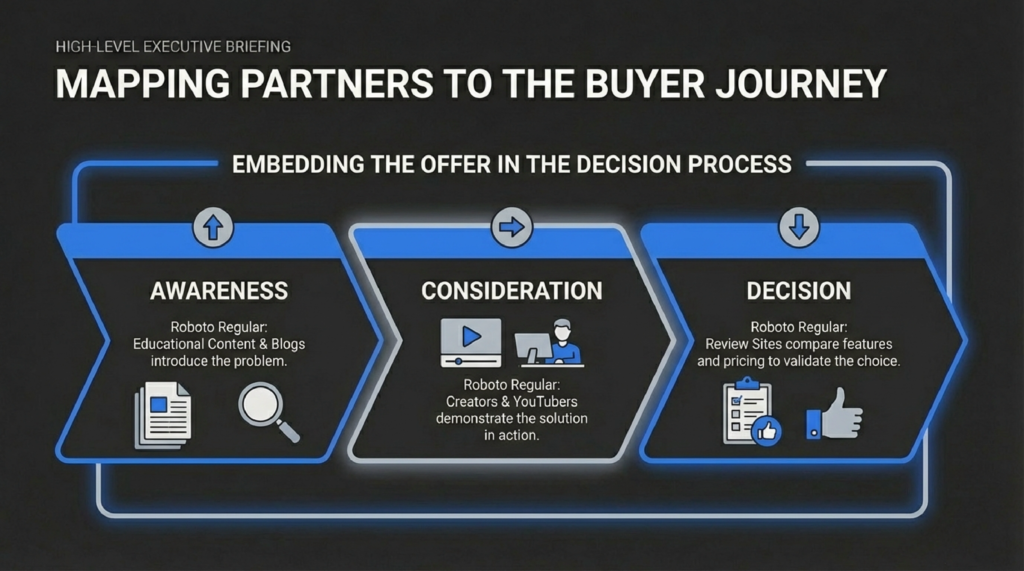
Content publishers introduce problems and solutions early. Review and comparison platforms help buyers choose. Email lists and communities nurture trust and encourage commitment. Intent driven creators remove final doubts by showing real usage.
No single affiliate type replaces the others. Strong programs succeed because they allow multiple partners to influence the same customer at different moments.
From a business perspective, this is the real power of affiliate marketing. You are not buying traffic from one source. You are embedding your offer across the entire decision making process, guided by partners who specialize in moving buyers one step closer to a sale.
5. How affiliate marketing generates sales, not just traffic
One of the most persistent misunderstandings about affiliate marketing is that it is just another traffic source. Businesses look at affiliate dashboards, see clicks, and assume success is about volume.
In reality, affiliate marketing works because it aligns with intent. The strongest affiliate programs are not built on sending as many visitors as possible, but on placing your offer in front of buyers who are already close to a decision.
This is why affiliate marketing consistently produces revenue even when traffic numbers look modest.
Why affiliates attract high intent buyers
Affiliates rarely interrupt users. They meet them at moments of intent.
Most affiliate content is consumed by people who are actively researching, comparing, or validating a purchase. A reader searching for “best project management tool for remote teams” or watching a detailed product comparison video is not browsing casually. They are preparing to buy.
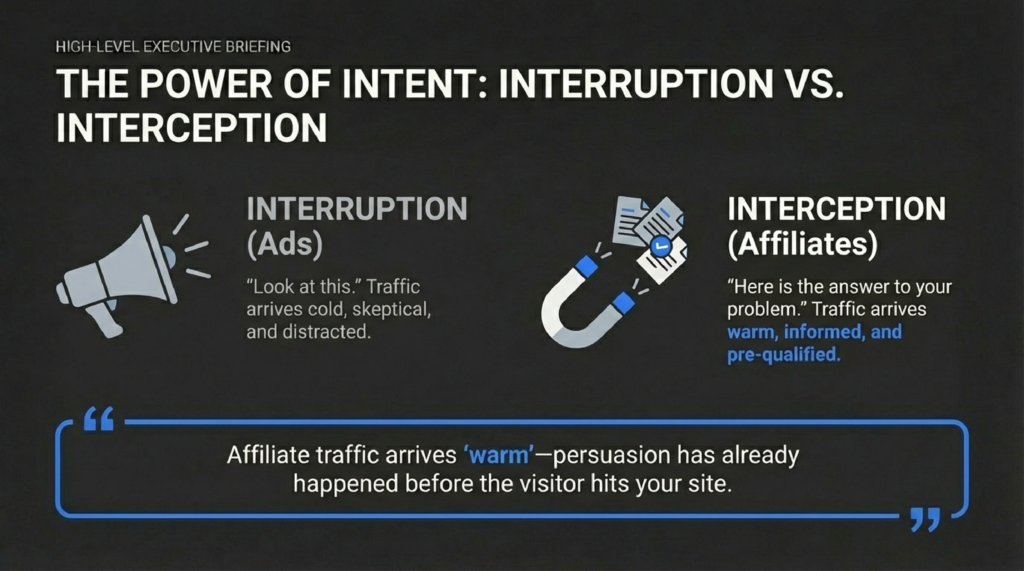
Affiliates specialize in serving these moments. Their business depends on conversion, not exposure. Over time, they learn which questions buyers ask before purchasing and structure their content to answer those questions directly.
For a brand, this means affiliate traffic arrives pre qualified. The persuasion work has already started before the visitor ever reaches your site.
Search driven affiliates capturing demand you did not create
Search driven affiliates are especially powerful because they capture existing demand rather than trying to generate it.
When users search for comparisons, reviews, alternatives, or use case specific solutions, they are expressing intent that your brand did not necessarily create. You might not rank for those searches. You might not even target them in your ad campaigns.
Affiliates fill that gap.
They rank for long tail, high intent keywords that would be expensive or slow for brands to pursue themselves. They appear in search results at the exact moment a buyer is deciding between options.
From a business perspective, this is incremental revenue. These customers were going to buy something anyway. The affiliate simply guided them to your product instead of a competitor.
Educational content that shortens the buying cycle
Many products fail to convert not because they are bad, but because customers do not fully understand them.
Affiliates often solve this problem better than brands do.
They create educational content that explains how a product works, who it is for, and how it compares to alternatives in plain language. Tutorials, walkthroughs, and real world examples reduce confusion and hesitation.
This education shortens the buying cycle. Instead of requiring multiple visits, emails, or retargeting ads, the customer arrives informed and ready to act.
For businesses with complex or unfamiliar products, affiliate education can be the difference between curiosity and conversion.
Social proof and third party validation effects
Buyers trust independent voices more than brand messaging.
Affiliate content provides third party validation. Reviews, comparisons, and recommendations feel less biased because the publisher is not the seller. Even when readers know there is an affiliate relationship, the perceived independence still carries weight.
This social proof lowers psychological risk. Seeing a product recommended by multiple independent sources signals legitimacy and reduces fear of making the wrong choice.
For brands, this effect compounds. When affiliates consistently validate your product across different platforms, your credibility increases far beyond what ads alone can achieve.
Why affiliate traffic often converts better than paid ads
Paid ads are designed to interrupt. Affiliate content is designed to assist.
Ad traffic often arrives cold, skeptical, or distracted. Affiliate traffic arrives warm, informed, and intentional. The difference in mindset matters.
Affiliate visitors have typically spent time reading, watching, or comparing before clicking. They understand pricing, features, and trade offs. When they land on your site, they are not asking “what is this,” but “is this the right choice.”
This is why many businesses see higher conversion rates, lower refund rates, and higher lifetime value from affiliate driven customers compared to paid acquisition.
Affiliate marketing does not win by being louder. It wins by being present at the exact moment a buyer is ready to decide.
6. How affiliate marketing creates exposure without upfront risk
Most forms of brand exposure require paying first and hoping results follow. Advertising, sponsorships, and influencer deals all ask businesses to commit budget before knowing whether attention will turn into revenue.
Affiliate marketing inverts that risk model.
Instead of buying exposure, you allow partners to create it on your behalf and only compensate them when that exposure produces measurable value. The result is visibility that grows over time without the financial pressure of upfront spend.
Affiliates as independent distribution channels
Each affiliate operates as its own distribution channel.
They control their platforms, audiences, and publishing cadence. Some rely on search traffic, others on video, email, or communities. From a brand perspective, this creates diversification. You are no longer dependent on a single platform or algorithm to be seen.
Affiliates decide where and how to feature your product. If it performs, they expand coverage. If it does not, they shift focus elsewhere. This market driven behavior ensures that exposure scales naturally with real demand.
Instead of managing dozens of channels internally, businesses gain access to many independent ones through a single performance based system.
Brand mentions across blogs, YouTube, newsletters, and social media
Affiliate marketing spreads brand mentions across the web in ways most marketing teams cannot coordinate manually.
Your product appears in blog posts, video reviews, tutorials, email newsletters, podcasts, and social feeds. These mentions are contextual, not forced. They appear inside content people intentionally consume.
Over time, potential customers encounter your brand in multiple places, often without realizing it is part of an affiliate program. This repeated exposure builds familiarity and trust long before a direct interaction with your website.
For businesses, this creates a form of distributed brand awareness that feels organic rather than promotional.
Long tail exposure you cannot buy with ads
Advertising excels at scale, but struggles with specificity.
Affiliate content thrives in the long tail. Affiliates publish content targeting narrow use cases, niche problems, and highly specific search queries. These are areas where ads are inefficient or impractical.
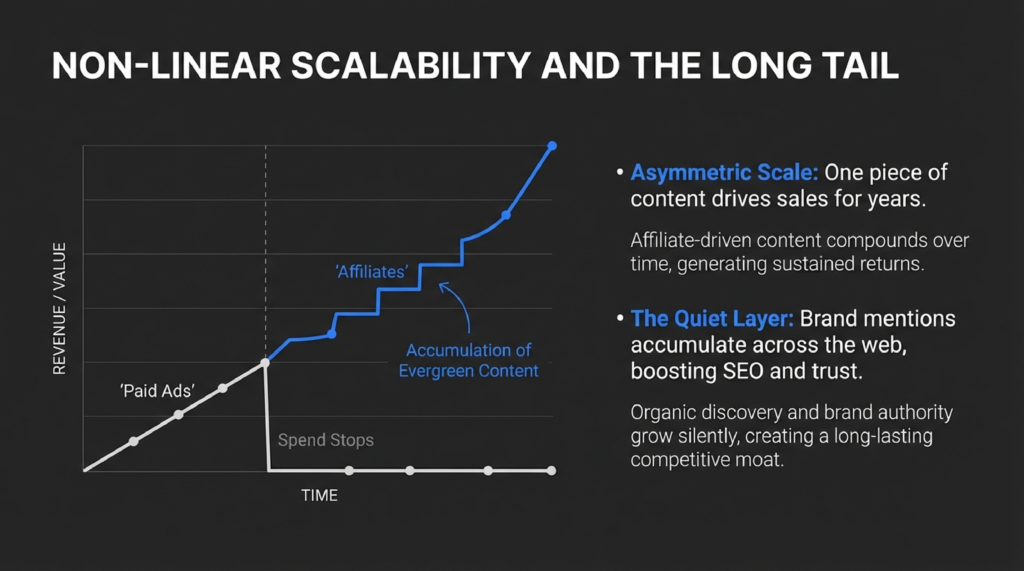
A single affiliate article or video can rank for dozens or hundreds of variations that would be expensive to target with paid campaigns. That content may continue driving visibility for years.
This long tail exposure is especially valuable for businesses with multiple customer segments or complex products. Affiliates naturally explore angles your internal team may never prioritize.
SEO benefits without relying on ranking your own site
Affiliate marketing indirectly strengthens your search presence without requiring your own site to rank for everything.
Affiliates occupy search results with reviews, comparisons, and guides that mention your brand. Even if you do not rank, your product still appears on the page.
This is not about manipulating search engines. It is about occupying real estate. When multiple independent sites discuss your product, it signals relevance and legitimacy to both users and algorithms.
For brands in competitive niches, affiliate content often becomes the fastest way to appear in high intent searches without years of SEO investment.
How affiliates extend your brand footprint quietly but consistently
Affiliate exposure rarely arrives as a spike. It compounds.
Each new article, video, or recommendation adds another surface where your brand exists. These surfaces do not disappear when a campaign ends. They remain discoverable, shareable, and influential.
Over time, your brand footprint expands across the internet without constant budget allocation or campaign planning. Many businesses only realize how significant this presence is when they search their own brand name and see it mentioned everywhere.
This is the quiet advantage of affiliate marketing. It does not shout. It accumulates. And as it does, it creates both awareness and revenue with remarkably little upfront risk.
Why affiliate marketing scales better than most channels
Most growth channels scale linearly. To get more results, you spend more money, hire more people, or increase effort in direct proportion to output. That model works, but it eventually hits limits in cost, complexity, or diminishing returns.
Affiliate marketing scales differently.
When structured correctly, it introduces leverage. Results are not tightly coupled to spend, and growth often comes from a small number of high performing partners rather than constant incremental investment.
No linear relationship between spend and results
In paid advertising, results scale with budget. Double the spend and, in the best case, you roughly double the outcome until efficiency drops. In affiliate marketing, there is no such relationship.
You do not pay to increase exposure. You share revenue when it happens. This means growth is driven by partner performance, not your spending capacity.
An affiliate can publish a single piece of content that generates sales for months or years without any additional cost from your side. Whether that content sends ten customers or ten thousand, your expense only exists as a percentage of actual revenue.
This breaks the linear spend model and replaces it with a variable, performance tied structure that scales naturally.
How one affiliate can outperform entire ad campaigns
In most mature affiliate programs, a small number of partners drive a disproportionate share of results.
One strong affiliate with high intent traffic, deep trust, and evergreen content can outperform entire ad campaigns that require constant optimization and budget allocation. This happens because affiliates often own distribution you cannot easily replicate.
They rank for competitive keywords. They control trusted newsletters. They run channels that audiences actively seek out. Their recommendations carry weight in ways ads rarely do.
From a business perspective, this means a single relationship can be more valuable than dozens of tactical experiments. The upside is asymmetric. When you find a great affiliate partner, the ceiling is much higher than most other channels allow.
The compounding effect of evergreen affiliate content
Affiliate content does not expire on a schedule.
A well written article, a detailed comparison, or a practical tutorial can continue driving traffic and sales long after it is published. As search rankings improve, audiences grow, and content gets shared, performance often increases without additional effort.
This creates compounding returns. Each piece of content adds to the total output of the program. Over time, new affiliates layer on top of existing ones, creating a growing base of recurring sales.
Unlike campaigns that reset each month, affiliate marketing accumulates. Past work continues to pay dividends while new partners add incremental growth.
Why mature programs become predictable revenue drivers
In the early stages, affiliate marketing can feel unpredictable. Performance fluctuates as partners test content and audiences respond.
As programs mature, patterns emerge.
Top affiliates stabilize. Conversion rates normalize. Seasonality becomes visible. Revenue becomes forecastable. At this stage, affiliate marketing stops feeling like an experiment and starts behaving like infrastructure.
Many established businesses rely on affiliate programs as a steady percentage of total revenue. Not because it is flashy, but because it is resilient. When ads get more expensive or platforms change rules, affiliate driven sales often continue with minimal disruption.
This is the real reason affiliate marketing scales so well. It does not demand constant input to keep working. Once built, it becomes a durable growth layer that compounds quietly and delivers predictable results over time.
8. How businesses structure profitable affiliate programs
Profitable affiliate programs are not built by copying commission rates from competitors or launching generic software and hoping for the best. They are designed intentionally around margins, customer lifetime value, and the type of partners a business wants to attract.
The goal is not to pay the highest commission. The goal is to create a structure where the best affiliates see your program as worth their time and where every sale still makes economic sense for the business.
Choosing commission rates that attract quality partners
Commission rate is the first filter affiliates use when evaluating a program, but it is not the only one.
Quality affiliates look at three things together. How much they earn per conversion. How well the product converts. How long the opportunity lasts.
A lower commission on a high converting, trusted product can outperform a high commission on a weak offer. This is why businesses should start commission planning from unit economics, not industry averages.
Ask one simple question. After commissions, refunds, and support costs, does this customer still make sense for us long term. If the answer is yes, the commission is viable.
Strong programs are clear and confident about their rates. They do not constantly negotiate or underpay. They communicate that partners who drive real value will be rewarded fairly and consistently.
Balancing margins with competitiveness
Affiliate commissions sit inside your margin structure, not outside it.
Businesses that struggle with affiliate profitability often treat commissions as an afterthought. Instead, they should be designed into pricing from the beginning.
If competitors pay 20 percent but your margins only allow 10 percent, the solution is not to match them blindly. It is to understand what affiliates actually value. Conversion rate, brand trust, cookie duration, and recurring revenue often matter as much as headline commission numbers.
A competitive program is not the one that pays the most. It is the one that delivers the highest earnings per visitor for affiliates while protecting the business.
Flat fees vs percentage based commissions
Flat fee commissions are simple. A fixed payout for a defined action such as a lead, signup, or purchase. This model works well when order values are predictable or when the business wants strict cost control.
Percentage based commissions scale with order value. They align incentives naturally, especially for e-commerce and digital products. Affiliates are motivated to attract buyers who spend more, not just more buyers.
From a business perspective, percentage based models are usually better for long term alignment. Flat fees can be effective for early testing or lead generation, but percentages tend to attract more sophisticated affiliates who think in terms of revenue, not volume.
Recurring commissions for subscriptions and SaaS
Recurring commissions change affiliate behavior dramatically.
When affiliates earn a share of ongoing payments, they focus on customer quality, not just acquisition. They invest more in education, onboarding content, and use case clarity because churn directly affects their income.
For subscription businesses, this model can be extremely powerful. Even a lower monthly percentage can be attractive if retention is strong. Affiliates think in lifetime value, not first month payouts.
From the business side, recurring commissions work best when churn is predictable and margins support long term sharing. When structured correctly, affiliates become long term growth partners rather than one time traffic sources.
Tiered commissions to reward top performers
Not all affiliates should be paid the same.
Tiered commission structures reward performance and create natural incentives for partners to scale. Higher rates unlock after hitting revenue or volume thresholds. Bonuses reward consistency or growth.
This approach does two things. It protects margins at the low end and motivates serious affiliates to invest more heavily once they see traction.
Tiered structures also signal professionalism. They show affiliates that the program is designed for long term collaboration, not one off promotion.
Well structured programs do not chase every partner. They are built to attract, retain, and reward the affiliates who actually drive revenue. When commissions align with business economics and partner incentives, affiliate marketing stops being a gamble and becomes a predictable, profitable growth channel.
9. The real costs businesses should expect
Affiliate marketing is often described as “free traffic,” but that description is misleading. While it avoids upfront media spend, it still requires investment. The difference is where and when those costs appear.
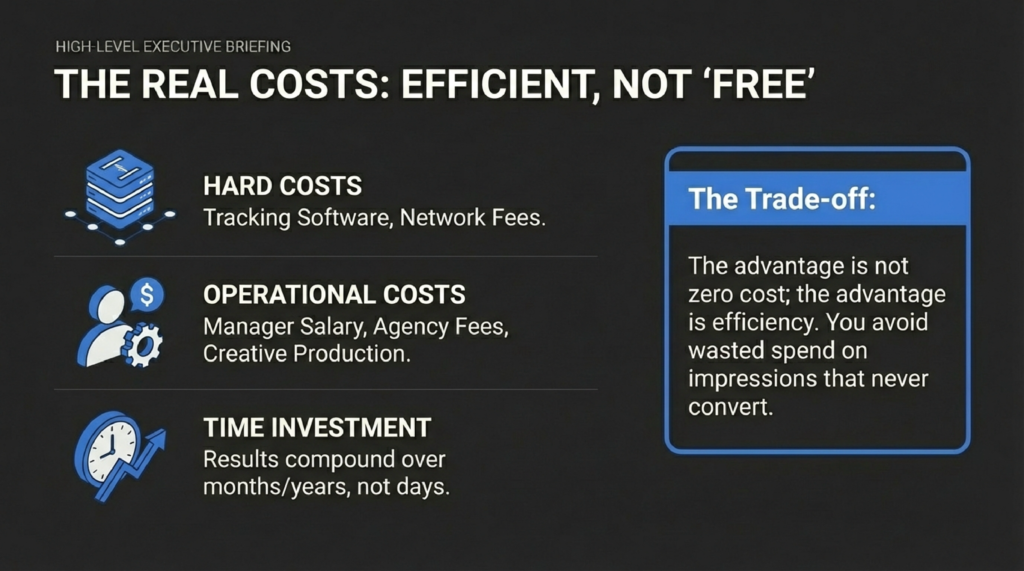
Well run affiliate programs are efficient, not free. Understanding the real cost structure is essential if you want predictable results and healthy margins.
Software and tracking platforms
The first unavoidable cost is technology.
Affiliate programs require reliable tracking to function. This typically means using affiliate software or an established network that can track clicks, attribute conversions, manage partners, and handle reporting.
Costs vary depending on scale and complexity. Smaller businesses may pay a monthly platform fee, while larger programs may combine platform costs with network fees or revenue based pricing.
From a business standpoint, this cost buys trust. Accurate tracking is what convinces affiliates to invest time and resources into promoting your product. If tracking is unreliable, the program will fail regardless of commission rates.
Affiliate management time or agencies
Affiliate marketing does not run itself.
Someone needs to recruit partners, answer questions, review applications, approve content, monitor compliance, and maintain relationships. In early stages, this is often handled internally by a founder or marketer. As programs grow, businesses either assign a dedicated manager or work with a specialized agency.
This is a real operational cost. However, it is also where much of the upside is created. Programs with active management consistently outperform passive ones.
From a return perspective, affiliate management often produces more leverage than ad optimization or content production because one strong relationship can unlock disproportionate revenue.
Creative assets and landing pages
Affiliates sell better when they have something to work with.
Businesses should expect to invest in basic creative assets such as banners, product images, messaging guidelines, and example copy. More importantly, they need landing pages that convert affiliate traffic effectively.
This may require dedicated pages for specific use cases, comparisons, or promotions. While these assets often overlap with general marketing needs, affiliate driven traffic exposes weaknesses quickly.
The cost here is usually upfront effort rather than ongoing spend, and the benefit extends beyond affiliates by improving overall conversion rates.
Payout delays and cash flow planning
Affiliate commissions are typically paid after a delay.
Businesses often hold commissions for a set period to account for refunds, cancellations, or chargebacks. This protects margins but also requires thoughtful cash flow planning.
For high volume programs, commission payouts can become a significant line item. While this money is earned revenue, it still needs to be managed responsibly, especially for subscription or high ticket products.
Clear payout schedules and transparent communication are critical. Affiliates plan their own cash flow based on your reliability.
Why affiliate marketing is not free, but still highly efficient
Affiliate marketing costs money because it produces value.
The key difference compared to other channels is efficiency. Costs scale with revenue, not speculation. You pay when a customer exists, not when attention is rented.
There is no wasted spend on impressions that never convert or clicks that go nowhere. Every commission is tied to a result that already happened.
For businesses that care about profitability and long term sustainability, this is a powerful tradeoff. Affiliate marketing may not be free, but it is one of the most capital efficient ways to turn distribution into predictable revenue.
10. When affiliate marketing makes sense for a business
Affiliate marketing is not a shortcut you add at any stage. It works best when a business has reached a certain level of product maturity, clarity, and economic stability. Launched too early, it creates noise and frustration. Launched at the right time, it becomes a scalable growth lever.
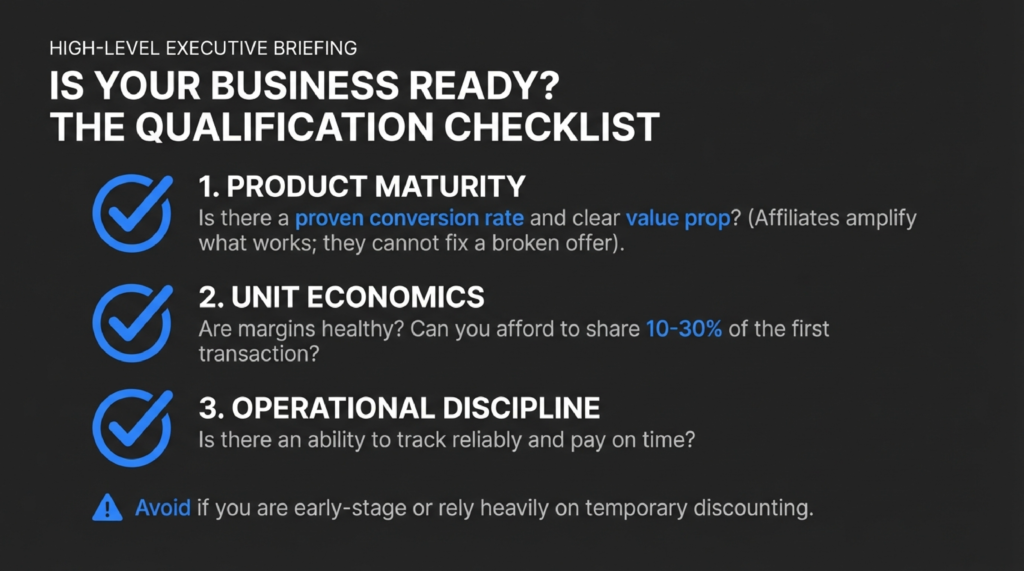
Knowing when affiliate marketing makes sense is as important as knowing how to run it.
Signs your product is ready for affiliates
The strongest signal is consistent organic demand.
If customers are already searching for your product, comparing it to alternatives, or asking for recommendations, affiliates have something to work with. They amplify existing demand. They do not create belief out of nothing.
Another sign is proven conversion. If your site converts reasonably well from organic, email, or paid traffic, affiliates can succeed. If your conversion rate is low, affiliates will struggle just like any other channel, and they will not stay long.
Customer satisfaction also matters. Products with high refund rates, unclear onboarding, or weak support tend to fail in affiliate programs. Affiliates care deeply about reputation because their audience trusts them.
Finally, internal readiness is key. You need the ability to track conversions, pay commissions reliably, and communicate clearly with partners. Without operational discipline, even good products fail with affiliates.
When not to launch an affiliate program yet
Affiliate marketing is a poor fit for unproven products.
If your product positioning is still changing weekly, affiliates cannot build stable content around it. If pricing shifts constantly, comparisons become outdated. If messaging is unclear, partners will misrepresent the offer or avoid it entirely.
It is also risky when margins are extremely thin. If you cannot afford to share revenue without damaging unit economics, affiliate marketing will create pressure instead of leverage.
Another warning sign is dependency on heavy discounting. Affiliates rarely succeed when the only conversion driver is a temporary promotion. Sustainable programs are built on value, not urgency hacks.
Minimum margins and pricing considerations
Affiliate commissions must come from real margin.
There is no universal minimum, but most successful programs have enough gross margin to comfortably share 10 to 30 percent of revenue on the first transaction, or a meaningful portion of lifetime value.
If your pricing barely covers costs, affiliates will force uncomfortable tradeoffs. Either commissions will be too low to attract quality partners, or profitability will erode.
Pricing strategy should anticipate affiliate distribution. Many mature businesses bake affiliate commissions into their pricing model from the start, treating them as a variable cost of growth rather than an exception.
Product clarity and messaging maturity
Affiliates do not write your story for you. They amplify it.
If your value proposition is clear, affiliates can explain it accurately and persuasively. If it is vague, every partner will interpret it differently, leading to inconsistent positioning.
Before launching an affiliate program, a business should be able to answer simple questions clearly. Who is this for. What problem does it solve. Why is it better than alternatives. What objections matter most.
When messaging is mature, affiliates create content that aligns naturally with your brand and converts well. When it is not, affiliate marketing magnifies confusion instead of solving it.
Affiliate marketing makes sense when a business is stable enough to share success and clear enough to let others sell on its behalf. At that point, it stops being an experiment and becomes a multiplier.

How To Start Affiliate Marketing Program
The Complete Launch Framework
eBook by Unseen Founder
How to Start an Affiliate Marketing Program is a structured, no-fluff framework for companies that want to design, validate, and launch a profitable affiliate program from scratch. It is not a collection of tips.
It is a complete operational blueprint built for founders, marketing leaders, and affiliate managers to launch a profitable affiliate program from zero.
